
Human brain cells are far more powerful than scientists thought
- Date:
- August 13, 2026
- Source:
- The Hebrew University of Jerusalem
- Summary:
- A single human brain cell may be far more powerful than scientists once realized. Researchers found that cortical neurons can perform remarkably complex computations, giving them capabilities more like tiny biological computers than simple on-off switches. This could help explain why the human brain supports abilities such as language, imagination, and mathematics.
- Share:
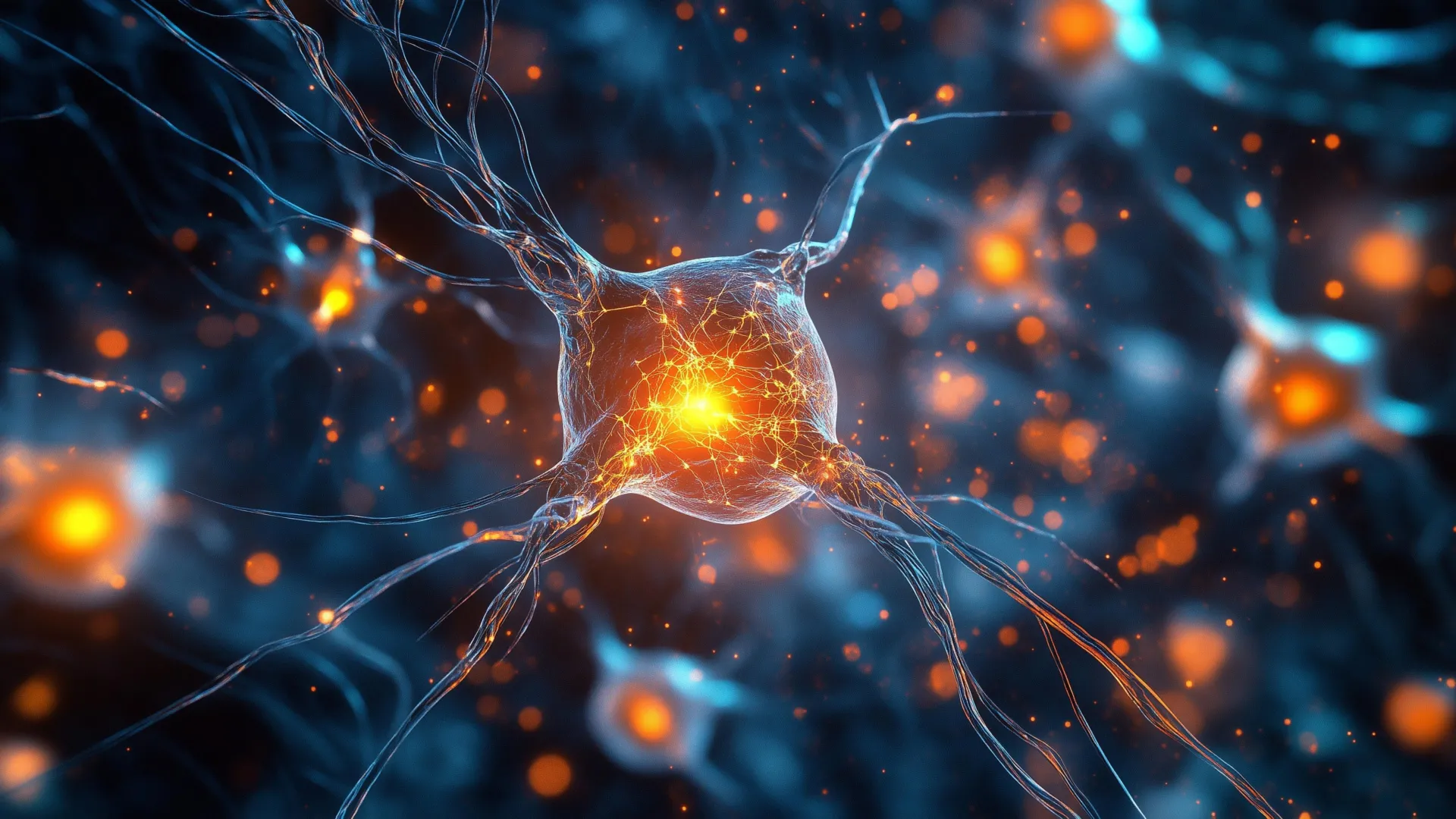
A new study published in the Proceedings of the National Academy of Sciences (PNAS) suggests that individual human neurons can carry out far more complex computations than neurons in other mammals. The discovery offers a new perspective on what may make the human brain so unusual.
How does the human brain produce abilities such as language, imagination, mathematics, and invention?
For decades, scientists have largely looked to size and connectivity for the answer. The human brain contains close to 100 billion neurons, linked through an enormous web of connections. New research, however, indicates that another important part of the explanation may be found at a much smaller level, in the remarkable processing capabilities of individual brain cells.
Human Neurons Are Powerful Information Processors
Researchers found that neurons in the human cortex function as significantly more complex information processing units ("microchips") than comparable cells in other mammals. The results raise the possibility that the individual building blocks of the human cortex are unusually powerful, which could help explain how humans developed exceptional cognitive abilities.
The research was led by Hebrew University researchers Profs. Idan Segev and Mickey London, along with PhD students Ido Aizenbud and Daniela Yoeli, at the Edmond and Lily Safra Center for Brain Sciences (ELSC). The team also collaborated with Prof. Chris de Kock from the Free University, Amsterdam.
"People often think of a neuron as a simple switch that either turns on or off," said Segev. "What we show is that a single human neuron is itself an extraordinarily sophisticated computing device."
Measuring the Computing Power of a Brain Cell
To investigate how much computation a single neuron can perform, the researchers created a new method for measuring the computational complexity of individual brain cells. They combined advanced computer modeling with artificial intelligence to determine how difficult it would be for an advanced artificial neural network (ANN) to learn and reproduce the relationship between the information entering a neuron and the response it produces.
The basic idea is straightforward. If an artificial "twin" requires greater complexity to imitate the behavior of a biological neuron, then the biological neuron itself has greater computational power.
The results revealed a striking advantage for neurons in the human cortex. Their richly branching dendritic trees and distinctive electrical characteristics allow them to carry out surprisingly sophisticated computations on incoming information, including visual input (e.g., distinguishing between images of cats versus dogs).
In other words, an individual human cortical neuron is much more than a basic "on-off" component. Each cell can operate as a sophisticated computing unit in its own right, with computational abilities comparable to those of a deep neural network.
A New View of Human Intelligence
The findings challenge the long-standing idea that intelligence arises primarily from the sheer number of neurons in the brain and the connections linking them together. Instead, the research suggests that the complexity of individual neurons may also have contributed importantly to the evolution of human cognition.
The researchers also developed a systematic and broadly applicable framework for connecting the physical structure of brain cells with what those cells are capable of computing. This approach could help scientists move closer to understanding how the human brain produces thought, learning, and cognition.
Human Neurons Could Inspire New AI
The findings could also influence the future of artificial intelligence. Today's leading machine learning systems are built from highly simplified artificial units. The new research points toward a different possibility: brain-inspired AI made from artificial units that are themselves computationally deep and powerful, more closely resembling the capabilities of biological neurons.
Story Source:
Materials provided by The Hebrew University of Jerusalem. Note: Content may be edited for style and length.
Journal Reference:
- Ido Aizenbud, Daniela Yoeli, David Beniaguev, Christiaan P. J. de Kock, Michael London, Idan Segev. Dendritic morphology and synaptic nonlinearities enhance functional complexity in human cortical neurons. Proceedings of the National Academy of Sciences, 2026; 123 (28) DOI: 10.1073/pnas.2533168123
Cite This Page: