
World-first photonic time crystal opens a new era of light control
The first all-optical photonic time crystal could unlock ultrafast computers, adaptable communications, and entirely new kinds of lasers.
- Date:
- July 31, 2026
- Source:
- École Polytechnique
- Summary:
- Scientists have built the first all-optical photonic time crystal, allowing them to reshape the behavior of terahertz light at extraordinary speeds. The breakthrough could open the door to ultrafast computing, smarter communication systems, advanced imaging, and a new generation of highly tunable lasers.
- Share:
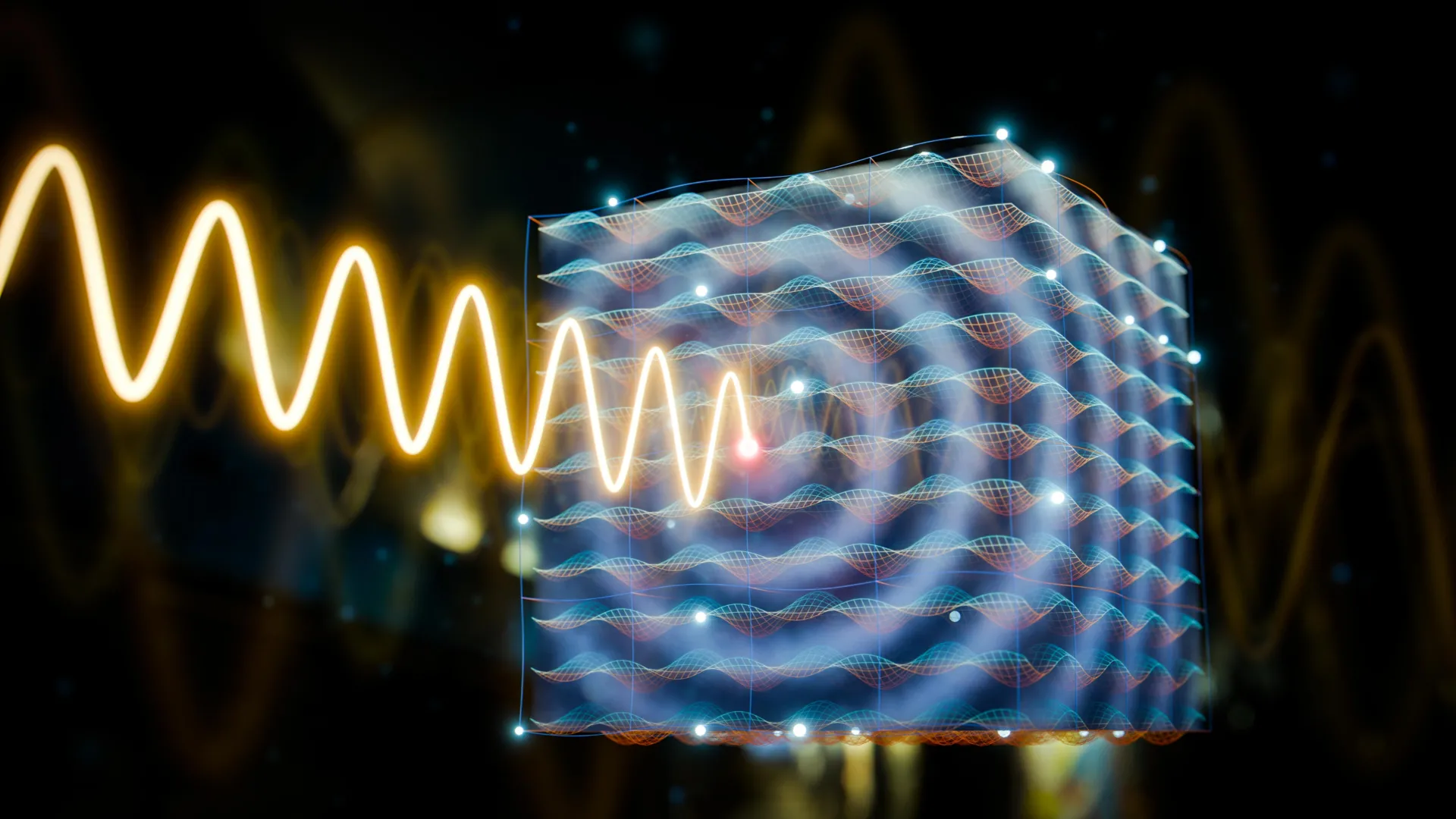
An international research team has experimentally produced the first all-optical photonic time crystal (PTC), a material designed to change its optical behavior rapidly and repeatedly over time. The researchers came from École Polytechnique, Collège de France, and Helmholtz-Zentrum Dresden-Rossendorf (HZDR).
Reported in Nature, the achievement was made possible by HZDR's powerful TELBE superradiant terahertz source. The system allowed the scientists to explore a previously inaccessible form of light-matter interaction in the terahertz range. In the future, the approach could contribute to ultrafast optical computers, advanced telecommunications, and entirely new terahertz lasers.
Controlling how light behaves inside materials has already led to technologies that shape modern life. Optical fibers carry information across communication networks, lasers provide highly precise light sources, and optical sensors are widely used in chemistry and biology.
Exploring the Terahertz Technology Frontier
At École Polytechnique, Yannis Laplace, an assistant professor, and his team at the Laboratory of Irradiated Solids (LSI) are working on photonic devices that can control light in the terahertz (THz) frequency range.
This largely underused part of the electromagnetic spectrum sits between conventional electronics and photonics. Research in the field is advancing quickly because terahertz frequencies, 1,000 times faster than used for electronic components, could offer powerful new ways to examine and manipulate matter.
"The THz range represents the frontier between electronic and photonic technologies," explains Laplace. "It is a range full of opportunities both for science and for the society, yet is still under-developed technologically compared to its electrical and photonic counterparts. Creating photonic crystals could lead the way to the closing of this gap."
Controlling Light Through Time
Conventional photonic crystals are nanostructured materials containing a repeating optical pattern (like a lattice) that determines how photons move through them. By carefully arranging materials with different shapes and refractive indexes, scientists can block, guide, or strengthen selected wavelengths of light. In that sense, photonic crystals control photons in a way that resembles how semiconductors control electrons.
Earlier experiments by the team showed that temperature and magnetic fields could change the ability of photonic crystals to capture light. However, once those conditions were established, the optical behavior remained fixed over time.
The new device goes much further. Its optical properties (e.g., reflectivity, resonance frequency) can be altered dynamically on picosecond timescales, close to the timescale of light's own oscillations. Rather than relying only on patterns arranged across space, the photonic time crystal introduces a repeating pattern in time.
"By extending photonic crystals from space to time, we open a new dimension for light control -- and a novel path toward amplification and lasing. That could be a game-changer for optical technologies at terahertz frequencies and beyond," explains Tingwen Guo, PhD student at École Polytechnique and lead author on the publication.
Building a Metamaterial That Traps Light
Creating such rapid control required a highly specialized and complex device. With support from Thales' Laboratoire Albert Fert and Polytechnique's Physics of Interfaces (PICM) laboratory, the researchers constructed a form of photonic crystal known as a "plasmonic metamaterial."
The material contains micrometer-scale gold crenelated structures positioned above an insulating layer and a semiconductor made from a mixture of indium and antimony. The gold structures form tiny cavities that confine light between the gold and semiconductor layers.
When the semiconductor surface is excited, it produces "surface plasmons," collective waves of electrons that can capture light and maintain its oscillations. This interaction gave the researchers a way to manipulate the trapped photons with exceptional speed.
Optical Properties Changed in Picoseconds
The team exposed the device to terahertz laser pulses produced by TELBE at HZDR's ELBE accelerator. Because the source generates intense terahertz radiation that can be tuned to different frequencies, the researchers were able to change the material's optical properties, especially its reflectivity, both strongly and rapidly.
Achieving these two effects at once had been a major technical obstacle. The strength of the change was comparable to forcing an object to emit a completely different color, while the transformation occurred on the picosecond scale -- one billionth of a billionth of a second.
"TELBE's unique ability to generate high-field, phase-stable terahertz pulses was critical," confirmed Jan-Christoph Deinert, the coordinator of the TELBE facility. "Without this infrastructure, achieving the coherent, ultrafast modulation needed for the PTC regime would have been impossible."
A Model Explains the Photons' Behavior
A theoretical model developed by Marco Schiró, Research Scientist at Collège de France, and his team supported the experimental findings and helped explain how photons behaved inside the device.
The calculations also showed that changing the material over time cut photon dissipation in half. In this context, dissipation refers to the portion of photons that are not reflected and instead pass through the metamaterial's surface.
"The theory not only reproduces the experiment but also provides the basis for guiding future discoveries in this system," rejoiced Schiró.
Toward Ultrafast Lasers and Optical Computers
The researchers now want to reduce photon dissipation even further and increase the number of photons held within the crystal. If they can produce sufficiently strong amplification, the device could become the basis for highly adaptable new lasers.
Photonic time crystals could ultimately change how light is used in technology, especially within the terahertz range. Their ability to alter light on extremely short timescales could support ultrafast lasers for medical imaging and communications.
The technology may also make it possible to tune properties such as light's "color" or intensity almost instantly and on demand. That level of control could lead to faster, smarter, and more adaptable optical systems.
Story Source:
Materials provided by École Polytechnique. Note: Content may be edited for style and length.
Journal Reference:
- Tingwen Guo, Jules Sueiro, Gian Marcello Andolina, Artem Levchuk, Stefano Ponzoni, Romain Grasset, Donald Monthe, Ian Aupiais, Dmitri Daineka, Javier Briatico, Thales VAG de Oliveira, Alexey Ponomaryov, Atiqa Arshad, Arjun Karimbana-Kandy, Gulloo Lal Prajapati, Igor Ilyakov, Jan-Christoph Deinert, Sebastian F. Maehrlein, Luca Perfetti, Marco Schirò, Yannis Laplace. Plasmonic metamaterial time crystal. Nature, 2026; DOI: 10.1038/s41586-026-10825-9
Cite This Page: