
They were drilling off Oregon. What they found could shake the entire West Coast
- Date:
- July 18, 2026
- Source:
- The Geological Society of America (GSA)
- Summary:
- Scientists have found evidence that a major Cascadia earthquake could trigger a second quake on the San Andreas Fault. The discovery came from unusual sediment layers formed by underwater landslides recorded over thousands of years. These patterns suggest both fault systems may have ruptured close together in the past. The findings raise new concerns about a potential coast-wide earthquake sequence.
- Share:
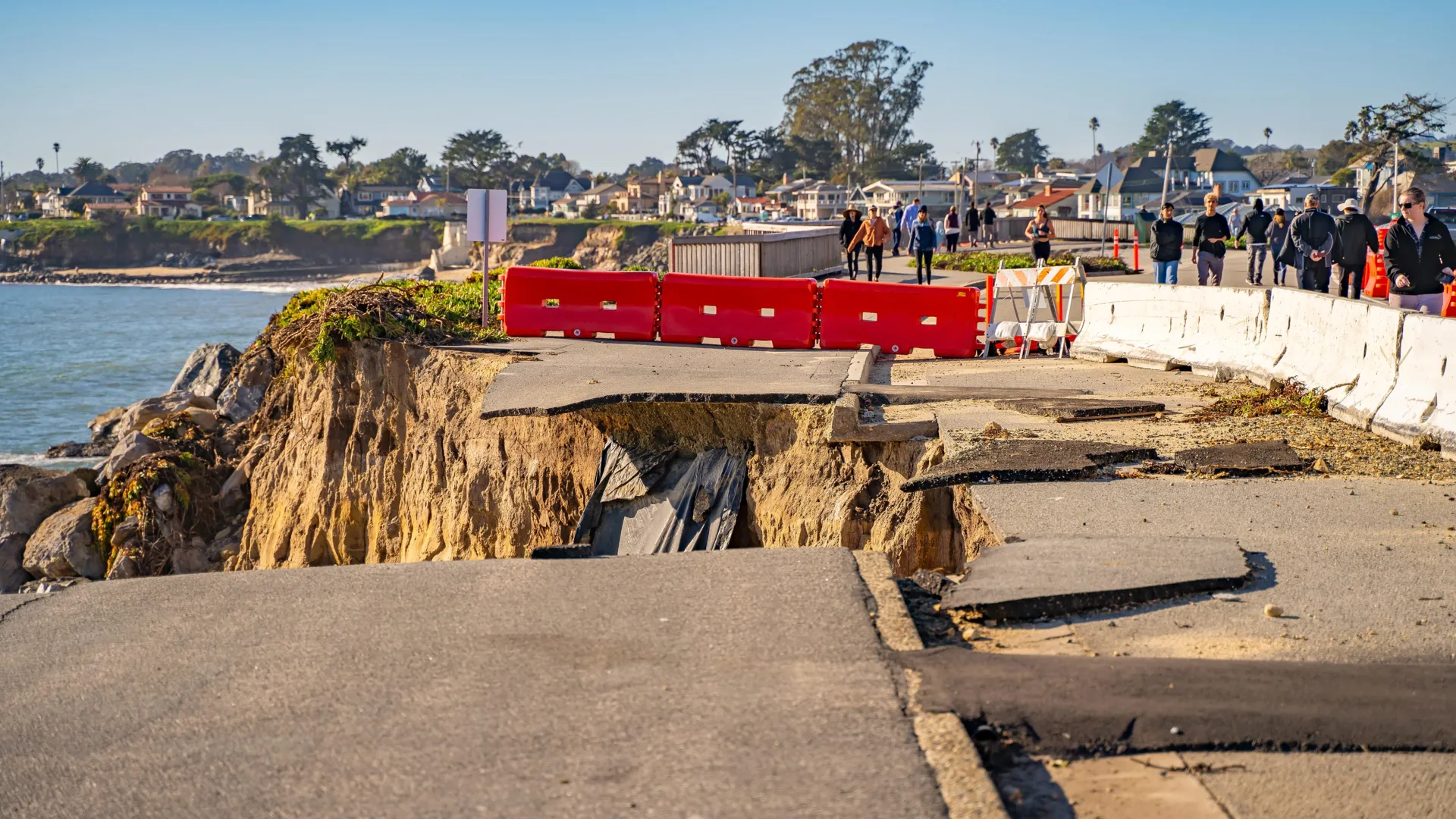
When the massive subduction zone off the Pacific Northwest finally shifts, the results can be catastrophic. A magnitude 9 or greater earthquake would unleash intense ground shaking, along with tsunamis and landslides that amplify the destruction. Now, a study published in Geosphere suggests this long-feared "really big one" may not act alone. It could also set off a powerful earthquake along California's San Andreas Fault.
"It's kind of hard to exaggerate what a M9 earthquake would be like in the Pacific Northwest," says Dr. Chris Goldfinger, a paleoseismologist at Oregon State University and lead author of the study. "And so the possibility that a San Andreas earthquake would follow, it's movie territory."
Tectonic Forces Shaping the Pacific Coast
The western edge of the United States sits atop a complex system of tectonic boundaries. North of Cape Mendocino, California, the Juan de Fuca plate is being forced beneath the North American plate, forming the Cascadia megathrust. South of that point, the Pacific and North American plates slide past one another along the San Andreas Fault, periodically producing major earthquakes such as the devastating 1906 San Francisco event.
If these two systems were to rupture close together, it would significantly change how scientists assess earthquake risk along the West Coast.
A Research Mistake That Changed Everything
The idea that these faults might be linked came from an unexpected place. In 1999, scientists set out on a research cruise to study ancient Cascadia earthquakes by collecting sediment cores from the seafloor. Their goal was to reconstruct past events along the Pacific Northwest margin.
However, a simple navigation error altered the course of the study. A graduate student entered the wrong latitude overnight, sending the ship about 90 kilometers south of its intended position. By morning, the team had drifted out of the Cascadia region and into an area influenced by the San Andreas Fault.
"We wound up off northern California," says Goldfinger. "When I woke up, I was pretty hot. But, once we were there, I thought, 'well, let's take a core here.'"
Unusual Sediment Layers Reveal a Pattern
The core sample they collected from Noyo Canyon near Fort Bragg held a surprising record of past activity. Stretching back about 3,000 years, the sediment contained repeated layers called turbidites. These form when underwater landslides, known as turbidity currents, rush down the seafloor and deposit material. Typically, these layers show a clear structure, with heavier grains settling first and finer particles resting on top.
But in this case, many of the deposits appeared in pairs. Both the Noyo Canyon core and samples from Cascadia showed this unusual double-layer pattern.
"There were these big, thick, sandy doublet events where it had a fine-grained element, and on top of it was a very coarse grained sandy unit. And we were just scratching our heads," says Goldfinger.
Evidence for Linked Cascadia and San Andreas Quakes
Radiocarbon dating of these layers revealed another important clue. Many of the paired deposits from sites north and south of Cape Mendocino formed at roughly the same time, within the limits of dating precision. That level of overlap suggested a shared cause rather than coincidence.
After considering and eliminating other possibilities, the researchers concluded that each pair likely records two separate but related events. The first layer appears to come from a major Cascadia megathrust earthquake, while the second reflects movement along the nearby San Andreas Fault.
"A lightbulb went on and we realized that the Noyo channel was probably recording Cascadia earthquakes, and that at a similar distance, Cascadia sites were probably recording San Andreas earthquakes," says Goldfinger. "Well, what if? What if Cascadia went off and triggered a weak turbidity current near the San Andreas, and then the San Andreas went off some time later and triggered a very coarse, sandy deposit to come down. It would create this upside-down doublet stratigraphy."
A Potential Chain Reaction Along the Coast
Exactly how much time might pass between these linked earthquakes remains uncertain. In some cases, later deposits may have erased evidence of any gap between events. Still, several samples suggest the second layer formed within minutes or hours of the first.
If that interpretation is correct, a Cascadia megathrust earthquake could quickly trigger a major rupture along the San Andreas, sending powerful shaking across much of the Pacific coast in rapid succession.
Such a scenario raises serious concerns about preparedness. A sequence of major earthquakes could strain emergency response systems and infrastructure across multiple states at once.
"I'm from the Bay Area originally," says Goldfinger. "If I were in my hometown of Palo Alto, and Cascadia went off, I think I would drive east. There looks to me like a very high risk the San Andreas would go off next."
Story Source:
Materials provided by The Geological Society of America (GSA). Note: Content may be edited for style and length.
Journal Reference:
- C. Goldfinger, J. Beeson, B. Black, A. Vizcaino, C.H. Nelson, A. Morey, J.R. Patton, J. Gutiérrez-Pastor, C. Romsos, M.D. Walzcak. Unravelling the dance of earthquakes: Evidence of partial synchronization of the northern San Andreas fault and Cascadia megathrust. Geosphere, 2025; 21 (6): 1132 DOI: 10.1130/GES02857.1
Cite This Page: