
A record-breaking X-ray flash may reveal the birth of a magnetar
A mysterious X-ray flash lasting nearly 10 minutes may have revealed the birth of a magnetar after two neutron stars collided.
- Date:
- September 30, 2026
- Source:
- ERC BHianca
- Summary:
- Astronomers have found strong evidence that some mysterious, minutes-long X-ray flashes are produced when two neutron stars collide and create a magnetar. One record-setting event glowed in X-rays for nearly 10 minutes, potentially opening a new way to find these extreme cosmic mergers.
- Share:
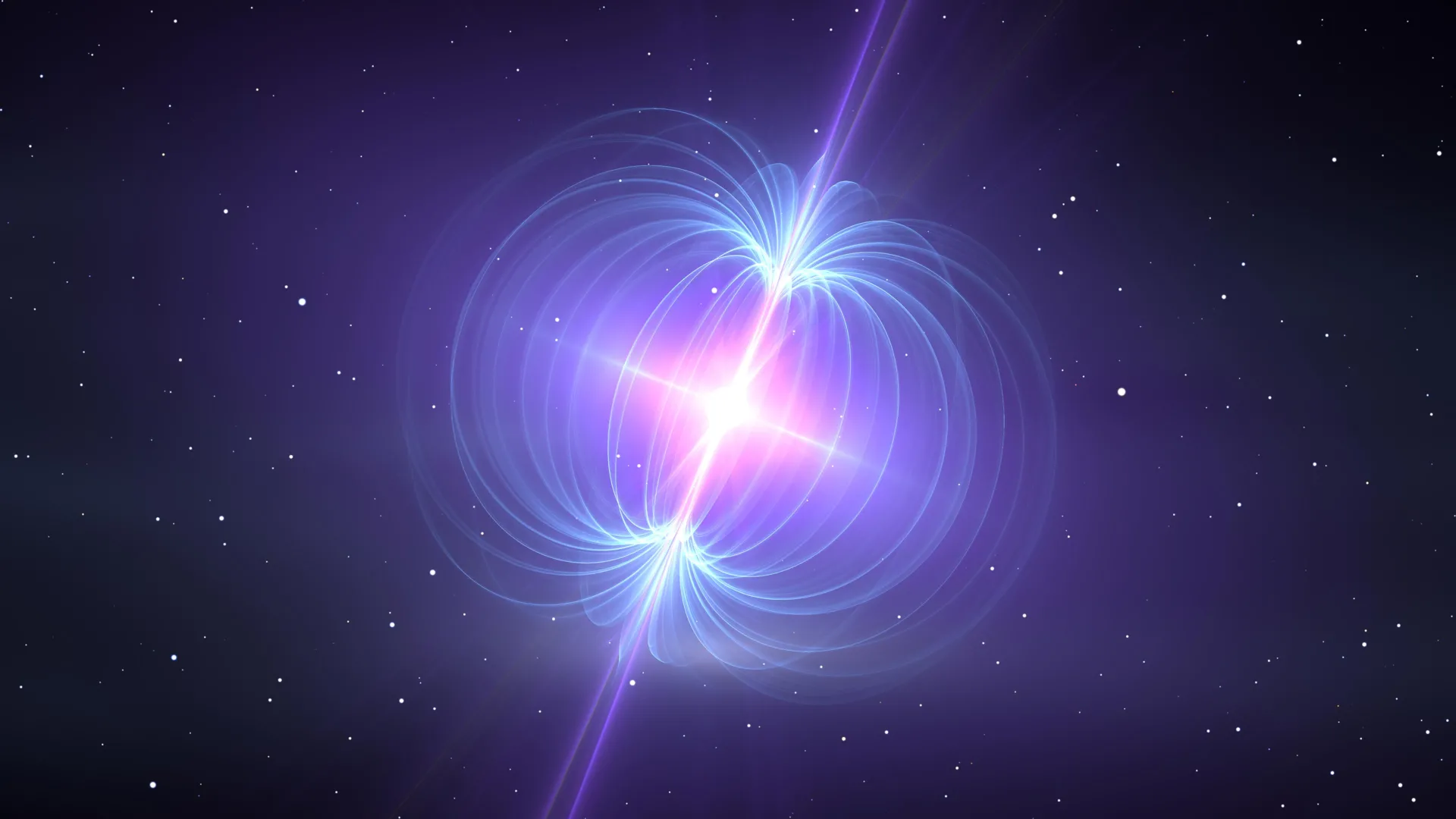
Astronomers have long relied on brief bursts of gamma rays to identify collisions between neutron stars. These flashes can vanish in less than two seconds. Now, new research suggests that some neutron star mergers may also produce X-ray flashes that remain visible for several minutes.
A study published in Science Bulletin presents strong evidence for that connection. The findings raise the possibility that some mysterious cosmic flashes, whose sources have been difficult to explain, may actually come from merging neutron stars.
Since the Einstein Probe satellite launched in January 2024, astronomers have detected hundreds of bright X-ray flashes from distant galaxies. These events, called fast X-ray transients, have several possible origins. Some have been connected to the deaths of massive stars, while others remain unexplained.
Determining what causes them can be difficult because astronomers often do not know how far away the events are or how much energy they release.
A Possible Magnetar Birth
Researchers in Professor Eleonora Troja's group, supported by a European Research Council (ERC) Consolidator grant, obtained observations that helped identify the source of one such X-ray transient.
After receiving an alert from the Einstein Probe satellite, the team rapidly organized follow-up observations with several instruments, including the European Southern Observatory's Very Large Telescope (VLT) and the Very Large Array. By studying what remained after the explosion, the researchers concluded that they may have witnessed the formation of a magnetar produced by the collision (or merger) of two neutron stars.
Neutron stars are extremely dense stellar remnants left behind after massive stars reach the ends of their lives. When two neutron stars merge, they generate gravitational waves that travel through space. The light produced during these events can help astronomers determine what survives the collision.
Short gamma-ray bursts have traditionally been the main electromagnetic signal associated with neutron star mergers.
"However, if the remnant of the collision is a magnetar, it could keep bursting for longer," said Prof. Troja, who is part of the Einstein Probe European collaboration and co-corresponding author of the paper. "Magnetars are rapidly spinning neutron stars with huge magnetic fields. When they damp their magnetic power into the surroundings, they can make any explosion brighter and longer-lasting. When I saw the X-ray data from this new event, I realized something was up."
A Record X-Ray Flash
The event, designated EP250704a/GRB 250704B, was detected on July 4, 2025, by the SVOM, Insight-HXMT and Einstein Probe satellites.
Its gamma-ray burst lasted only about half a second. In contrast, Einstein Probe recorded bright X-ray emission for nearly ten minutes.
"This is the longest lasting prompt X-ray flash ever observed from a neutron star merger," said graduate student Niccolò Passaleva, who led the follow-up observations using the VLT in Chile. "It is an opportunity to have a front-row seat to the most extreme forces of the Universe and discover more of its secrets."
The researchers had spent several years looking for a firm connection between fast X-ray transients and neutron star mergers. Previous candidates faded too quickly to provide enough evidence.
This time, Passaleva responded within minutes, allowing observations to begin while the event was still bright enough to study in detail.
"I was traveling home by train," recalls Passaleva, "and all of a sudden I was rushing against time to commandeer one of the largest telescopes in the world from my laptop."
Measuring a Flash From More Than 6 Billion Years Away
Using the VLT's X-Shooter instrument, Passaleva and his colleagues broke the event's light into its individual components. They identified distinct absorption patterns that allowed them to measure its redshift, which reveals how far away the source is.
The team measured a redshift of z=0.6610. That showed the explosion happened long before our Sun and its planets formed. Its light traveled for more than six billion years before reaching Earth.
The researchers then searched for another important clue.
Using deep observations from the VLT's FORS2 instrument, they looked for a bright supernova. A supernova would normally be expected if a long-lasting X-ray flash had been produced by the collapse of a massive star.
No supernova appeared.
Taken together, the measured distance, the absence of a supernova and the properties of the burst provided strong evidence that the event came from a neutron star merger.
A New Way To Find Neutron Star Mergers
If additional events like this one are found, astronomers may be able to determine how frequently neutron star mergers produce magnetars.
"Finding more of these X-ray flashes could help reveal how often neutron star mergers create magnetars," concludes Passaleva, "I am really excited for the next run of gravitational wave observations, when we could finally pair one of these X-ray flashes with a burst of gravitational waves from the same source."
Additional Information
The research was carried out by an international collaboration of astronomers.
Lead authors are: An Li (Beijing Normal University), Chen-Wei Wang (Chinese Academy of Sciences), Niccolò Passaleva (University of Rome Tor Vergata), Jie An (Chinese Academy of Sciences)
Corresponding authors are: Binbin Zhang (Nanjing University), Eleonora Troja (University of Rome Tor Vergata), Yi-Han Iris Yin (The University of Hong Kong), Jing-Wei Hu (Chinese Academy of Sciences), Hua-Li Li (Chinese Academy of Sciences)
The VLT observations used in this study were conducted as part of the large program 114.27LW (PI: Eleonora Troja) titled "QUEENB: a QUEst for Elusive Neutron star and Black hole mergers."
Story Source:
Materials provided by ERC BHianca. Note: Content may be edited for style and length.
Journal Reference:
- An Li, Chen-Wei Wang, Niccolò Passaleva, Jie An, Bin-Bin Zhang, Eleonora Troja, Yi-Han Iris Yin, Yuan Liu, Shao-Lin Xiong, Li-Ping Xin, Yi-Xuan Shao, Jun Yang, Hui Sun, Dong Xu, Yu-Han Yang, Roberto Ricci, He Gao, Sarah Antier, Rosa L. Becerra, Jia-Xin Cao, Alberto Javier Castro-Tirado, Xin-Lei Chen, Ye-Hao Cheng, Yong Chen, Hua-Qing Cheng, Valerio D’Elia, Massimiliano De Pasquale, Yong-Wei Dong, Eslam Elhosseiny, Rob A.J. Eyles-Ferris, Maria Gritsevich, Xu-Hui Han, Dieter Hartmann, You-Dong Hu, Jing-Wei Hu, Shu-Mei Jia, Nino Kochiashvili, Wei-Hua Lei, Andrew J. Levan, Cheng-Kui Li, Dong-Yue Li, Hua-Li Li, Xiao-Bo Li, Zhi-Xing Ling, He-Yang Liu, Hou-Jun Lü, Daniele B. Malesani, Brendan O’Connor, Hai-Wu Pan, Shashi Bhushan Pandey, Ignacio Perez-Garcia, Daniëlle L.A. Pieterse, Marion Pillas, Yu-Lei Qiu, Andrea Saccardi, Rubén Sánchez-Ramírez, Wen-Jun Tan, Manasanun Tanasan, Nial R. Tanvir, Susanna D. Vergani, Jing Wang, Xiao-Feng Wang, Qin-Yu Wu, Shu-Xu Yi, Tillayev Yusufjon, Chen Zhang, Wen-Da Zhang, Yi-Jia Zhang, Guo-Ying Zhao, Chao Zheng, Shi-Jie Zheng, Chang Zhou, Ping Zhou, Bertrand Cordier, Jian-Yan Wei, Weimin Yuan, Shuang-Nan Zhang, Bing Zhang. Minutes-long soft X-ray prompt emission from a compact object merger. Science Bulletin, 2026; 71 (18): 4657 DOI: 10.1016/j.scib.2026.08.021
Cite This Page: