
Most distant supernova: James Webb sees a star explode at cosmic dawn
JWST has revealed a stellar explosion from the universe’s childhood, and it looks astonishingly familiar.
- Date:
- December 28, 2025
- Source:
- UCD Research & Innovation
- Summary:
- Scientists have detected the most distant supernova ever seen, exploding when the universe was less than a billion years old. The event was first signaled by a gamma-ray burst and later confirmed using the James Webb Space Telescope, which was able to isolate the blast from its faint host galaxy. Surprisingly, the explosion closely resembles supernovae linked to gamma-ray bursts in the modern universe.
- Share:
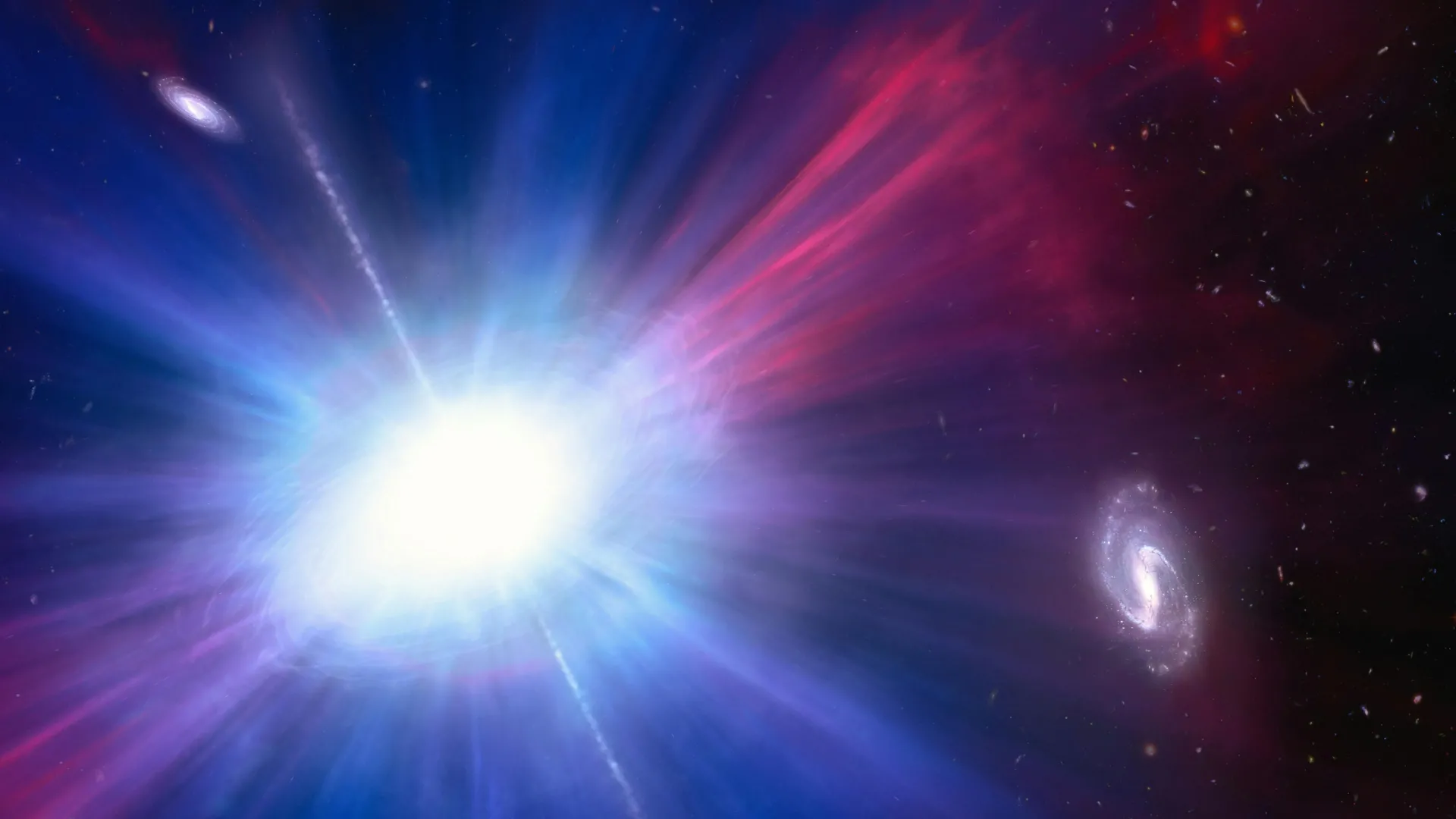
Astronomers from around the world have reached a major milestone in studying the early universe. Using the James Webb Space Telescope (JWST), they identified a supernova, the explosive death of a massive star, at a distance never observed before.
The blast, known as SN in GRB 250314A, occurred when the universe was only about 730 million years old. This places it firmly within the era of reionisation, a period when the first stars and galaxies were beginning to emerge. The observation offers a rare and direct view of how massive stars ended their lives during this formative stage of cosmic history.
A Gamma Ray Burst Leads the Way
The discovery was first reported in the academic paper 'JWST reveals a supernova following a gamma-ray burst at z ≃ 7.3,' (Astronomy & Astrophysics, 704, December 2025). The event initially drew attention after a powerful flash of high energy radiation, called a long duration Gamma Ray Burst (GRB), was detected on March 14, 2025 by the space based multi band astronomical Variable Objects Monitor (SVOM). Astronomers then used the European Southern Observatory's Very Large Telescope (ESO/VLT) to confirm that the source was located at an extreme distance.
JWST Separates the Explosion From Its Host Galaxy
The decisive observations came about 110 days after the burst, when JWST targeted the region using its Near Infrared Camera (NIRCAM). These images allowed researchers to isolate the fading light of the supernova from the much dimmer glow of its host galaxy, a critical step in confirming the nature of the explosion.
Co author and UCD School of Physics astrophysicist Dr. Antonio Martin Carrillo explained the importance of the finding: "The key observation, or smoking gun, that connects the death of massive stars with gamma-ray bursts is the discovery of a supernova emerging at the same sky location. Almost every supernova ever studied has been relatively nearby to us, with just a handful of exceptions to date. When we confirmed the age of this one, we saw a unique opportunity to probe how the Universe was there and what type of stars existed and died back then.
"Using models based on the population of supernovae associated with GRBs in our local universe, we made some predictions of what the emission should be and used it to proposed a new observation with the James Webb Space Telescope. To our surprise, our model worked remarkably well and the observed supernova seems to match really well the death of stars that we see regularly. We were also able to get a glimpse of the galaxy that hosted this dying star."
An Unexpectedly Familiar Explosion
Measurements show that this distant supernova closely matches the brightness and spectral features of SN 1998bw, a well known supernova linked to a gamma ray burst that exploded much closer to Earth. This resemblance suggests that the star behind GRB 250314A was not dramatically different from massive stars that produce similar explosions in the nearby universe.
Despite forming in an environment with very different conditions, including much lower metallicity, the star appears to have died in a familiar way. The data also rule out a far brighter type of explosion, such as a Superluminous Supernova (SLSN).
Rethinking the First Generations of Stars
These results challenge the long held idea that the earliest stars would produce explosions that were distinctly brighter or bluer than those seen today. Instead, the findings point to a surprising consistency in how massive stars end their lives across cosmic time.
While the discovery provides an important reference point for understanding stellar evolution in the early universe, it also raises new questions about why these explosions appear so uniform.
The team plans to conduct another round of JWST observations within the next one to two years. By then, the supernova should have faded by more than two magnitudes, making it easier to fully study the faint host galaxy and confirm exactly how much light came from the supernova itself.
Story Source:
Materials provided by UCD Research & Innovation. Note: Content may be edited for style and length.
Journal Reference:
- A. J. Levan, B. Schneider, E. Le Floc’h, G. Brammer, N. R. Tanvir, D. B. Malesani, A. Martin-Carrillo, A. Rossi, A. Saccardi, A. Sneppen, S. D. Vergani, J. An, J.-L. Atteia, F. E. Bauer, V. Buat, S. Campana, A. Chrimes, G. Corcoran, B. Cordier, L. Cotter, F. Daigne, V. D’Elia, M. De Pasquale, A. de Ugarte Postigo, R. A. J. Eyles-Ferris, H. Fausey, A. S. Fruchter, O. Godet, B. P. Gompertz, D. Götz, N. Habeeb, D. H. Hartmann, L. Izzo, P. Jakobsson, T. Laskar, A. Melandri, P. T. O’Brien, J. T. Palmerio, L. Piro, G. Pugliese, Y. L. Qiu, B. C. Rayson, R. Salvaterra, S. Schanne, A. L. Thakur, C. C. Thöne, D. Watson, J. Y. Wei, K. Wiersema, R. A. M. J. Wijers, L. P. Xin, D. Xu, S. N. Zhang. JWST reveals a supernova following a gamma-ray burst at z ≃ 7.3. Astronomy, 2025; 704: L8 DOI: 10.1051/0004-6361/202556581
Cite This Page: