
150-million-year-old dinosaur footprints reveal something strange about its walk
- Date:
- August 11, 2026
- Source:
- University of Queensland
- Summary:
- A spectacular 150-million-year-old trail of more than 130 footprints captures a giant sauropod making a complete loop before continuing on its way. Its uneven stride hints that the long-necked dinosaur may have been walking with a limp.
- Share:
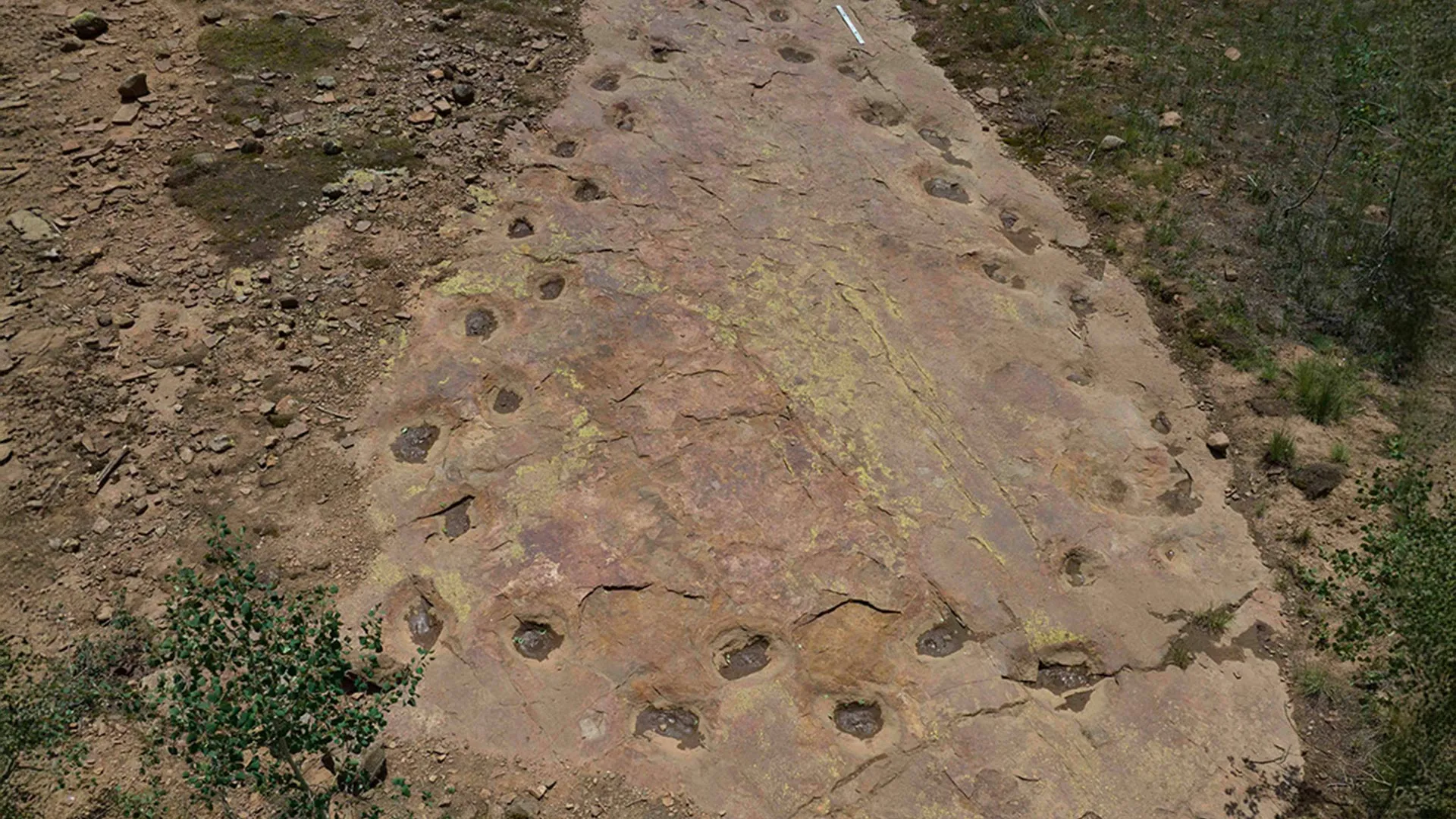
A rare looping trail of fossilized footprints in Colorado is giving scientists a detailed look at how a giant dinosaur moved 150 million years ago. The evidence also raises the possibility that the animal was walking with a limp.
Located near Ouray, the trackway is one of the most continuous and tightly curved sauropod footprint trails ever recorded.
Dr. Anthony Romilio of The University of Queensland's Dinosaur Lab studied more than 130 footprints spread across the 95.5-meter track.
"This was left in the Late Jurassic when long-necked dinosaurs such as Diplodocus and Camarasaurus roamed North America," Dr. Romilio said.
"This trackway is unique because it is a complete loop.
"While we may never know why this dinosaur curved back on itself, the trackway preserves an extremely rare chance to study how a giant sauropod handled a tight, looping turn before resuming its original direction of travel."
Drones Reveal the Full Dinosaur Trackway
Because of the enormous size of the West Gold Hill Dinosaur Tracksite, examining the footprints entirely from ground level has been difficult.
Co-author Dr. Paul Murphey from San Diego Natural History Museum said researchers needed a different way to document the site.
"It has been challenging to document these footprints from the ground because of the size of the trackway," Dr. Murphey said.
"We used drones to capture the entire trackway in high resolution.
"With these images we generated a detailed 3D model, which could then be digitally analyzed in the lab at millimeter-scale accuracy."
The resulting virtual reconstruction allowed the researchers to follow the sauropod's movement across the entire trail.
"It was clear from the start that this animal began walking toward the northeast, completed a full loop, and then finished facing the same direction again," Dr. Romilio said.
"Within that loop we found subtle, yet consistent, clues to its behavior."
Ancient Footprints Reveal Changes in Its Stride
One of the strongest patterns involved the spacing between the dinosaur's left and right footprints.
"One of the clearest patterns was a variation in the width between left and right footprints, shifting from quite narrow to distinctly wide.
"This shift from narrow to wide step placement shows that footprint width can change naturally as a dinosaur moves, meaning short trackway segments with seemingly consistent widths may give a misleading picture of its usual walking style.
The researchers also found a small but persistent difference between the lengths of the dinosaur's left and right steps.
"We also detected a small but persistent difference in left and right step lengths, of about 10 centimeters or 4 inches.
"Whether that reflects a limp or simply a preference for one side is hard to say.
The findings suggest that long dinosaur trackways can preserve behavioral details that shorter stretches of footprints may fail to reveal.
"There are many long dinosaur trackways around the world where this method could be applied to extract behavioral information that was previously inaccessible."
The investigation of the track site has been supported by the U.S. Forest Service.
Story Source:
Materials provided by University of Queensland. Note: Content may be edited for style and length.
Journal Reference:
- Anthony Romilio, Paul C. Murphey, Neffra A. Matthews, Bruce A. Schumacher, Lance D. Murphey, Marcello Toscanini, Parker Boyce, Zach Fitzner. Track by Track: Revealing Sauropod Turning and Lateralised Gait at the West Gold Hill Dinosaur Tracksite (Upper Jurassic, Bluff Sandstone, Colorado). Geomatics, 2025; 5 (4): 67 DOI: 10.3390/geomatics5040067
Cite This Page: