
Distant time crystals can somehow fall into the same rhythm
Physicists have discovered that separate time crystals can synchronize across surprisingly large distances inside a semiconductor.
- Date:
- September 24, 2026
- Source:
- TU Dortmund University
- Summary:
- Researchers have shown that multiple time crystals inside a semiconductor can synchronize their oscillations, much like pendulum clocks gradually falling into the same rhythm. The coupling is carried by spin-polarized electrons, allowing time crystals separated by up to 40 micrometers to lock to a common frequency. The discovery reveals surprisingly long-range connections between these exotic spin systems and could help researchers develop future spin-based devices.
- Share:
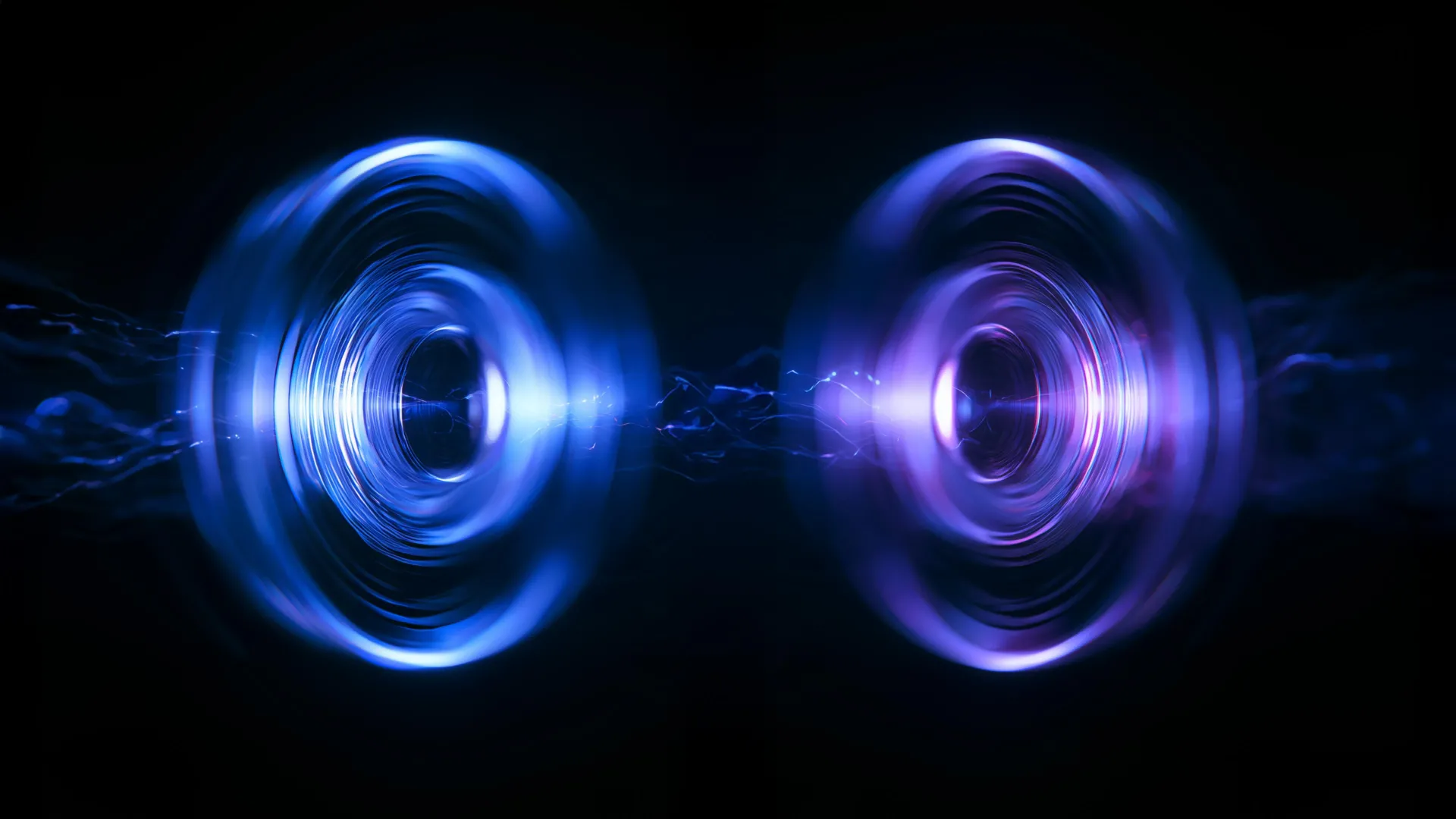
Physicists at TU Dortmund University showed in January 2024 that a continuous time crystal could persist inside a semiconductor, with its oscillations remaining stable for hours. Now, in a new study published inNature Communications, Prof. Alex Greilich and his colleagues have found that multiple time crystals can emerge within the same material and synchronize their electron-nuclear spin oscillations.
Time crystals are unusual physical systems whose internal behavior repeats in a regular rhythm over time, even though they are not being driven by a repeating external signal.
In the TU Dortmund experiments, the time crystals form inside a semiconductor made from gallium arsenide with small amounts of indium and silicon. These added elements create localized electrons within the material. At temperatures close to -270 °C, each electron interacts with roughly one million nearby nuclear spins.
To initiate the process, the researchers use a pump laser to align the electron spins. The electrons then transfer their polarization to the surrounding nuclear spins. When a weak magnetic field is applied, the polarization of those nuclear spins begins to rotate.
Feedback between the electron spins and nuclear spins keeps the oscillations going. A second laser allows the researchers to monitor how those oscillations develop over time.
Separate Oscillations Fall Into Sync
Different regions of the semiconductor are not perfectly identical at the microscopic level. Because of these local variations, time crystals that form in separate areas would normally oscillate at slightly different frequencies.
That changes when the researchers illuminate many regions at once with a broad laser beam. Under those conditions, the separate oscillations can lock together and begin operating at the same frequency.
The effect is reminiscent of an observation made by Christiaan Huygens in 1665 involving two pendulum clocks. Huygens noticed that clocks attached to the same support could gradually synchronize because of the weak mechanical interaction transmitted through that shared structure.
In the semiconductor, the connection works differently. Instead of mechanical vibrations, the time crystals become coupled through the movement of spin-polarized electrons.
Synchronization Across Surprising Distances
The team found that time crystals located as far as 40 micrometers apart could still synchronize. That distance is more than one thousand times greater than the characteristic size of a single oscillator.
Once the separation becomes larger, however, the individual time crystals no longer lock together and instead continue oscillating independently.
The findings demonstrate non-local coupling between spatially separated spin systems. They could also help lay the groundwork for future networks of controllable spin oscillators, potentially opening new possibilities for spin-based technologies.
Story Source:
Materials provided by TU Dortmund University. Note: Content may be edited for style and length.
Journal Reference:
- Alex Greilich, Nataliia E. Kopteva, Vladimir L. Korenev, Philipp A. Haude, Linus Kunze, Ben W. Grobecker, Sergiu Anghel, Markus Betz, Manfred Bayer. Non-local synchronization of continuous time crystals in a semiconductor. Nature Communications, 2026; 17 (1) DOI: 10.1038/s41467-026-75714-1
Cite This Page: