
Do spiders dream? Scientists just found a surprising clue
- Date:
- October 27, 2026
- Source:
- University of Bonn
- Summary:
- Scientists have discovered that spiders may sleep in ways surprisingly similar to humans, complete with distinct sleep stages and a dream-like REM state. Researchers at the University of Bonn studied the Australian jumping spider Portia fimbriata, a remarkably clever hunter known for its sophisticated strategies. By recording the spiders over several days and nights, they found clear evidence of regulated sleep, including a REM-like stage marked by eye movements and muscle twitches.
- Share:
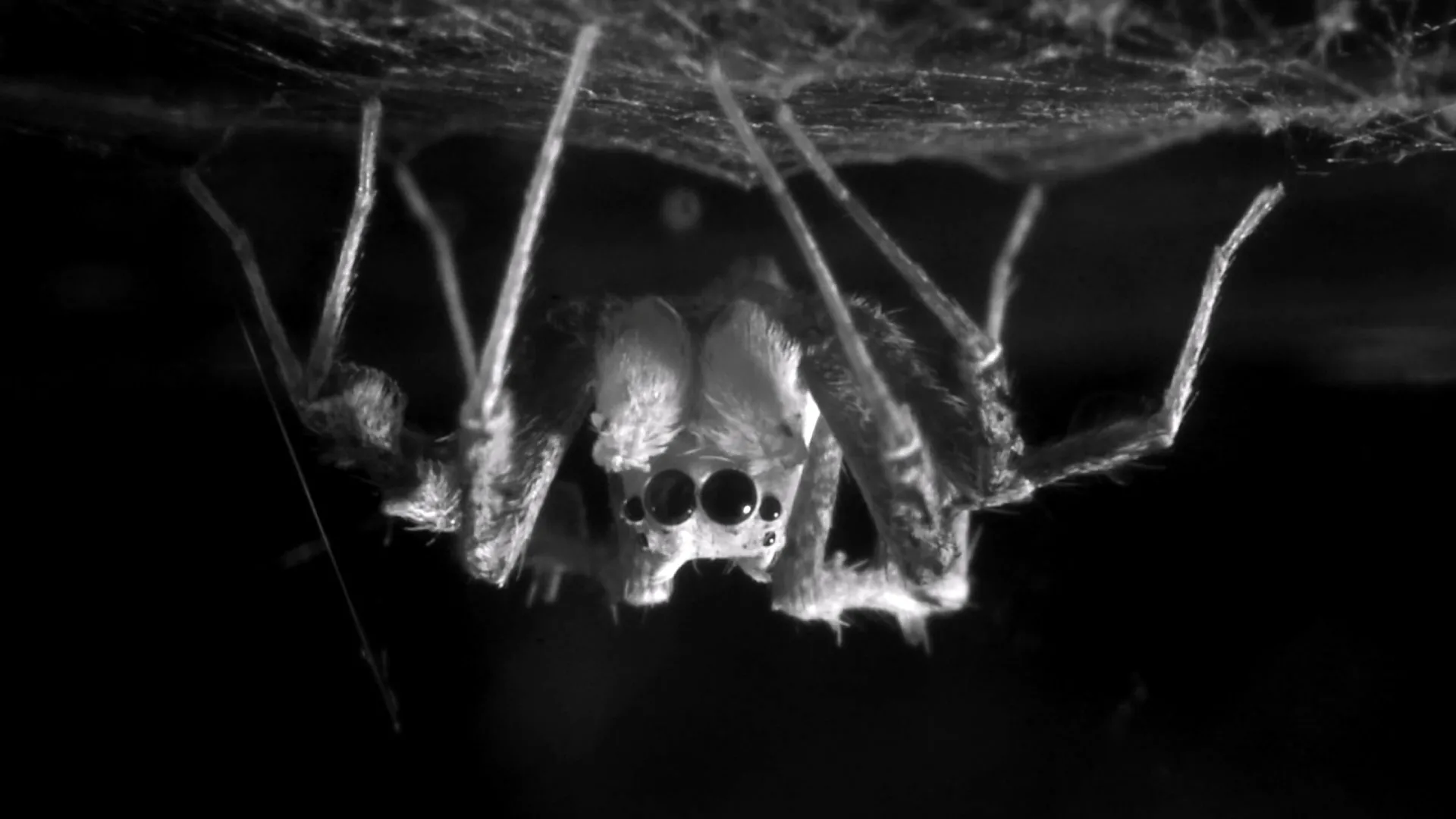
Scientists at the University of Bonn have discovered that spiders experience distinct stages of sleep, including a REM-like state that shares surprising similarities with human sleep. During this stage, the spiders move their eyes and twitch their muscles, behaviors also associated with REM (rapid eye movement) sleep in humans and other vertebrates.
The findings provide the first comprehensive experimental confirmation that spiders experience genuine, regulated sleep rather than simply remaining inactive. They also raise intriguing questions about how sleep evolved and whether animals with very different nervous systems might share some of its fundamental features.
Researchers at the University of Bonn's Institute of Organismic Biology made the discovery while studying the Australian jumping spider Portia fimbriata, a small but remarkably sophisticated predator.
A Tiny Spider With Remarkable Hunting Skills
The Australian jumping spider Portia fimbriata is only about the size of a one-euro coin when fully grown, but its hunting abilities make it particularly interesting to scientists.
Unlike many spiders that primarily capture insects, members of the genus Portia specialize in hunting other spiders. They use a variety of sophisticated strategies to catch their prey, including imitating the vibrations made by struggling insects trapped in spiderwebs.
These deceptive signals can lure web-building spiders toward what appears to be an easy meal, only for them to encounter the hunting Portia instead.
Such complex behaviors suggest that these spiders have unusual learning abilities, making them valuable subjects for investigating the relationship between sleep, nervous system function, and cognition.
Scientists Discover Two Distinct Stages of Spider Sleep
Although sleep has been extensively studied in humans and other vertebrates, scientists still know relatively little about how it works in animals with very different nervous systems.
To investigate whether spiders experience genuine sleep and whether that sleep includes different stages, the researchers closely monitored Portia fimbriata over several days and nights.
They discovered that the spiders exhibit two clearly distinguishable sleep stages. One of these resembles REM sleep, the phase in humans associated with rapid eye movements, muscle activity, and vivid dreaming.
During this REM-like stage, the spiders displayed characteristic eye movements and muscle twitches. These observations suggest that some features of sleep previously studied mainly in vertebrates may also occur in spiders.
The researchers emphasize that identifying REM-like movements does not establish whether spiders dream. However, the discovery provides important evidence that sleep in these animals is more complex than previously understood.
How Researchers Confirmed That Spiders Really Sleep
To study the spiders' sleeping behavior, the team placed individual Portia fimbriata spiders in plastic dishes measuring 12 centimeters in diameter. They monitored the animals under different lighting conditions to examine their daily activity and rest cycles.
Infrared cameras allowed the researchers to observe the spiders throughout the night without relying on visible light. Detailed recordings captured their sleeping positions, periods of quiet rest, and episodes of REM-like movement.
The team also conducted experiments to determine whether the spiders were genuinely asleep rather than simply sitting motionless.
Using sound stimuli, the researchers measured how quickly the spiders responded to disturbances. These tests helped distinguish sleep from ordinary inactivity.
Another important part of the investigation involved sleep deprivation. The researchers examined whether the spiders displayed "sleep rebound," meaning they compensated for interrupted sleep by increasing their subsequent sleep.
Together, the behavioral observations and experimental tests provided strong evidence that Portia fimbriata experiences regulated sleep with distinct stages.
Studying Spider Sleep Presented Unusual Challenges
Determining whether a spider is truly asleep is considerably more complicated than observing a sleeping human.
Because spiders sense their surroundings differently from people, the researchers first had to identify a sound stimulus that would produce a consistent response during their experiments.
They also needed to avoid assuming that the observed eye movements and muscle twitches necessarily represented the same processes seen during human REM sleep.
One major limitation was that the researchers could not measure the spiders' brain activity. Instead, they relied entirely on carefully documented behavior to identify different sleep states.
This required extensive high-resolution video recordings collected over many days and nights, producing enormous amounts of data for analysis.
Despite these obstacles, the combination of behavioral monitoring, response testing, and sleep disruption experiments allowed the researchers to build a detailed picture of how these spiders sleep.
What Spider Sleep Could Reveal About Evolution
The discovery has implications that extend well beyond spiders.
Most scientific knowledge about sleep comes from studying vertebrates, particularly mammals and birds. Finding comparable sleep features in animals with radically different nervous systems could help researchers understand when and why different types of sleep evolved.
The results also open new opportunities in behavioral science, neuroscience, and chronobiology, the study of biological rhythms.
By investigating sleep in a wider variety of animals, scientists hope to identify features that are shared across species and uncover the fundamental biological functions that sleep may have served early in evolutionary history.
The researchers argue that future investigations should move beyond traditionally studied animals and include species with unusual adaptations or much simpler nervous systems.
Such comparisons could reveal whether certain sleep mechanisms are widespread throughout the animal kingdom or developed independently in different evolutionary lineages.
Even after decades of intensive research, many basic questions about sleep remain unanswered, including important mysteries surrounding human sleep.
Could Spiders Dream? Scientists Have More Questions
The University of Bonn team is now expanding its research to investigate how sleep, particularly REM-like sleep, varies across different spider species.
Scientists are also comparing spiders sleeping in natural environments with those observed in laboratories to determine how surroundings influence their behavior.
Another major goal is to investigate the relationship between sleep and cognitive abilities. Researchers want to understand what happens inside the brains of spiders and insects during sleep, and whether different sleep stages contribute to learning and other mental processes.
Environmental changes are also becoming an important focus. The team plans to examine how climate change and human activities, especially artificial light at night (ALAN), may interfere with the sleep patterns of spiders and other arthropods.
For now, the findings establish that even a tiny jumping spider can experience a surprisingly complex form of sleep. Whether spiders actually dream remains unknown, but their nighttime behavior is offering scientists new clues about one of biology's most enduring mysteries.
Story Source:
Materials provided by University of Bonn. Note: Content may be edited for style and length.
Journal Reference:
- Nadja Geiger, Maxim Q. Capelle, Phillip Rosentreter, Marie E. Herberstein, Armin Bahl, Massimo De Agrò, Barrett A. Klein, Daniela C. Rößler. Behavioral evidence for two-stage sleep in spiders. Proceedings of the National Academy of Sciences, 2026; 123 (45) DOI: 10.1073/pnas.2618030123
Cite This Page: