
Robots descend into lava tubes to prepare for future Moon bases
A trio of smart robots may be the key to unlocking hidden lava tunnels, and future bases, on the Moon and Mars.
- Date:
- February 2, 2026
- Source:
- University of Malaga
- Summary:
- Hidden lava tunnels on the Moon and Mars could one day shelter human explorers, offering natural protection from radiation and space debris. A European research team has unveiled a bold new mission concept that uses three different robots working together to explore these extreme underground environments autonomously. Recently tested in the volcanic caves of Lanzarote, the system maps cave entrances, deploys sensors, lowers a scout rover, and creates detailed 3D maps of the interior.
- Share:
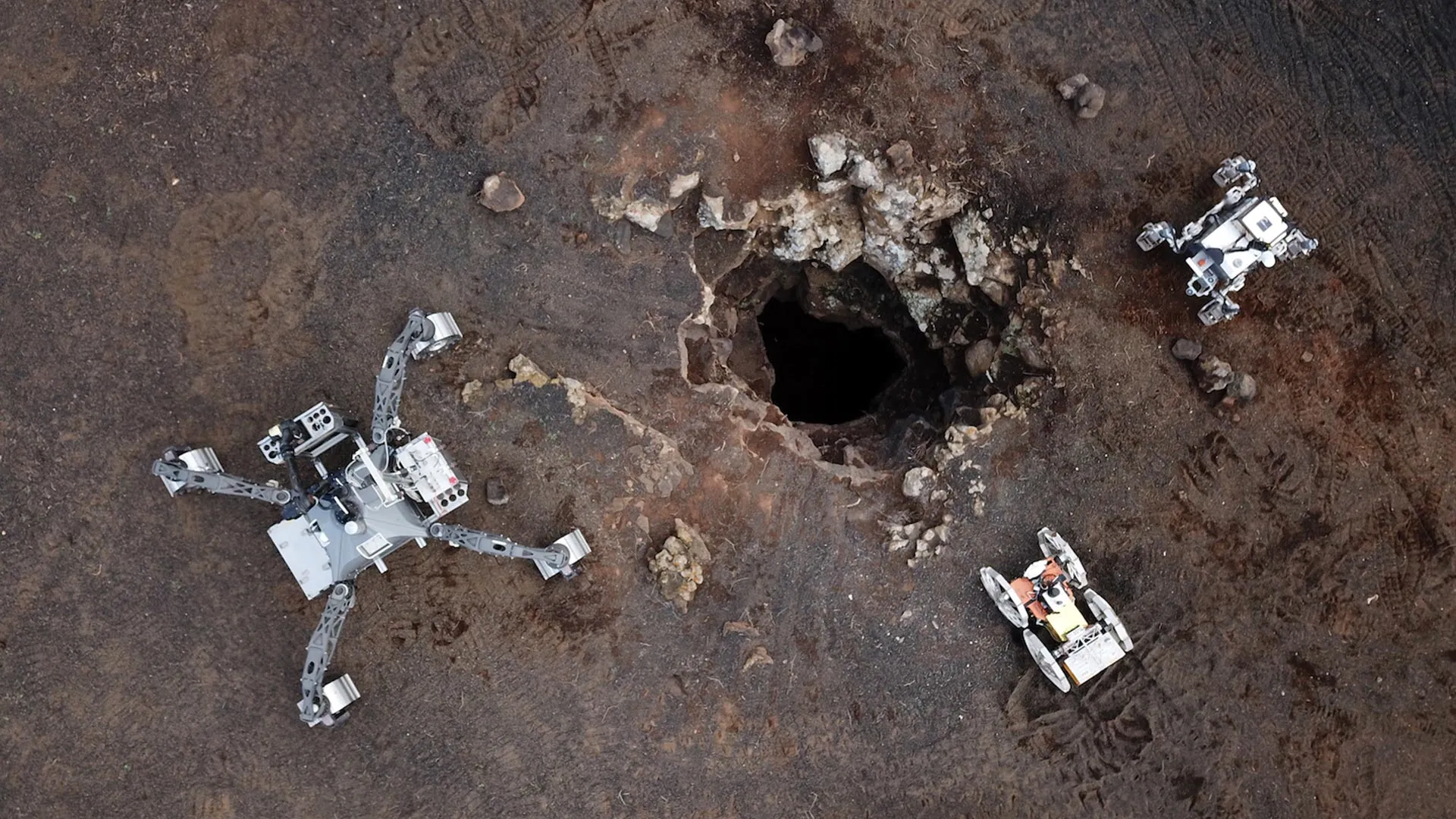
Lava tunnels on nearby planetary bodies are increasingly seen as strong candidates for future base camps. These underground structures can naturally shield astronauts from harmful radiation and frequent meteorite impacts. Despite their promise, reaching and studying these environments is extremely challenging due to rough terrain, limited entry points, and dangerous conditions.
To tackle these challenges, a European research consortium that includes the Space Robotics Laboratory at the University of Malaga has developed a new mission concept focused on exploring lava tunnels. The work was recently published in the journal Science Robotics. The concept centers on three different types of robots that can work together autonomously to explore and map these harsh underground spaces. The system is currently being tested in volcanic caves in Lanzarote (Spain), with future missions aimed at the Moon.
Four Phases of Autonomous Exploration
The proposed mission unfolds in four carefully planned stages. First, the robots cooperatively map the area around the lava tunnel entrance (phase 1). Next, a sensorized payload cube is dropped into the cave to gather initial measurements (phase 2). A scout rover then rappels down through the entrance to reach the interior (phase 3). In the final stage, the robotic team explores the tunnel in depth and produces detailed 3D maps of its interior (phase 4).
A real world field test conducted on Lanzarote in February 2023 showed that the approach works as planned. The trial highlighted the technical capabilities of the consortium led by the German Research Center for Artificial Intelligence (DFKI), with contributions from the University of Malaga and the Spanish company GMV.
Preparing for the Moon and Mars
The results confirmed that the mission concept is technically feasible and demonstrated the broader potential of collaborative robotic systems. These findings suggest that teams of autonomous robots could play a key role in future exploration missions to the Moon or Mars. The study also supports continued development of advanced robotic technologies for planetary exploration.
The Role of the Space Robotics Laboratory at the UMA
The Space Robotics Laboratory at the UMA focuses on creating new methods and technologies that increase autonomy in space robotics, covering both planetary and orbital missions. In recent years, the laboratory has worked closely with the European Space Agency, developing algorithms that help planetary exploration vehicles (rovers) plan routes and operate more independently.
Beyond research, the laboratory is dedicated to training the next generation of space robotics engineers. Students from the School of Industrial Engineering at UMA participate in internships and thesis projects related to this work. Most projects are carried out in partnership with national and international research institutions through joint research efforts or technology transfer agreements with companies and research organizations.
Story Source:
Materials provided by University of Malaga. Note: Content may be edited for style and length.
Journal Reference:
- Raúl Domínguez, Carlos Pérez-del-Pulgar, Gonzalo J. Paz-Delgado, Fabio Polisano, Jonathan Babel, Thierry Germa, Iulia Dragomir, Valérie Ciarletti, Anne-Claire Berthet, Leon Cedric Danter, Frank Kirchner. Cooperative robotic exploration of a planetary skylight surface and lava cave. Science Robotics, 2025; 10 (105) DOI: 10.1126/scirobotics.adj9699
Cite This Page: