
NASA scientists say meteorites can’t explain mysterious organic compounds on Mars
- Date:
- February 12, 2026
- Source:
- NASA’s Goddard Space Flight Center
- Summary:
- Scientists studying a rock sample collected by NASA’s Curiosity rover have uncovered something tantalizing: the largest organic molecules ever detected on Mars. The compounds — decane, undecane, and dodecane — may be fragments of fatty acids, which on Earth are most often linked to life. While non-living processes like meteorite impacts can also create such molecules, researchers found those sources couldn’t fully explain the amounts detected.
- Share:
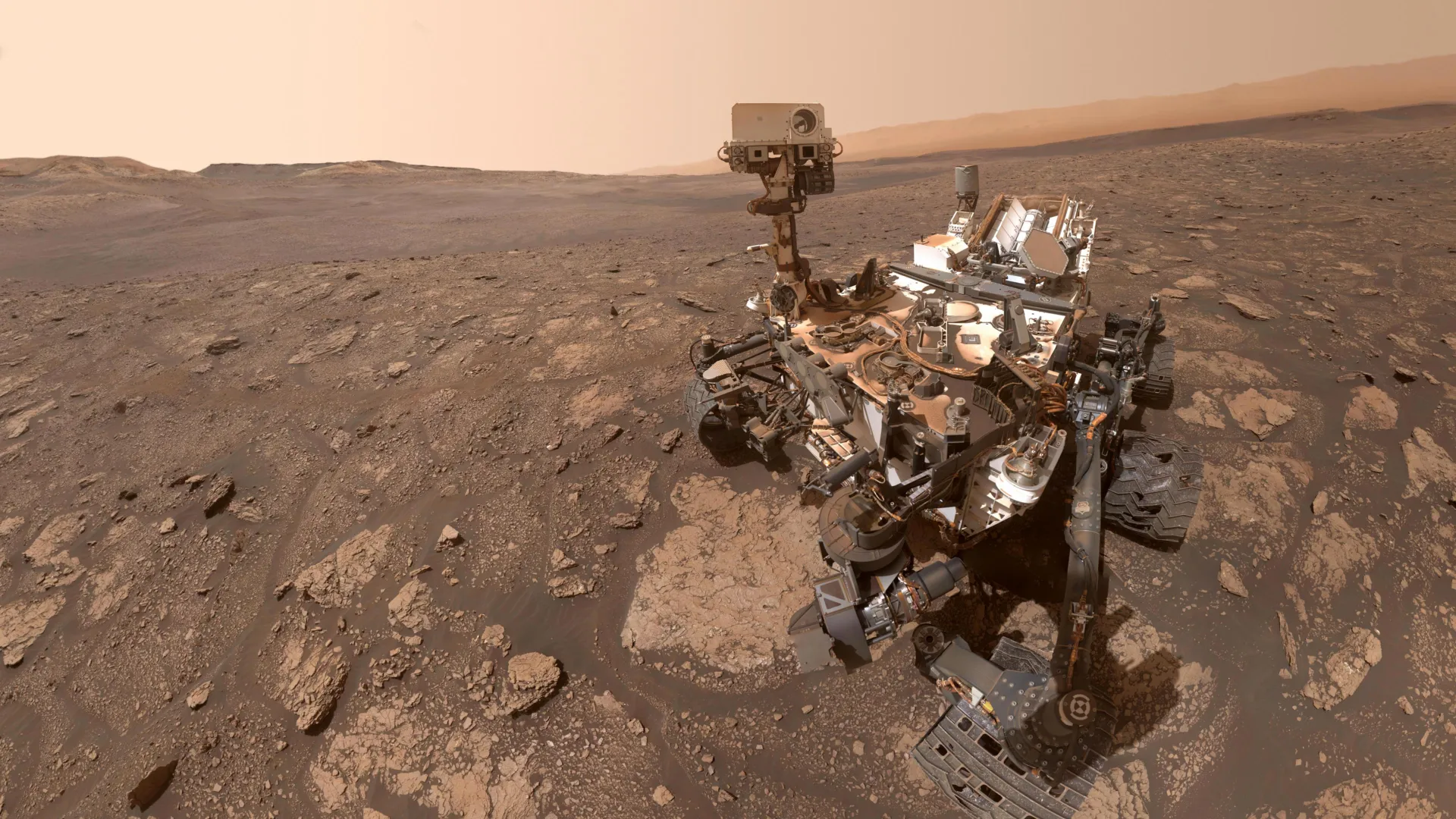
A new scientific analysis suggests that known non biological processes cannot fully explain the amount of organic material discovered in a rock collected on Mars by NASA's Curiosity rover. Organic compounds are carbon containing molecules that form the chemical building blocks of life as we know it. They can be created by living organisms, but some can also form through natural chemical reactions that do not involve life.
Curiosity, which has been exploring Gale Crater since 2012, carries a miniature chemistry lab designed to heat rock samples and analyze the gases they release. Using this onboard laboratory, scientists detected several intriguing compounds in a drilled rock sample.
Largest Organic Molecules Yet Found on Mars
In March 2025, researchers announced they had identified trace amounts of decane, undecane, and dodecane. These are hydrocarbons, meaning they are made only of carbon and hydrogen atoms. They belong to a group of molecules that can be related to fatty acids. Fatty acids are important components of cell membranes in living organisms on Earth, although similar molecules can also form through purely geological reactions under certain conditions.
The rock that contained these compounds is an ancient mudstone located in Gale Crater. Mudstone forms from fine grained sediment that once settled in water, suggesting the area may have hosted lakes billions of years ago. Scientists proposed that the molecules detected by Curiosity could be fragments of fatty acids that were preserved in the rock over vast stretches of time.
Could Meteorites Explain the Mars Organics
Curiosity's instruments can identify molecules, but they cannot directly determine how those molecules formed. Because of this limitation, researchers could not tell whether the compounds were produced by biological activity or by non living chemical processes.
To explore that question, scientists conducted a follow up investigation focused on known non biological sources. One possibility is that meteorites striking Mars delivered organic material to the surface. Meteorites are known to contain carbon based molecules, and impacts have been common throughout Martian history. The team evaluated whether this type of external delivery, along with other abiotic chemical reactions, could account for the levels of organic compounds measured in the sample.
Writing on Feb. 4 in the journal Astrobiology, the researchers reported that the non biological mechanisms they examined could not fully account for the abundance of organic compounds detected by Curiosity. Based on their analysis, they concluded that it is reasonable to consider the possibility that living organisms could have contributed to the formation of these molecules.
This does not mean life has been confirmed on Mars. Instead, it suggests that non living explanations alone may not be sufficient to explain the data.
Reconstructing 80 Million Years of Radiation Exposure
To better understand how much organic material may have originally been present, the scientists combined laboratory radiation experiments, computer simulations, and Curiosity's measurements. Mars lacks a thick atmosphere and a global magnetic field like Earth's, which means its surface is constantly exposed to cosmic radiation. Over time, this radiation can break apart complex molecules.
The team attempted to "rewind the clock" by about 80 million years, which is how long the rock is estimated to have been exposed at the Martian surface. By modeling how radiation gradually destroys organic molecules, they calculated how much material would have existed before being degraded. Their results indicate that the original quantity of organic compounds was likely far greater than what typical non biological processes are known to produce.
More Research Needed on Organic Molecules on Mars
The researchers emphasize that further experiments are necessary to understand how quickly organic molecules break down in Mars like rocks under Mars like environmental conditions. Laboratory studies that better replicate Martian temperatures, radiation levels, and chemistry will help refine these estimates.
Until more data are available, scientists cannot draw firm conclusions about whether these compounds point to past life or can ultimately be explained through chemistry alone. What the findings do show is that the chemical story preserved in Martian rocks may be more complex and more intriguing than previously thought.
Story Source:
Materials provided by NASA’s Goddard Space Flight Center. Original written by Lonnie Shekhtman. Note: Content may be edited for style and length.
Journal Reference:
- Alexander A. Pavlov, Caroline Freissinet, Daniel P. Glavin, Christopher H. House, Jennifer C. Stern, Amy C. McAdam, Anais Roussel, Jason P. Dworkin, Luoth Chou, Andrew Steele, Paul R. Mahaffy, Denise Buckner, Felipe Gomez. Does the Measured Abundance Suggest a Biological Origin for the Ancient Alkanes Preserved in a Martian Mudstone? Astrobiology, 2026; DOI: 10.1177/15311074261417879
Cite This Page: