
Rogue planet moons could harbor alien life for billions of years
Hydrogen atmosphere could keep exomoons habitable for billions of years
- Date:
- May 29, 2026
- Source:
- Ludwig-Maximilians-Universität München
- Summary:
- Scientists say moons around rogue planets wandering through the galaxy could remain warm enough for life thanks to tidal heating and hydrogen-rich atmospheres. These dark, starless worlds may have had stable oceans for billions of years — long enough for complex life to potentially emerge.
- Share:
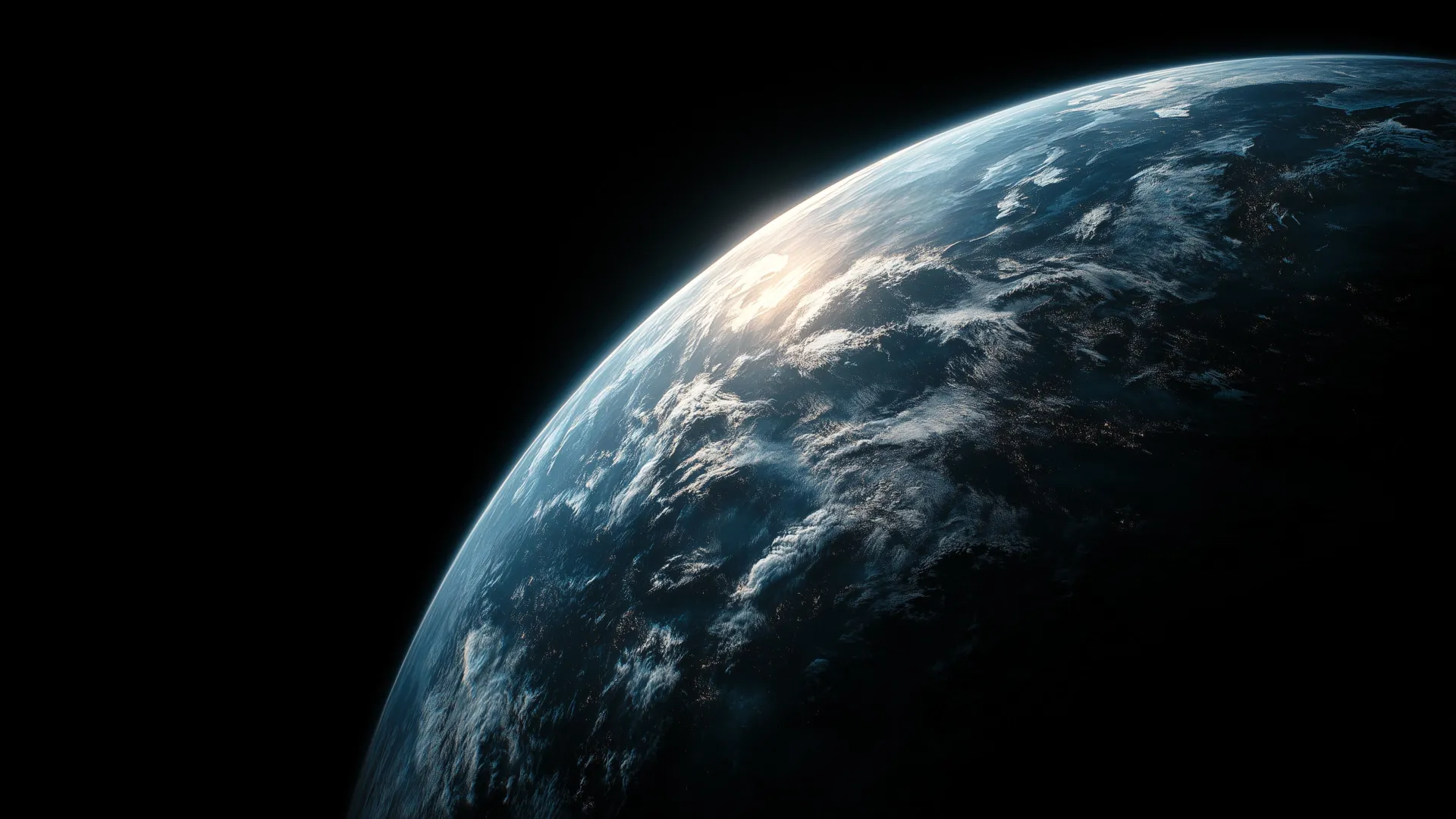
Liquid water is widely considered one of the key ingredients for life. But new research suggests that worlds drifting through the darkness of interstellar space could still remain habitable, even without the warmth of a nearby star.
A team of scientists from the Excellence Cluster ORIGINS at Ludwig Maximilian University of Munich (LMU) and the Max Planck Institute for Extraterrestrial Physics (MPE) found that moons orbiting free floating planets may be able to maintain liquid water oceans for up to 4.3 billion years. According to the researchers, dense hydrogen atmospheres combined with tidal heating could keep these distant moons warm enough for life to potentially develop and evolve over immense stretches of time.
Rogue planets and wandering moons
Planetary systems often form in chaotic environments. During the early stages of development, giant planets can pass dangerously close to one another and sometimes sling neighboring worlds completely out of their solar systems. These expelled worlds are known as free floating planets (FFPs), or rogue planets, because they travel through the galaxy without orbiting a star.
Previous work led by LMU physicist Dr. Giulia Roccetti showed that giant planets ejected from their systems may still retain some of their moons after being thrown into deep space.
Although the moons survive, their orbits can change dramatically. Instead of moving in nearly circular paths, they often end up traveling in highly elongated orbits around their planet.
Tidal heating could keep oceans warm
As these moons move closer to and farther from their planet during each orbit, powerful gravitational forces continuously stretch and squeeze them. This repeated flexing generates internal heat through friction, a process known as tidal heating.
Researchers found that this heat could be strong enough to keep surface oceans from freezing solid, even in the extreme cold of interstellar space where no sunlight is available.
Whether that heat remains trapped near the surface depends heavily on the atmosphere.
On Earth, carbon dioxide acts as an important greenhouse gas that helps retain heat. Earlier studies suggested carbon dioxide rich atmospheres might support habitable conditions on exomoons for up to 1.6 billion years. But in the freezing environments surrounding rogue planets, carbon dioxide would eventually condense and lose much of its warming ability.
Hydrogen atmospheres may trap heat
To solve that problem, the researchers investigated atmospheres rich in hydrogen.
Hydrogen molecules normally allow infrared radiation to pass through easily. However, under extremely high pressure, collisions between hydrogen molecules create temporary molecular interactions that can absorb and trap thermal radiation. This effect is called collision induced absorption.
Because hydrogen remains stable at very low temperatures, the researchers found it could act as an effective insulating blanket around these moons, helping them hold onto heat for billions of years.
Clues about the origin of life
The findings may also offer insights into how life first emerged on Earth.
"Our collaboration with the team of Professor Dieter Braun helped us recognize that the cradle of life does not necessarily require a sun," says David Dahlbüdding, doctoral researcher at LMU and lead author of the study. "We discovered a clear connection between these distant moons and the early Earth, where high concentrations of hydrogen through asteroid impacts could have created the conditions for life."
The researchers also suggest tidal forces may drive important chemical activity. Constant stretching and compression of a moon can create recurring wet dry cycles where water repeatedly evaporates and condenses. Scientists believe these cycles may help produce complex molecules that are essential for life.
Hidden habitable worlds across the galaxy
Astronomers believe rogue planets may be extremely common throughout the Milky Way. Some estimates suggest there could be as many free floating planets as stars in our galaxy.
If many of those planets also host moons, the number of possible environments where life could exist may be far larger than previously thought. The new study suggests that habitable worlds may not need sunlight at all and that life could potentially arise and survive even in the darkest regions of space.
Story Source:
Materials provided by Ludwig-Maximilians-Universität München. Note: Content may be edited for style and length.
Journal Reference:
- David Dahlbüdding, Tommaso Grassi, Karan Molaverdikhani, Giulia Roccetti, Barbara Ercolano, Dieter Braun, Paola Caselli. Habitability of tidally heated H2-dominated exomoons around free-floating planets. Monthly Notices of the Royal Astronomical Society, 2026; 548 (2) DOI: 10.1093/mnras/stag243
Cite This Page: