
The missing notebooks that solved a 55-million-year-old fossil mystery
- Date:
- June 12, 2026
- Source:
- University of Otago
- Summary:
- A spectacular fossil fish discovered on a remote cliff in New Zealand nearly 30 years ago has finally revealed its full story thanks to an unexpected discovery: the original collector’s long-lost field notebooks. The 1.2-meter fossil, preserved in stunning three-dimensional detail, belonged to an ancient tarpon-like predator that cruised New Zealand waters about 55 million years ago.
- Share:
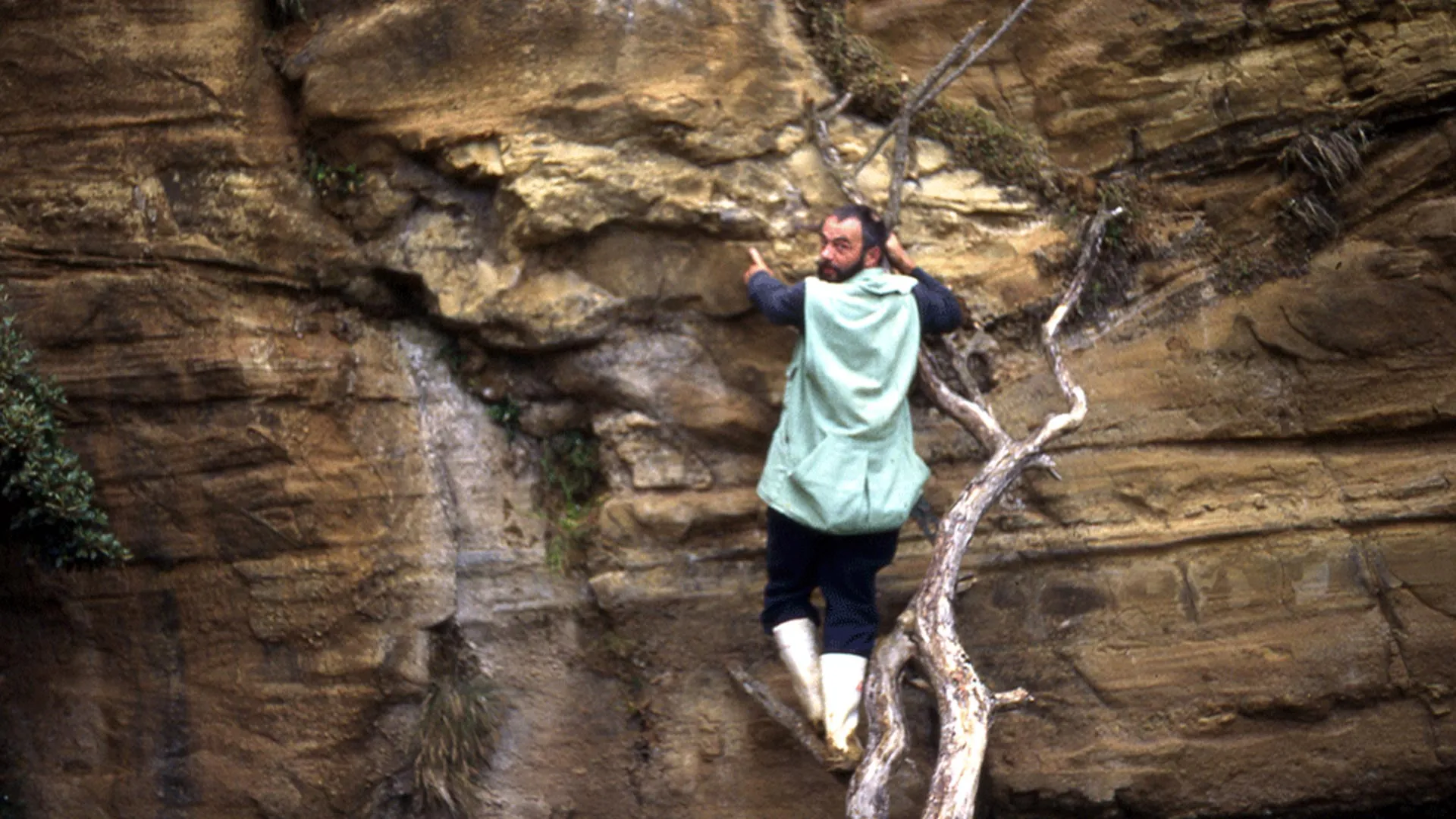
Field notebooks recently recovered from a late paleontologist have provided the crucial missing details researchers needed to complete a study of a remarkable fossil fish discovered nearly three decades ago.
The story began in 1999 when Dr. Richard Köhler uncovered the fossil during a research expedition to Pitt Island in the Chatham Islands.
While exploring the island's western coastline above Waihere Bay, Köhler spotted a three-dimensionally preserved, mummified fish fossil embedded in a steep section of cliff that was almost impossible to reach.
To recover it, he walked 3km back to his lodging in Flowerpot Bay to borrow a ladder. He then returned to the site and carefully extracted the fossil in several large, extremely heavy blocks.
Once back in Dunedin, Köhler brought the specimen to the University of Otago's Department of Geology. Emeritus Professor Daphne Lee recalls that she and the late Professor Ewan Fordyce immediately recognized its significance.
"It was quite unlike any other fish fossil known from Aotearoa, New Zealand," Daphne says.
Remarkable Ancient Predator Identified
The fossil was painstakingly prepared by the late fossil preparator Andrew Grebneff and remained in the Department's collection for several years. Eventually, it attracted the attention of Professor Mike Gottfried, a fossil fish specialist from Michigan State University.
Mike had previously collaborated with Ewan on several studies involving fossil fishes and sharks from New Zealand, and he soon began investigating the unusual specimen.
Researchers determined that the 1.2m long mummified fish was a tarpon, a species no longer found in New Zealand waters.
Modern tarpon are large predatory fish that typically swallow smaller fish whole. The fossil's anatomy suggests it lived in much the same way. Its elongated body, thick rigid scales, powerful tail fin, and large upward-facing mouth all point to an active predator near the top of the food chain.
Missing Information Delays Research
Despite the importance of the fossil, researchers faced a major obstacle.
Critical geological information about the exact discovery site was missing, and Richard had passed away several years earlier.
By the time Ewan died in November 2023, a draft scientific paper had already been prepared. However, work on the study could not move forward because researchers lacked the detailed field information needed to properly document where and how the fossil had been found.
The breakthrough came in early 2025 when one of Richard's children, who was studying at Otago, visited the Department hoping to locate photographs of his father.
After meeting with Daphne, Richard's family decided to donate his field notebooks, including those from the original Pitt Island expedition.
"This enabled us to get enough specific locality information to prepare a Fossil Record Form and to scientifically catalogue the fossil," Daphne says.
New Fossil Species Named
The completed study was recently published in the New Zealand Journal of Geology and Geophysics.
According to the researchers, it represents the first report of a high-in-the-food-chain pursuit predatory bony fish from rocks of Paleogene age (around 55 million years ago) in Aotearoa.
The fossil was given the name Ikawaihere koehleri in honor of Richard Köhler and the location where it was discovered. The authors also thanked Heidi Lanauze and the Hokotehi Moriori Trust for approving the name.
Mike says it was a privilege to work on the "remarkable fossil."
"It greatly expands our knowledge of the evolutionary history of tarpons, and it preserves unique and unusual features in exquisite 3D detail," he says.
"It is certainly among the most important and impressive fossils recovered to date from Aotearoa, New Zealand."
Daphne says she is delighted that the study has finally reached completion.
"It is a fitting tribute to Richard, Ewan and Andrew. We're extremely grateful to Richard's family for donating his notebooks -- we could not have done this without them."
Story Source:
Materials provided by University of Otago. Note: Content may be edited for style and length.
Journal Reference:
- Michael D. Gottfried, R. Ewan Fordyce, Jeffrey H. Robinson, Daphne E. Lee. A New Tarpon‐Like Fish (Elopomorpha, Megalopidae) With Exceptional Preservation and Unusual Features From the Paleogene of Pitt Island, Chatham Islands, New Zealand. New Zealand Journal of Geology and Geophysics, 2026; 69 (1) DOI: 10.1002/jgo2.70022
Cite This Page: