
Fossil feet may be misleading scientists about human evolution
Surprisingly agile monkeys are forcing scientists to rethink how the ancient ancestor of humans and chimpanzees may have climbed through the trees.
- Date:
- August 31, 2026
- Source:
- Ohio State University
- Summary:
- Wild monkeys in West Africa can climb vertical tree trunks using foot flexibility scientists did not realize they possessed. The discovery challenges a key assumption about what the last common ancestor of humans and chimpanzees looked like and how it moved.
- Share:
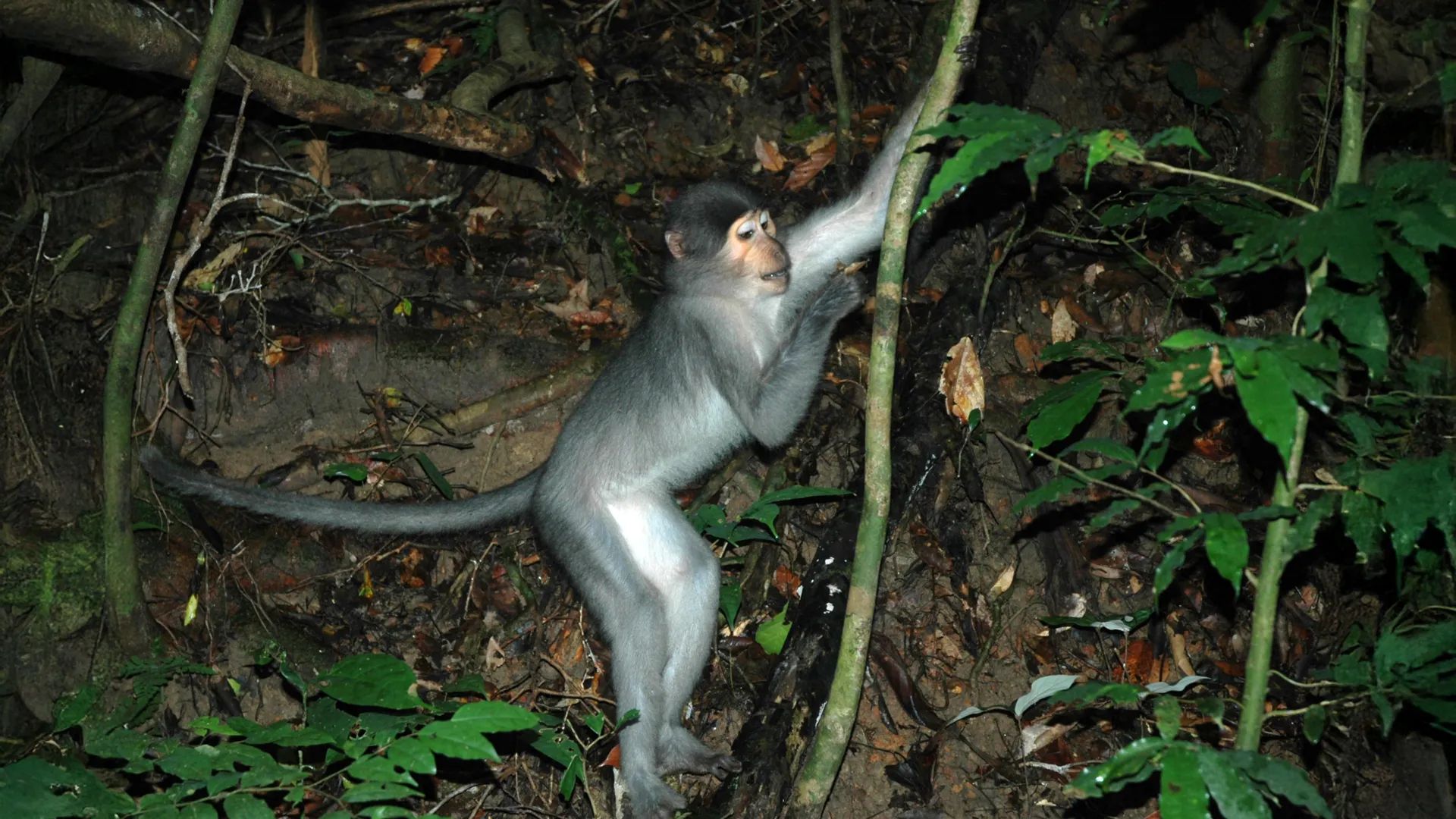
New research suggests that whatever scientists ultimately discover about the last common ancestor of humans and chimpanzees, one characteristic may be difficult to dispute: it was probably capable of climbing trees.
Humans and chimpanzees went their separate evolutionary ways between 6 and 7 million years ago, when they diverged from the last common ancestor (LCA) they once shared. Reconstructing that ancestor has become an important part of understanding human evolution, including the emergence of walking on two legs.
One major question concerns where and how the LCA moved through forests. Did it spend much of its time among high horizontal branches, climb vertically from the ground, or combine both behaviors?
Rethinking What Feet Reveal About Climbing
Chimpanzees are highly capable tree trunk climbers, aided by ankles that can flex much farther than human ankles. Monkeys, by contrast, have often been viewed as relying more heavily on their arms to move through trees. That distinction has influenced ideas about whether the human-chimpanzee ancestor should have possessed feet more like those of modern apes or monkeys.
New video evidence from West Africa is challenging that assumption.
Researchers from The Ohio State University studied wild sooty mangabey monkeys, whose feet do not have the same highly flexible ankles found in chimpanzees. Detailed observations and measurements showed that the monkeys can nevertheless bend parts of their feet enough to climb narrow vertical tree trunks while seeking food, hiding or finding places to sleep.
"People are making behavioral inferences from fossils, and some say a monkey can't vertically climb as well as an ape can," said first study author Luke Fannin, assistant professor of anthropology at Ohio State. "We're saying there's a functional equivalence here. So you can't rule out vertical climbing just because something doesn't have a chimpanzee-like foot."
The research appears this week in Proceedings of the National Academy of Sciences.
A New Clue to Human Evolution
Determining what the LCA looked like and how it moved could help researchers understand the evolutionary steps that eventually produced habitual bipedalism, a form of movement practiced regularly only by humans.
Humans are apes, but the new findings suggest that an ancestor with feet resembling those of monkeys might still have been capable of climbing in ways comparable to modern apes.
"Part of paleoanthropology is understanding how our evolution happened, and it's often through the hallmark of how we move because modern humans move quite differently than our cousins, the chimpanzees, do, and they're the living primate we're most closely related to," Fannin said. "And we're trying to understand why that is."
Fannin collected video of wild mangabeys at the Taï Forest Monkey Project field station in Ivory Coast. The project is co-directed by W. Scott McGraw, professor and chair of anthropology at Ohio State and senior author of the study.
"The great thing about having the video is that it allows us to capture exactly what the monkey is doing in a high-resolution manner. So we can actually say how the joint is loaded. Before, we had hunches, but in this way, it's far more precise," McGraw said.
Monkeys Show Unexpected Foot Flexibility
During a tree climb, a chimpanzee ankle can flex upward by about 45 degrees. Most human ankles, in comparison, can flex by roughly 20 degrees.
The mangabeys achieved something surprisingly similar through a different part of the foot. Fannin measured as much as 46 degrees of flexion in the animals' midfoot while they climbed vertically.
That finding complicates competing ideas about how the LCA traveled through forest environments. Some theories have suggested that an ape-like foot was necessary for effective vertical climbing, while others allow for an ancestor with a more monkey-like foot.
"What's neat about this paper is it adds clarity, but it also makes the broader picture more fuzzy," McGraw said. "Because this notion that you have to have a foot like an advanced ape to vertically climb, which is a difficult task, is not true. You've got a bunch of monkeys that aren't extinct - and which can be filmed - that are very competent at performing a biomechanically challenging behavior right now in a forest in West Africa.
"The videos that Luke made in Taï are particularly important because they provide some of the first kinematic documentation of a locomotor behavior in a monkey that has largely been unrecognized or underappreciated."
Humans Still Carry a Connection to Trees
Vertical climbing is not limited to nonhuman primates. Some modern hunter-gatherers and human foragers are also highly capable climbers. In humans, however, that ability is thought to depend more heavily on flexible ligaments, tendons, and muscles than on the structure of the foot bones.
Fannin and McGraw also point out that although walking on two feet is one of the defining characteristics of modern humans, climbing remains part of human behavior. Our tendency to ascend and reach higher places may reflect a deep ancestral relationship with trees that extends beyond anatomy alone.
"Arboreality is fundamental to understanding primates - including ourselves - because it has shaped our body to a large degree: hands and feet, wrists and ankles, nails instead of claws, etc.," McGraw said.
Added Fannin, "Regardless of where you're starting from, which we don't know yet, vertical climbing is universal, and the anatomy is going to perform that behavior. So I think that to get at the question of a monkey-like or ape-like last common ancestor, we need more fossils."
The research was supported by Dartmouth College, the Explorer's Club, the U.S. National Science Foundation, the Emory National Primate Research Center, the Primate Society of Great Britain and a Schmidt Sciences Postdoctoral Fellowship.
Former Ohio State undergraduate Carmen Pape was also a co-author.
Story Source:
Materials provided by Ohio State University. Original written by Emily Caldwell. Note: Content may be edited for style and length.
Journal Reference:
- Luke D. Fannin, Carmen Pape, W. Scott McGraw. A kinematic convergence in ape and monkey vertical climbing informs debates on early hominin arborealism. Proceedings of the National Academy of Sciences, 2026; 123 (35) DOI: 10.1073/pnas.2608183123
Cite This Page: