
SpaceX just delivered some very strange cargo to the International Space Station
- Date:
- October 16, 2026
- Source:
- NASA
- Summary:
- SpaceX just delivered some surprisingly strange cargo to the International Space Station, including tiny brain models, 3D heart tissue, and technology for making artificial retinas in space. Scientists hope these experiments could unlock new ways to treat devastating brain diseases, restore eyesight, and test future medicines. The shipment also includes materials for creating unusual glass in near weightlessness and the station’s final upgraded solar arrays.
- Share:
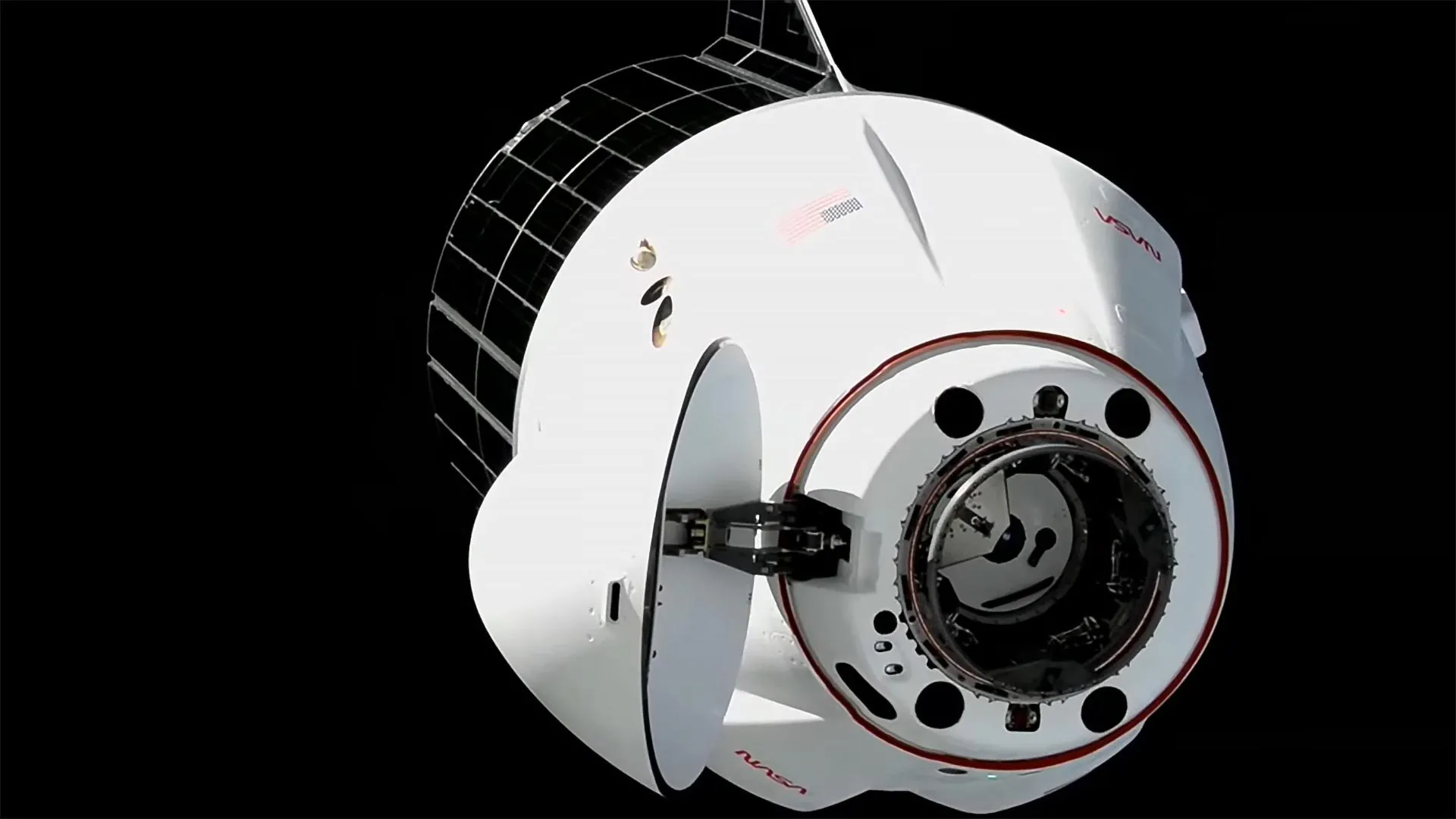
SpaceX's Dragon spacecraft arrived at the International Space Station at 10:27 a.m. EDT on October 15, docking at the space-facing port of the station's Harmony module. The spacecraft delivered more than 6,300 pounds of food, essential supplies, and scientific equipment for the Expedition 75 crew.
The arrival marks SpaceX's 35th commercial resupply mission to the orbiting laboratory under its contract with NASA. Along with everyday necessities for the astronauts, Dragon brought an unusual collection of scientific experiments that could help researchers develop new medical treatments and better understand how materials behave in space.
Artificial Retinas, Brain Research, and New Solar Arrays
Among the most important items aboard Dragon is the final set of International Space Station Roll-Out Solar Arrays, known as IROSAs. These solar panels are designed to expand the station's ability to generate electricity, providing additional power for its operations and scientific research. Installation is planned for later this fall.
The spacecraft also delivered equipment for manufacturing artificial retinas in microgravity, the condition of near weightlessness experienced aboard the space station. Researchers hope that producing these structures in space could eventually lead to technologies that help restore vision for people on Earth.
Other experiments include 3D heart tissue models, which recreate important features of human heart tissue. Scientists plan to use these models to advance methods for testing large numbers of potential drugs during future space missions.
Dragon also transported materials for investigating how a new type of glass forms in microgravity. Studying the process without the usual influence of Earth's gravity could provide insights into how the material develops and behaves.
Another experiment involves brain organoids, tiny three-dimensional models of brain tissue grown from cells. These miniature models allow scientists to investigate aspects of brain biology that can be difficult to study directly in humans. Researchers hope the findings will reveal potential targets for treating neurological conditions, including Alzheimer's disease, Parkinson's disease, and multiple sclerosis.
Dragon's Return to Earth
Dragon is expected to remain docked at the space station until mid-November. After completing its stay, the spacecraft will carry time-sensitive research materials and other cargo back to Earth, ending its journey with a splashdown in the Pacific Ocean off the California coast.
The mission began on October 13 at 6:33 a.m. EDT, when a SpaceX Falcon 9 rocket lifted off from Space Launch Complex 40 at Cape Canaveral Space Force Station in Florida.
Cite This Page: