
Giant sea monsters lived in rivers at the end of the dinosaur age
The discovery paints a striking picture of flexible super-predators adjusting to a rapidly changing world just before mass extinction struck.
- Date:
- December 15, 2025
- Source:
- Uppsala University
- Summary:
- Giant mosasaurs, once thought to be strictly ocean-dwelling predators, may have spent their final chapter prowling freshwater rivers alongside dinosaurs and crocodiles. A massive tooth found in North Dakota, analyzed using chemical isotope techniques, reveals that some mosasaurs adapted to river systems as seas gradually freshened near the end of the age of dinosaurs. These enormous reptiles, possibly as long as a bus, appear to have hunted near the surface, perhaps even feeding on drowned dinosaurs.
- Share:
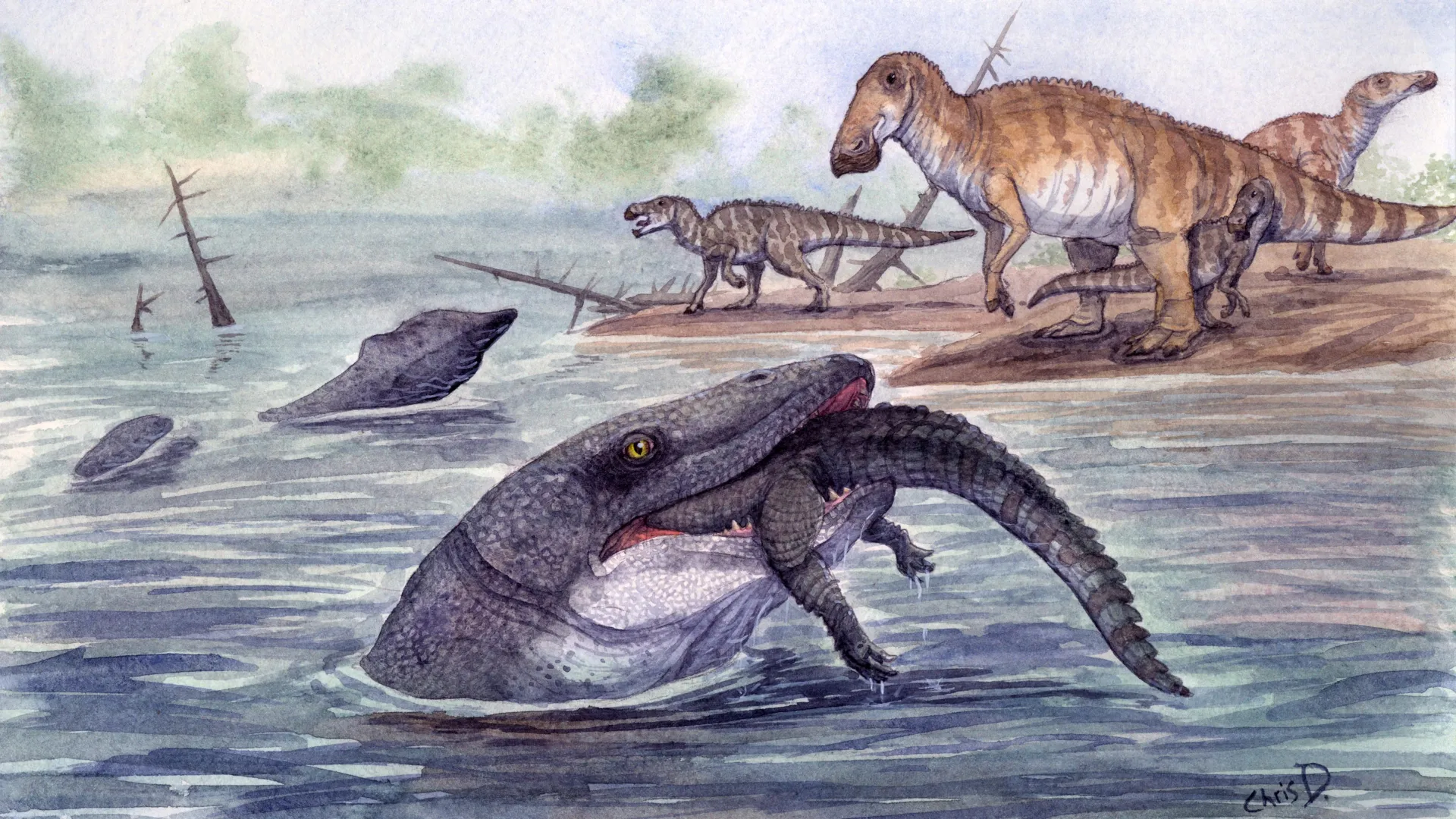
Mosasaurs were enormous marine reptiles that lived more than 66 million years ago, but new evidence shows they did not spend all their time in the ocean. Researchers analyzing a mosasaur tooth discovered in North Dakota have found strong signs that some of these animals lived in rivers. The tooth likely came from an individual that grew up to 11 meters long. Led by scientists at Uppsala University, the international research team concluded that mosasaurs adapted to freshwater river systems during the final million years before their extinction.
The tooth was uncovered in 2022 from a river deposit in North Dakota. It was found alongside a tooth from a Tyrannosaurus rex and a jawbone from a crocodylian, in a region already known for fossils of the duck-billed dinosaur Edmontosaurus. The unusual mix of land dinosaurs, river-dwelling crocodiles, and a giant marine reptile immediately stood out. If mosasaurs were ocean animals, how did one of their teeth end up preserved in a river?
Isotopes Provide the Answer
To solve this puzzle, researchers from the United States, Sweden, and the Netherlands examined the chemical makeup of the mosasaur tooth enamel using isotope analysis.
Because the mosasaur tooth, the T. rex tooth, and the crocodylian jawbone all date to roughly the same time, about 66 million years ago, the scientists could directly compare their chemistry. The work was carried out at the Vrije Universiteit (VU) in Amsterdam and focused on isotopes of oxygen, strontium, and carbon. The mosasaur tooth contained unusually high levels of the lighter oxygen isotope (16O), which is typical of freshwater environments rather than marine ones. Strontium isotope ratios also pointed to a freshwater habitat.
"Carbon isotopes in teeth generally reflect what the animal ate. Many mosasaurs have low 13C values because they dive deep. The mosasaur tooth found with the T. rex tooth, on the other hand, has a higher 13C value than all known mosasaurs, dinosaurs and crocodiles, suggesting that it did not dive deep and may sometimes have fed on drowned dinosaurs," says Melanie During, one of the study's corresponding authors.
"The isotope signatures indicated that this mosasaur had inhabited this freshwater riverine environment. When we looked at two additional mosasaur teeth found at nearby, slightly older, sites in North Dakota, we saw similar freshwater signatures. These analyses shows that mosasaurs lived in riverine environments in the final million years before going extinct," says During.
When Seas Slowly Turned Into Rivers
The findings also help explain how this lifestyle shift became possible. Over time, increasing amounts of freshwater flowed into the Western Interior Seaway, a vast inland sea that once ran north to south across what is now central North America and split the continent in two. As freshwater input grew, the seaway gradually changed from salty to brackish and eventually to mostly freshwater, similar to conditions seen today in the Gulf of Bothnia. The researchers suggest this process created a 'halocline', with lighter freshwater forming a surface layer above denser saltwater. Isotope data supports this idea.
"For comparison with the mosasaur teeth, we also measured fossils from other marine animals and found a clear difference. All gill-breathing animals had isotope signatures linking them to brackish or salty water, while all lung-breathing animals lacked such signatures. This shows that mosasaurs, which needed to come to the surface to breathe, inhabited the upper freshwater layer and not the lower layer where the water was more saline," says Per Ahlberg, coauthor of the study and promotor of Dr. During.
Adapting to a Changing World
The researchers argue that the teeth studied clearly belonged to mosasaurs that had adjusted to these new conditions. Large predators shifting between habitats is not unheard of in evolutionary history.
"Unlike the complex adaptation required to move from freshwater to marine habitats, the reverse adaptation is generally simpler," says During.
Modern animals show similar flexibility. River dolphins live entirely in freshwater even though their ancestors were marine. The estuarine crocodile, known in Australia as the saltwater crocodile, regularly moves between rivers and the open ocean, hunting wherever prey is available.
A Bus-Sized Predator in Unexpected Places
Mosasaur fossils are common in marine deposits across North America, Europe, and Africa dating from 98-66 million years ago. In contrast, they are rarely found in North Dakota, making this discovery especially striking. The size of the tooth suggests an animal up to 11 meters long, roughly the length of a bus. Earlier discoveries of mosasaur bones at a nearby site support this estimate. The tooth likely belonged to a prognathodontine mosasaur, although its exact genus cannot be identified. Close relatives in the genus Prognathodon had massive heads, powerful jaws, and robust teeth, and are thought to have been opportunistic predators capable of attacking large prey.
"The size means that the animal would rival the largest killer whales, making it an extraordinary predator to encounter in riverine environments not previously associated with such giant marine reptiles," says Ahlberg.
The research was carried out by scientists from Uppsala University in collaboration with Eastern West Virginia Community and Technical College, Moorefield, West Virginia, Vrije Universiteit Amsterdam, and the North Dakota Geological Survey. The article draws on a chapter from Melanie During's doctoral thesis, which she defended at Uppsala University in November 2024.
Story Source:
Materials provided by Uppsala University. Note: Content may be edited for style and length.
Journal Reference:
- Melanie A. D. During, Nathan E. Van Vranken, Clint A. Boyd, Per E. Ahlberg, Suzan J. A. Warmerdam-Verdegaal, Jeroen H. J. L. Van der Lubbe. “King of the Riverside”, a multi-proxy approach offers a new perspective on mosasaurs before their extinction. BMC Zoology, 2025; 10 (1) DOI: 10.1186/s40850-025-00246-y
Cite This Page: