
This walking robot could change how we search for life on Mars
A new semi-autonomous robot could transform space exploration—scanning more rocks, faster, and uncovering clues to life and resources in record time.
- Date:
- April 8, 2026
- Source:
- Frontiers
- Summary:
- Planetary exploration may be about to get a major speed boost. Researchers tested a semi-autonomous robot that can move from rock to rock, analyzing each without waiting for human instructions. The system completed missions up to three times faster than traditional methods while still accurately identifying important geological targets. This could allow future missions to cover far more ground in the search for resources and signs of life.
- Share:
Planetary missions on the surface of Mars are carried out with extreme caution. Communication delays between Earth and robotic explorers can range from four to 22 minutes, and limited data transmission capacity adds another layer of constraint. Because of this, scientists must carefully plan each step in advance. Rovers are also built to conserve energy and avoid hazards, so they move slowly across rough terrain. Most travel only a few hundred meters per day, which limits how much of the landscape they can study and makes it harder to gather a wide range of geological data.
Researchers explored a new strategy designed to overcome these limitations. Instead of relying on constant human direction, they tested a semi-autonomous robot capable of moving from one target to another and collecting data on its own. Equipped with compact instruments, the robot could examine multiple rocks in sequence and perform measurements independently.
The results showed a major improvement in efficiency. Rather than focusing on a single rock under continuous supervision, the robot could navigate to several locations and analyze each one. This approach significantly accelerated both resource prospecting and the search for 'biosignatures' (ie, evidence of life) on planetary surfaces.
The team wanted to know whether a robot carrying a relatively simple set of instruments could still produce meaningful scientific results while working quickly. The findings confirmed that even compact tools were sufficient to meet key objectives, including identifying rocks important for astrobiology and resource exploration.
Testing a Legged Robot in Mars-Like Conditions
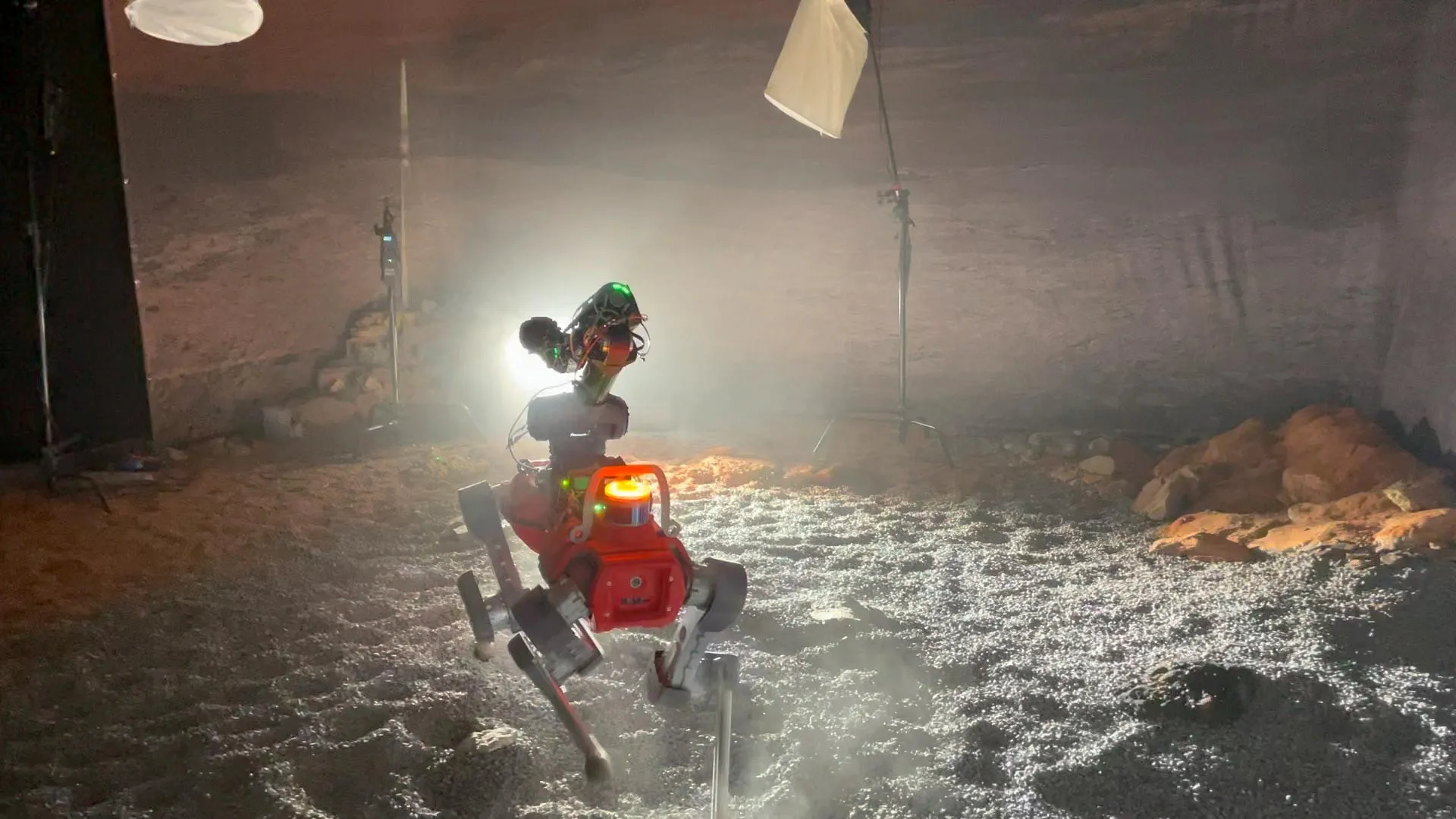
To demonstrate this concept, the researchers used the four-legged robot 'ANYmal.' It was equipped with a robotic arm holding two instruments: the microscopic imager MICRO and a portable Raman spectrometer developed for the ESA-ESRIC Space Resources Challenge. The project involved collaboration with the Robotic Systems Lab at ETH Zurich, ETH Zurich | Space, the University of Zurich, and the University of Bern.
Experiments took place at the 'Marslabor' facility at the University of Basel. This environment simulates planetary surface conditions using analogue rocks, 'regolith' (ie, planetary dust) materials, and analog lighting conditions. During the tests, the robot moved autonomously toward selected targets, positioned its instruments using the robotic arm, and transmitted images and spectral data for analysis.
The system successfully identified a variety of rock types that are important for planetary science. These included gypsum, carbonates, basalts, dunite, and anorthosite. Many of these materials are especially valuable for future missions. For example, lunar-analog rocks such as dunite (rich in olivine and oxides), anorthosite (containing anorthite), and oxides such as rutile could point to useful resources.
Faster Results With Multi-Target Exploration
The researchers compared two methods: a traditional approach in which scientists guide the robot to a single target, and a semi-autonomous approach where the robot investigates multiple targets in sequence.
The difference in speed was striking. Multi-target missions were completed in just 12 to 23 minutes, while a comparable human-guided mission took 41 minutes.
Even with this faster pace, the robot maintained strong scientific performance. In one test, it correctly identified every selected target.
This method could allow future missions to scan much larger areas of planetary surfaces in a shorter time. Scientists would then review the incoming data and decide which locations deserve closer study.
By reducing the need for constant human input, robots could move more freely across terrain, analyze rocks quickly, and gather valuable data. This would enable faster scientific progress and help researchers focus on the most promising samples.
Preparing for Future Missions to the Moon and Mars
The study demonstrates that smaller, simpler instruments can still deliver valuable scientific insights when paired with autonomous robotic systems. Instead of depending entirely on large and complex equipment, future missions could use agile robots to quickly survey their surroundings and identify high-priority targets.
As space agencies plan new missions to the Moon, Mars, and beyond, semi-autonomous robots like this could play a key role. By covering more ground in less time, they could improve both resource prospecting and the search for signs of past life.
Story Source:
Materials provided by Frontiers. Note: Content may be edited for style and length.
Journal Reference:
- Gabriela Ligeza, Philip Arm, Tomaso R. R. Bontognali, Valentin T. Bickel, Hendrik Kolvenbach, Nikolaus J. Kuhn, Florian Kehl. Semi-autonomous exploration of martian and lunar analogues with a legged robot using a Raman-equipped robotic arm and microscopic imager. Frontiers in Space Technologies, 2026; 7 DOI: 10.3389/frspt.2026.1741757
Cite This Page: