
Einstein Probe may have caught a black hole tearing apart a white dwarf for the first time
- Date:
- June 25, 2026
- Source:
- The University of Hong Kong
- Summary:
- Astronomers may have witnessed one of the rarest and most dramatic cosmic events ever seen: a long-sought intermediate-mass black hole ripping apart a dense white dwarf star and devouring it. The Einstein Probe space telescope caught the explosion in its earliest moments, revealing an unusual sequence of intense X-ray flashes unlike anything seen in a typical gamma-ray burst.
- Share:
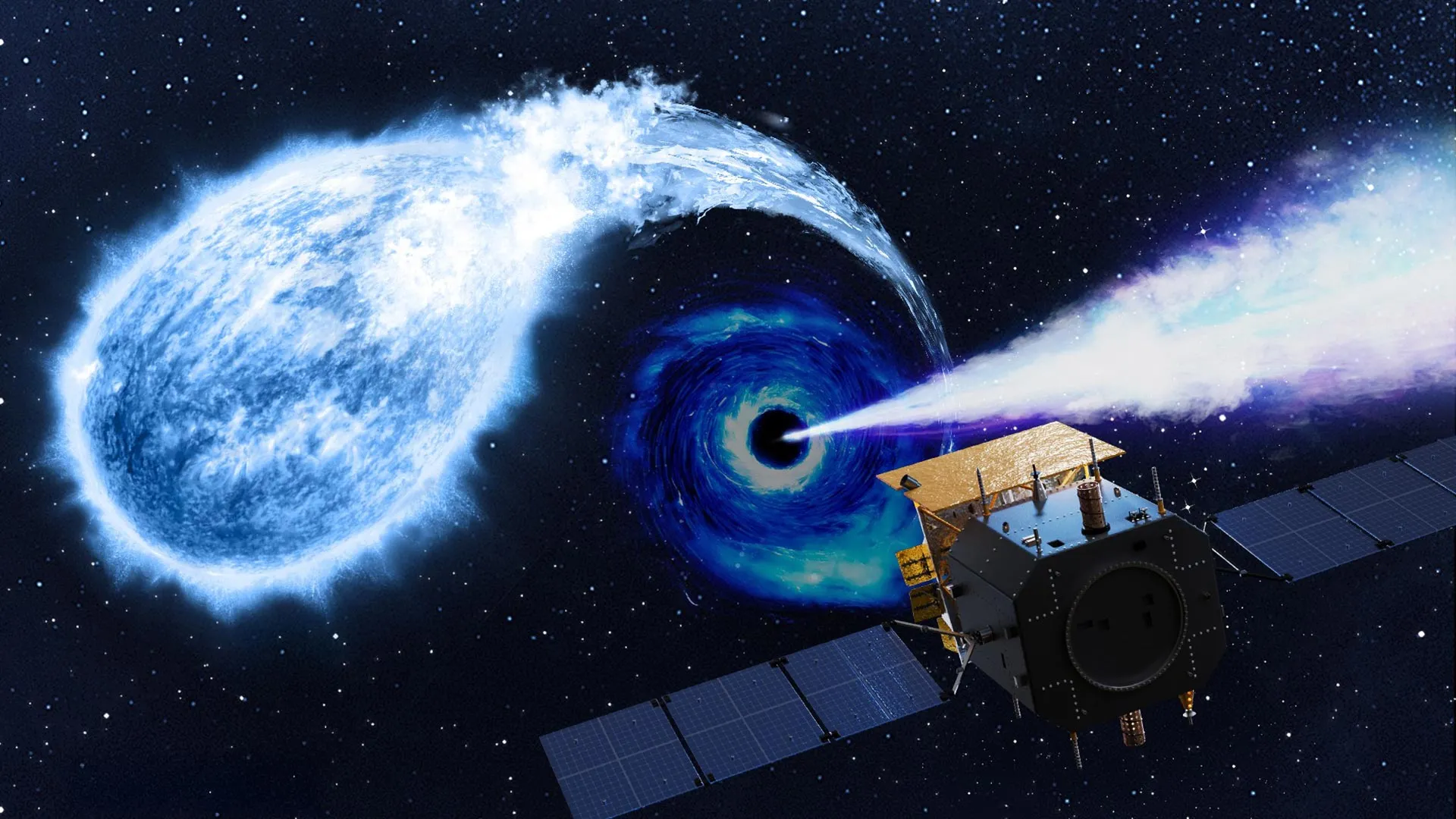
An extraordinary high-energy event detected deep in space is giving astronomers a rare opportunity to study some of the Universe's most extreme phenomena.
On July 2, 2025, the China-led Einstein Probe (EP) space telescope spotted an exceptionally bright X-ray source during a routine survey of the sky. The object's brightness changed rapidly, making it immediately stand out from typical cosmic X-ray sources. The unusual detection prompted observatories around the world to begin follow-up observations.
The research was coordinated by the EP Science Center at the National Astronomical Observatories, Chinese Academy of Sciences (NAOC), with scientists from research institutions in China and several other countries contributing to the effort. Researchers from the Department of Physics at The University of Hong Kong (HKU), who are key members of the Einstein Probe scientific collaboration, helped interpret the observations. Their analysis suggests the event may represent an intermediate-mass black hole tearing apart and consuming a white dwarf star. If confirmed, it would provide the first direct observational evidence of this type of black hole feeding event. The results were published as the cover article in Science Bulletin.
Einstein Probe Detects an Unusual Cosmic Explosion
The discovery relied on the Einstein Probe's two complementary X-ray instruments.
During its routine survey on July 2, 2025, the mission's Wide-field X-ray Telescope (WXT), which combines advanced lobster-eye micro-pore optics with a very wide field of view and high sensitivity, detected a rapidly changing X-ray source that was later designated EP250702a (also known as GRB 250702B). At nearly the same time, NASA's Fermi Gamma-ray Space Telescope detected several gamma-ray bursts coming from the same region of the sky.
Scientists realized the event was far more unusual after reviewing earlier WXT observations. The telescope had already detected steady X-ray emission from the same location roughly a day before the gamma-ray bursts appeared, a sequence rarely associated with powerful cosmic explosions. Around 15 hours after the initial detection, the source erupted into a series of intense X-ray flares. At its brightest, it reached a luminosity of approximately 3 × 1049 erg s-1, making it one of the brightest instantaneous outbursts ever recorded in the Universe.
"This early X-ray signal is crucial," said Dr. Dongyue Li, first author of the paper from the National Astronomical Observatories of China. "It tells us this was not an ordinary gamma-ray burst."
Rare X-Ray Signal Points to a Black Hole Feeding Event
Using the precise location measured by WXT, astronomers quickly directed major telescopes around the world toward the source. Observations across multiple wavelengths confirmed that the object was located on the outskirts of a distant galaxy. The Einstein Probe's second instrument, the Follow-up X-ray Telescope (FXT), then monitored the event as it evolved.
Over roughly 20 days, the object's brightness faded by more than a factor of 100,000. During that time, its X-ray emission also shifted from higher-energy ("hard") X-rays to lower-energy ("soft") X-rays.
After combining Einstein Probe observations with data collected across the electromagnetic spectrum, researchers found that EP250702a displayed several characteristics that existing models struggled to explain. Its X-ray emission began before the gamma-ray burst, it reached extraordinary brightness, evolved unusually quickly, and occurred in the outer region of its host galaxy instead of near the galaxy's center, a combination that is rarely seen in known high-energy cosmic events. After evaluating multiple possible explanations, one scenario emerged as the strongest candidate: an intermediate-mass black hole tearing apart and consuming a white dwarf star.
Story Source:
Materials provided by The University of Hong Kong. Note: Content may be edited for style and length.
Journal Reference:
- Dongyue Li, Wenda Zhang, Jun Yang, Jin-Hong Chen, Weimin Yuan, Huaqing Cheng, Fan Xu, Xinwen Shu, Rong-Feng Shen, Ning Jiang, Jiazheng Zhu, Chang Zhou, Weihua Lei, Hui Sun, Chichuan Jin, Lixin Dai, Bing Zhang, Yu-Han Yang, Wenjie Zhang, Hua Feng, Bifang Liu, Hongyan Zhou, Haiwu Pan, Mingjun Liu, Stéphane Corbel, Sitha K. Jagan, Maria Cristina Baglio, Christopher R. Burns, Floriane Cangemi, Chun Chen, Yehao Cheng, Alexis Coleiro, Francesco Coti Zelati, Sourya R. Das, Zhongnan Dong, Luis Galbany, Noa Grollimund, Daniel Kelson, Dong Lai, Xia Li, Yuan Liu, Alessio Marino, Brenna Mockler, Paul O’Brien, Erlin Qiao, Nanda Rea, L. Resmi, Jérome Rodriguez, Richard Saxton, Luming Sun, Lian Tao, Tinggui Wang, Yilong Wang, Xuefeng Wu, Dong Xu, Yijia Zhang, Guoying Zhao, Congying Bao, Zhiming Cai, Yehai Chen, Yong Chen, Bertrand Cordier, Chenzhou Cui, Weiwei Cui, Zhou Fan, He Gao, Giancarlo Ghirlanda, Ju Guan, Dawei Han, Jinxin Hao, Jingwei Hu, Maohai Huang, Yong-Feng Huang, Shumei Jia, Ge Jin, Stefanie Komossa, Chengkui Li, Zhixing Ling, Congzhan Liu, Heyang Liu, Huaqiu Liu, Fangjun Lu, Kirpal Nandra, Jan-Uwe Ness, Arne Rau, Jeremy Sanders, Liming Song, Roberto Soria, Shengli Sun, Xiaojin Sun, Yuyin Tan, Eleonora Troja, Sixiang Wen, Haitao Xu, Changbin Xue, Yongquan Xue, Yi-Han Iris Yin, Chen Zhang, Shuang-Nan Zhang, Yonghe Zhang. A fast powerful X-ray transient from possible tidal disruption of a white dwarf. Science Bulletin, 2026; 71 (3): 538 DOI: 10.1016/j.scib.2025.12.050
Cite This Page: