
400,000-year-old teeth reveal a hidden link in human evolution
- Date:
- September 9, 2026
- Source:
- Chinese Academy of Sciences Headquarters
- Summary:
- More than 400,000-year-old Homo erectus teeth from China may reveal a surprising link between this ancient human species, Denisovans, and some modern people. Scientists found protein mutations suggesting several East Asian Homo erectus populations belonged to the same evolutionary group, including one mutation previously associated with Denisovans. That variant may have passed from Homo erectus into Denisovans and eventually reached modern populations in Southeast Asia and Oceania.
- Share:
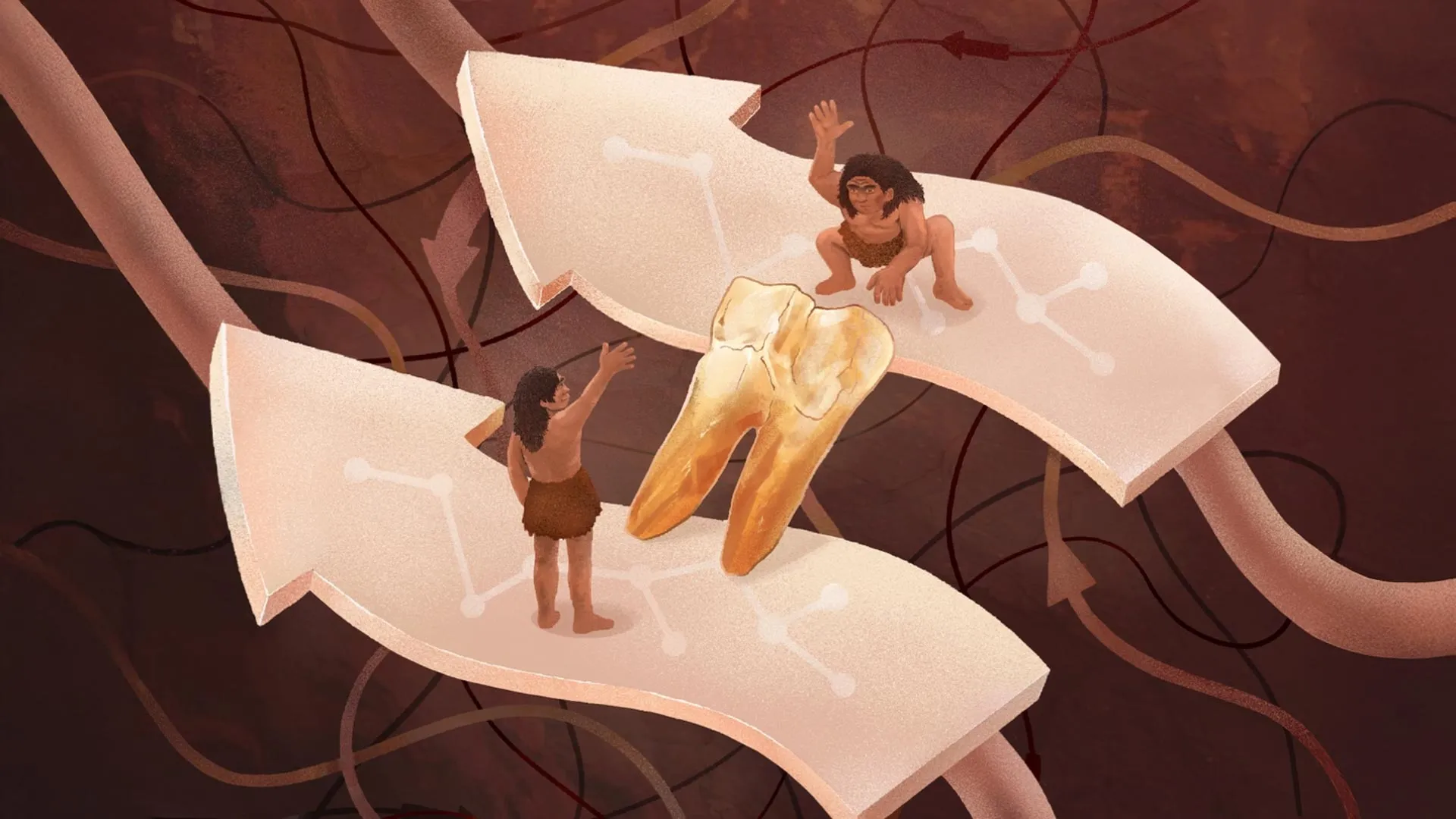
Scientists at the Institute of Vertebrate Paleontology and Paleoanthropology (IVPP) of the Chinese Academy of Sciences have uncovered molecular evidence that could point to a previously unknown connection between Homo erectus and modern humans. At the same time, the team developed new paleoproteomics techniques that can extract valuable information from fossils while causing very little damage.
Homo erectus, or H.erectus, occupies an important place in human evolutionary history because it was the first species in the genus Homo known to have migrated out of Africa. Yet scientists still know relatively little about its genetic makeup, the diversity of its populations, or how it may have been related to later human groups.
One major reason is the shortage of molecular evidence from H. erectus. Without DNA or other preserved biological molecules, researchers have struggled to determine whether these ancient humans contributed genetically to populations that came later. This uncertainty has made the evolutionary role of H. erectus one of the enduring questions in the study of human origins.
Extracting Molecular Clues Without Ruining Fossils
Studying molecules preserved in H. erectus fossils presents another challenge. Ancient human remains are both scientifically irreplaceable and culturally important, making sampling methods that significantly damage fossils unacceptable in many cases. That limitation has slowed attempts to obtain molecular information from these specimens.
A research group led by FU Qiaomei of IVPP, working with scientists from several institutions, has now found a way around much of that problem. The team used an acid etching technique that requires only very small amounts of material to recover molecular information from six Homo erectus teeth while leaving the shape of the fossils intact.
The findings were published online in Nature.
A commentary published at the same time in Nature emphasized the importance of enamel proteins recovered from the six Chinese H. erectus teeth, saying they provide "new insights into how ancient genetic material was eventually introduced into modern human populations."
400,000-Year-Old Teeth Reveal Two Key Mutations
The researchers detected two mutations in teeth from three Chinese fossil sites: Zhoukoudian (Peking Man), Hexian, and Sunjiadong. The fossils date to at least 400,000 years ago, and the molecular evidence points to possible genetic connections between East Asian H. erectus and Denisovans. Denisovans, in turn, are known to have contributed genetic material to some modern human populations.
One of the mutations, AMBN A253G, had not previously been identified. The researchers propose that it could serve as a molecular marker for these H. erectus populations. Its presence also provides the first evidence that H. erectus individuals from all three sites belonged to the same evolutionary population.
The second variant, AMBN M273V, had previously been considered specific to Denisovans. The new results show that it was also present in these H. erectus populations, meaning it was not exclusive to Denisovans.
A Possible Genetic Path From Homo Erectus to Modern Humans
The researchers suggest that AMBN M273V may have entered the Denisovan lineage through admixture, meaning genetic exchange between different ancient human populations. Denisovans could then have passed the variant to certain modern human groups (in Southeast Asia and Oceania) through introgression, the introduction of genetic material from one population into another through interbreeding.
If that interpretation is correct, the finding offers the first molecular clues to a possible connection between East Asian H. erectus (such as those from Zhoukoudian) and Denisovans. It could also point to a much deeper genetic relationship between those ancient H. erectus populations and some people living today.
New Tools for Studying Ancient Human Proteins
Beyond the evolutionary findings, the researchers developed several experimental and computational methods that could expand what scientists can learn from valuable human fossils.
These include a method for determining the sex of ancient hominins using the male-specific enamel protein AMELY, a system for cross-checking results with tandem mass spectrometry and multiple data analysis pipelines, and DNA analysis techniques connected to particular amino acid variants.
Together, these approaches establish a new framework for systematic paleoproteomics research. By recovering molecular evidence while minimizing damage to rare fossils, the methods could help researchers investigate ancient human relationships that have remained inaccessible through traditional genetic techniques.
Story Source:
Materials provided by Chinese Academy of Sciences Headquarters. Note: Content may be edited for style and length.
Journal Reference:
- Qiaomei Fu, Zhongyou Wu, E. Andrew Bennett, Song Xing, Qiang Ji, Zhe Dong, Huiyun Rao, Xuejun Gu, Yizhao Dang, Jun Xing, Kai Zhou, Xiaotian Feng. Enamel proteins from six Homo erectus specimens across China. Nature, 2026; 655 (8121): 141 DOI: 10.1038/s41586-026-10478-8
Cite This Page: