
NASA offers $500,000 to develop next-generation electric rocket engines
- Date:
- November 9, 2026
- Source:
- NASA
- Summary:
- NASA is putting $500,000 on the line in a new competition to accelerate the development of advanced electric rocket engines for satellites and future space exploration. The AMPERE Challenge will reward up to two U.S. companies with cash prizes and access to NASA testing facilities to help bring promising propulsion technology closer to real-world missions.
- Share:
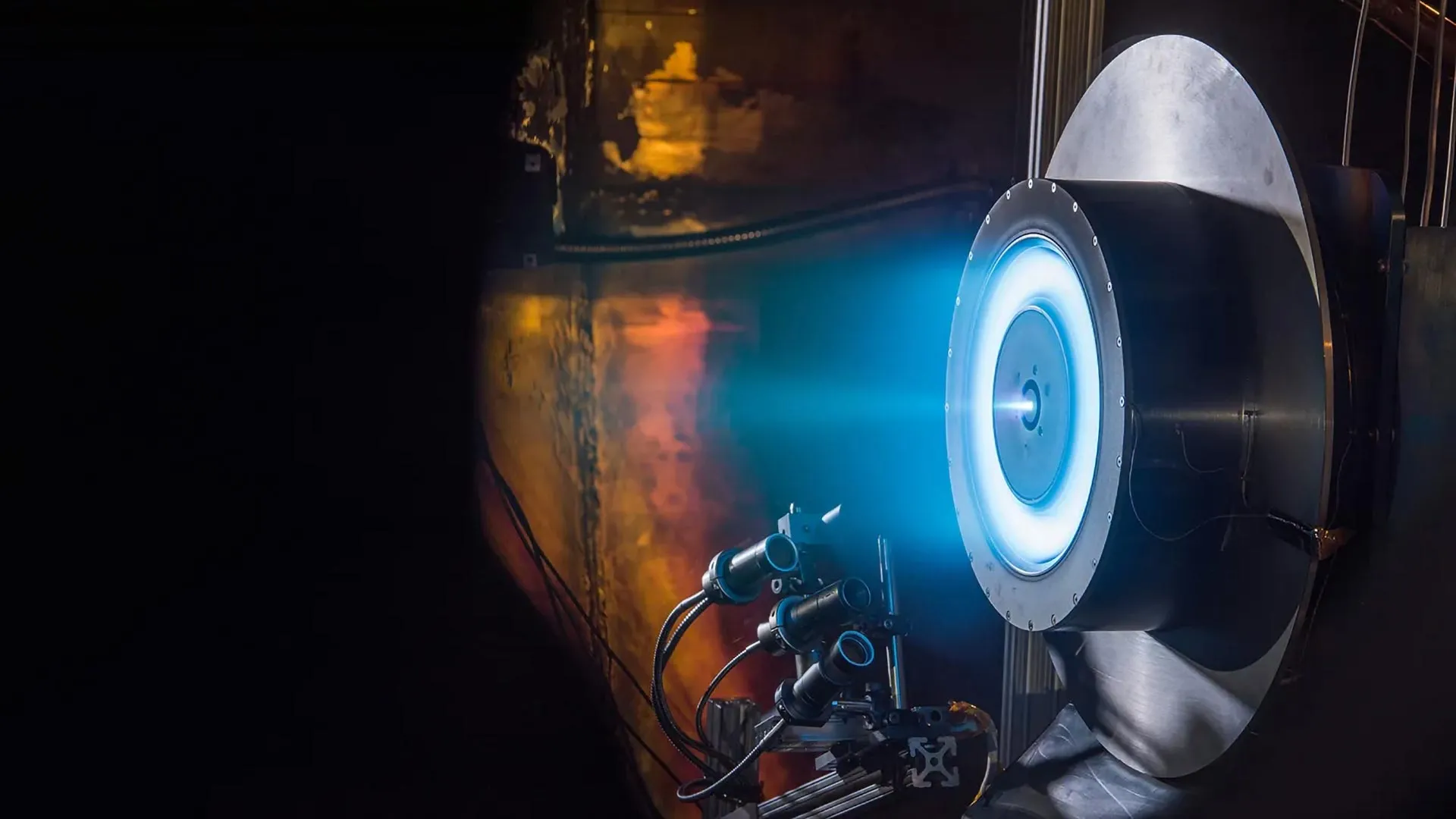
NASA is offering $500,000 in prizes to encourage American companies to develop more capable electric propulsion systems for future space missions. The competition focuses on a technology known as Hall effect thrusters, which use electricity to propel spacecraft through space.
The new initiative, called the Advanced Mid-Power Electric Rocket (AMPERE) Challenge, seeks to advance mid-power (3-7 kW) propulsion systems. Government agencies and aerospace industry experts have identified this class of thrusters as an important technology for satellite operations, national defense, and space exploration.
By inviting commercial companies to design and demonstrate working prototypes, NASA hopes to accelerate progress in electric propulsion and help prepare promising technologies for practical use.
How Electric Rocket Engines Work
Unlike conventional rockets, which burn chemical propellants to produce powerful bursts of thrust, electric propulsion systems use electrical energy to accelerate charged particles and expel them at high speeds. The resulting force pushes a spacecraft in the opposite direction.
Hall effect thrusters are a particular type of electric propulsion system that uses electric and magnetic fields to control and accelerate charged particles. They typically produce much less thrust than chemical rocket engines, but they can use propellant far more efficiently.
That efficiency makes electric thrusters especially valuable for missions that require spacecraft to operate for extended periods. Rather than delivering a brief, powerful push, these engines can provide gentle acceleration over long stretches of time, gradually changing a spacecraft's speed or trajectory.
Hall effect thrusters are already used in space, including for adjusting satellite orbits and maintaining spacecraft positions. Improving their performance could expand the range of missions they can support.
The power range targeted by NASA's challenge refers to the electrical energy these systems consume. A kilowatt equals 1,000 watts, so the competition focuses on thrusters that operate using approximately 3,000 to 7,000 watts of electrical power.
NASA Seeks More Advanced Spacecraft Thrusters
The AMPERE Challenge is designed to help American companies move promising electric propulsion concepts beyond early development and toward technologies that can be evaluated under realistic testing conditions.
Participating companies will develop and demonstrate Hall-effect thruster prototypes within the specified power range. NASA intends to assess their performance using its testing facilities, providing an opportunity to evaluate how well the systems function and identify areas that need improvement.
This testing is an important step in turning experimental propulsion technology into equipment suitable for future missions. Spacecraft engines must deliver predictable performance and operate reliably in the demanding environment of space.
By supporting commercial innovation, NASA aims to strengthen the technological foundation for future government and private sector missions. Potential applications include satellite operations, defense systems, and robotic exploration beyond Earth.
$500,000 in Prizes for Electric Propulsion Innovation
NASA has allocated a total of $500,000 in cash prizes for the AMPERE Challenge. The competition will take place across three phases, with as many as two winning teams eligible to receive up to $250,000 each.
In addition to the financial awards, winning teams can gain access to NASA testing resources and technology. These opportunities could help companies evaluate and improve their propulsion systems while advancing their readiness for future applications.
The challenge is open to commercial companies that are incorporated in the United States and maintain their primary place of business in the country.
Registration begins November 9, 2026, and closes January 27, 2027.
Companies interested in participating can find complete competition rules, eligibility requirements, and registration information on the official NASA AMPERE Challenge website.
Through this competition, NASA hopes to encourage new advances in electric rocket technology and strengthen the propulsion capabilities available for the next generation of spacecraft.
Cite This Page: