
Researchers find how plants survive without sunlight or sex
A mysterious parasitic plant lineage reveals just how far evolution can bend the rules of plant life.
- Date:
- December 14, 2025
- Source:
- Kobe University
- Summary:
- The study reveals how Balanophora plants function despite abandoning photosynthesis and, in some species, sexual reproduction. Their plastid genomes shrank dramatically in a shared ancestor, yet the plastids remain vital. Asexual reproduction appears to have evolved repeatedly, helping the plants survive in isolated, humid forest habitats. The research highlights surprising resilience in these bizarre parasitic species.
- Share:
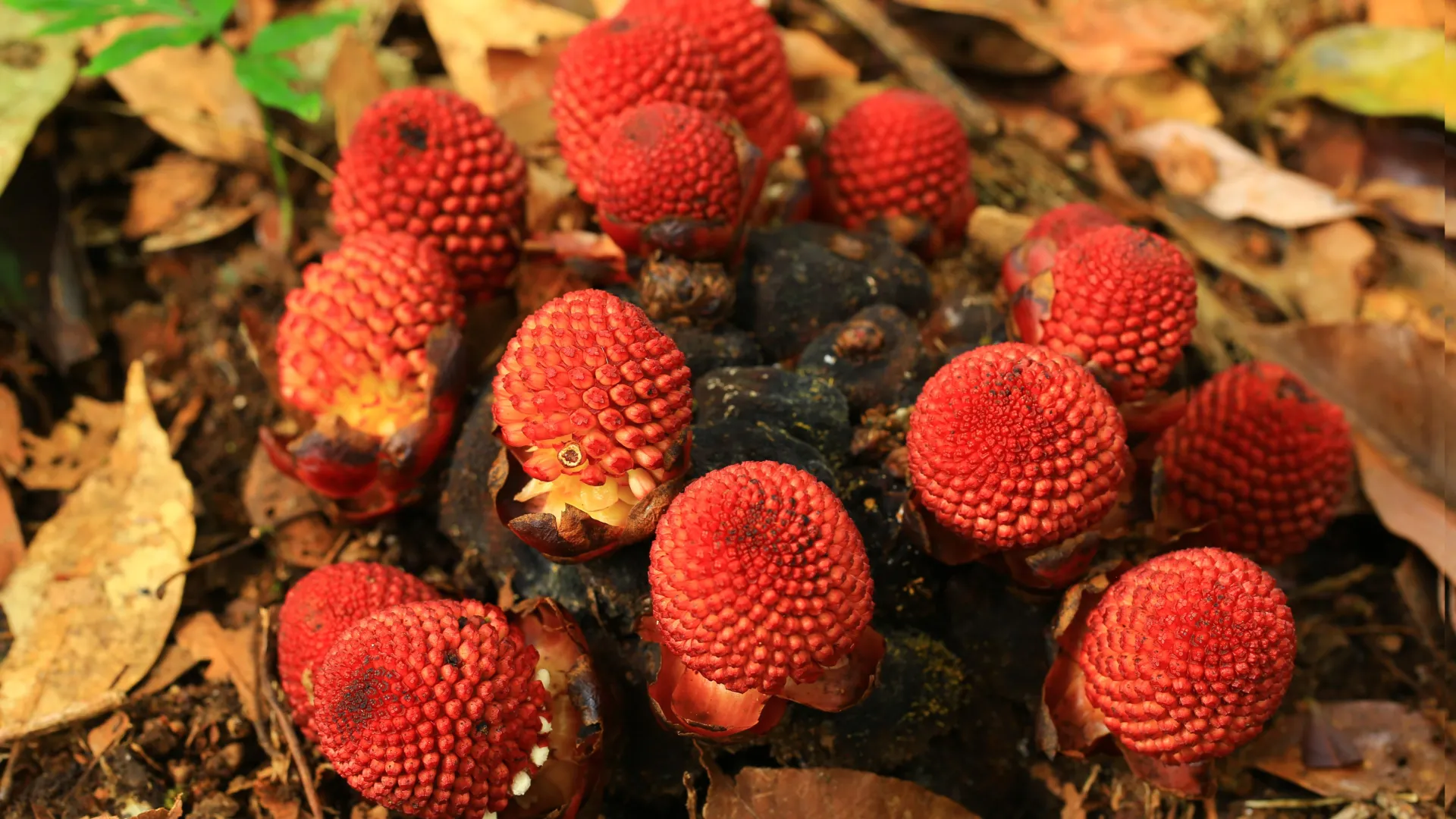
Some plants lack both green pigments and sexual reproduction, yet these unusual traits reveal important insights into what defines plant life. A new study involving Kobe University examined species in the genus Balanophora to understand how non-green, asexual plants develop and survive.
"My long-standing aim is to rethink what it truly means to be a plant," says Kobe University botanist Kenji Suetsugu. He continues, "For many years I have been fascinated by plants that have abandoned photosynthesis, and I want to uncover the changes that occur in the process." Balanophora species represent an extreme case because they do not photosynthesize and instead draw nutrients from the roots of host plants. They remain underground for most of their lives and appear above the soil only during flowering season, and some species reproduce only through asexual means. "However, while there have been individual studies on changes in the plants' genomes, their ecology and their reproduction, we don't know how they relate to each other," explains Suetsugu.
Linking Evolution, Plastids, and Ecology in Balanophora
To address this gap, Suetsugu set out to unify three areas of research that had never been examined together for Balanophora. He aimed to clarify the relationships among species, investigate how their plastids have been altered (a part of a plant's cells which in green plants serves as the cell's "solar panels"), and determine how their reproductive strategies fit within their ecological context. Describing the difficulty of the work, he says: "These plants are rare, patchy and often restricted to steep, humid forests. But years of experience with studying Balanophora both in the lab and in field studies, as well as long-standing relationships with local naturalists made this project possible." To expand the project, he collaborated with experts at the Okinawa Institute of Science and Technology who specialize in highly reduced genomes.
Extreme Plastid Reduction Suggests a Shared Ancestral Shift
The study, now published in the journal New Phytologist, reports that all members of the group possess a dramatically reduced plastid genome (DNA not kept in the plant cell's nucleus but directly in the plastid). The team concluded that this reduction likely occurred in a common ancestor before the lineage split into multiple species. Suetsugu says: "It is exciting to see how far a plant can reduce its plastid genome, which at first glance looks as though the plastid is on the verge of disappearing. But looking more closely we found that many proteins are still transported to the plastid, showing that even though the plant has abandoned photosynthesis, the plastid is still a vital part of the plant's metabolism."
Repeated Evolution of Asexual Reproduction Across the Region
The researchers also determined that asexual reproduction probably emerged several times within the group. Their findings suggest that the plants may have developed the capacity to produce seeds without fertilization early on, which would have helped them colonize the chain of islands extending from mainland Japan through Okinawa to Taiwan. "Over the past decade I have studied Balanophora pollination and seed dispersal where camel crickets and cockroaches play an unexpected role, but I also noticed that asexual seed production often ensured reproduction when mates or pollinators are scarce," explains Suetsugu. In some species, this reproductive approach may have become the primary mode of producing offspring.
Understanding How Parasitic, Non-Photosynthetic Plants Persist
For Suetsugu, the work represents a major step toward understanding how plants that no longer perform photosynthesis continue to function and survive in natural environments. Suetsugu says, "For someone who has spent many hours observing these plants in dark, humid forests, seeing their story unfold at the genomic level is deeply satisfying. My next goal is to connect these results with biochemical measurements to find out what Balanophora plastids actually produce and how these products help sustain the parasitic plants' growth within the roots of their hosts."
This research was funded by the Japan Society for the Promotion of Science (grant 23K14256), the Human Frontier Science Program (grant RGEC29/2024), the Japan Science and Technology Agency (grants JPMJPR21D6, JPMJFR2339) and the National Science and Technology Council, Taiwan (grant 109-2311-B-845-001). It was conducted in collaboration with researchers from the Okinawa Institute of Science and Technology and the University of Taipei.
Story Source:
Materials provided by Kobe University. Note: Content may be edited for style and length.
Journal Reference:
- Petra Svetlikova, Huei‐Jiun Su, Kenji Suetsugu, Filip Husnik. Phylogenomics clarifies Balanophora evolution, metabolic retention in reduced plastids, and the origins of obligate agamospermy. New Phytologist, 2025; DOI: 10.1111/nph.70761
Cite This Page: