
NASA just caught a rare glimpse of an interstellar comet
Europa Clipper just caught a once-in-a-generation glimpse of an alien comet.
- Date:
- December 20, 2025
- Source:
- Southwest Research Institute
- Summary:
- An instrument aboard NASA’s Europa Clipper spacecraft captured rare ultraviolet observations of an interstellar comet while Earth-based telescopes were blinded by the Sun. The spacecraft’s unique position provided an unprecedented look at the comet’s dust and plasma tails from an unusual angle. Scientists detected hydrogen, oxygen, and signs of intense gas release, hinting at powerful activity after the comet’s closest approach to the Sun. The findings may reveal clues about how comets form around other stars.
- Share:
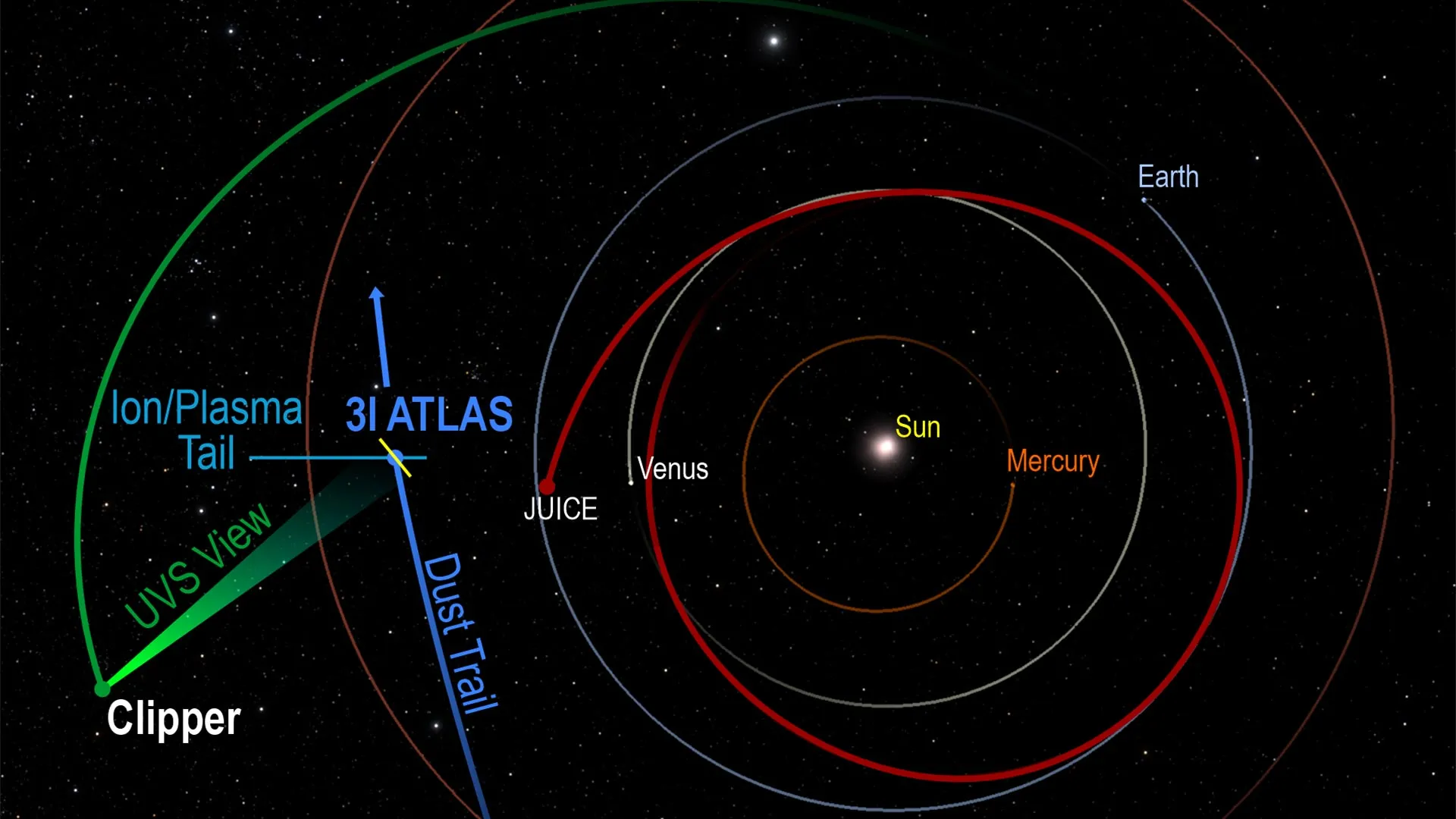
NASA's Europa Clipper spacecraft has captured important new data on the interstellar comet 3I/ATLAS using its Southwest Research Institute-led Ultraviolet Spectrograph (UVS). In July, 3I/ATLAS became the third officially confirmed interstellar object known to enter our solar system. The UVS instrument was able to observe the comet during a window when viewing from Mars and Earth was difficult or not possible.
"We're excited that this opportunity to view another target on the way to Jupiter was completely unexpected," said SwRI's Dr. Kurt Retherford, the principal investigator for Europa-UVS. "Our observations have allowed for a unique and nuanced view of the comet."
Europa Clipper launched in 2024 and is expected to reach the Jovian system in 2030. Once there, it will orbit Jupiter and carry out 49 close flybys of the moon Europa. UVS collects ultraviolet light to study the makeup of Europa's atmospheric gases and materials on its icy surface.
Timing matters when telescopes cannot see
Less than a week after the comet was discovered, analysts at NASA's Jet Propulsion Laboratory (JPL) mapped its path through the solar system. The Europa Clipper team soon recognized that the spacecraft could watch 3I/ATLAS in November, a period when the comet's position near the Sun would block much of the view from Earth and when Mars-based observing conditions were no longer at their best.
That timing let Europa Clipper fill a critical gap, connecting Mars-based observations from late September with later viewing opportunities from Earth. Because the comet's trajectory placed it between Europa Clipper and the Sun, the spacecraft had an unusual vantage point. This matters because comets typically show two main tails, a dust tail that trails behind and a plasma tail that points away from the Sun.
A behind-the-tails view and a second spacecraft perspective
From its sunward location, Europa-UVS captured a downstream view of both tails, looking largely from "behind" the tails back toward the comet's nucleus and coma (cloud of gas surrounding it). At the same time, observations from the SwRI-led UVS instrument aboard ESA's Jupiter Icy Moons Explorer (JUICE) will add an anti-sunward view, giving scientists a more typical angle during the exact same period.
"We're hopeful that this new view, along with observations from Earth-based assets and other spacecraft, will help us to piece together a more complete understanding of the tails' geometries," said SwRI's Dr. Thomas Greathouse, co-deputy principal investigator of Europa-UVS.
Europa-UVS identified oxygen, hydrogen, and dust-related signatures. These findings support the broader set of observations indicating that 3I/ATLAS went through a stretch of high outgassing activity shortly after its closest approach to the Sun.
"Europa-UVS is particularly adept at measuring fundamental transitions from atoms and molecules," Retherford said. "We can see gases come off the comet, and water molecules break apart into hydrogen and oxygen atoms."
Those measurements allow Europa Clipper to closely study these atomic species, offering a more detailed look at what is happening in the comet and what it is made of.
Clues to the comet's origin beyond our solar system
"Understanding the composition of the comet and how readily these gases are emitted can give us a clearer view of the comet's origin and how it may have evolved during transit from elsewhere in the galaxy to our solar system," SwRI's Dr. Tracy Becker, co-deputy principal investigator of Europa-UVS said. "What are the chemical processes at play, and how can we unravel the comet's origin in its own star system? Were those processes similar to how we believe our solar system formed? Those are big questions."
JPL manages the Europa Clipper mission for NASA's Science Mission Directorate in Washington, D.C. The mission was developed in partnership with the Johns Hopkins University Applied Physics Laboratory (APL), in Laurel, Maryland.
Story Source:
Materials provided by Southwest Research Institute. Note: Content may be edited for style and length.
Cite This Page: