
Chang’e-6 lunar samples reveal a giant impact reshaped the Moon’s interior
- Date:
- February 8, 2026
- Source:
- Chinese Academy of Sciences Headquarters
- Summary:
- A colossal ancient impact may have reshaped the Moon far more deeply than scientists once realized. By analyzing rare lunar rocks brought back by China’s Chang’e-6 mission from the Moon’s largest crater, researchers found unusual chemical fingerprints pointing to extreme heat and material loss caused by a giant impact. The collision likely stripped away volatile elements, reshaped volcanic activity, and left a lasting chemical signature deep below the surface.
- Share:
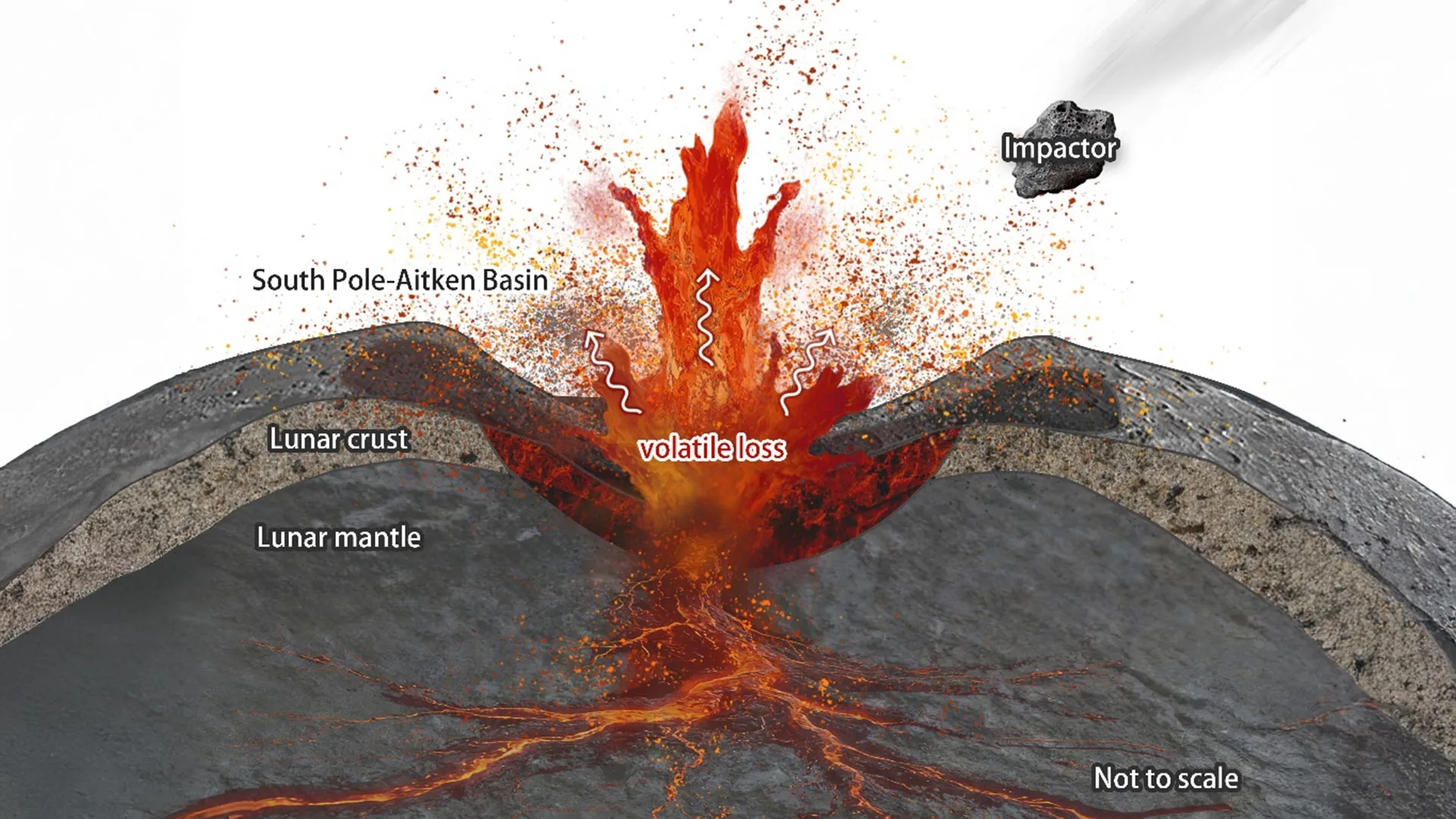
Ever since the Moon formed, asteroid strikes have played the leading role in shaping its surface. These collisions carved out vast craters and basins and altered the Moon's landscape and chemistry. What scientists have not fully understood is how deeply these enormous impacts affected the Moon beneath the surface.
To explore that question, a team led by Prof. Hengci Tian from the Institute of Geology and Geophysics of the Chinese Academy of Sciences (IGGCAS) analyzed lunar basalt samples returned by Chang'e-6 (CE6). These rocks came from the South Pole-Aitken (SPA) Basin, the largest and oldest known impact basin on the Moon. The samples stood out immediately because their potassium (K) isotopic makeup was heavier than any lunar basalts previously collected by the Apollo missions or found in lunar meteorites.
Why Potassium Holds Clues to Ancient Impacts
Potassium is considered a moderately volatile element, meaning it can partially evaporate under extreme heat. During a massive impact, temperatures soar, allowing potassium to vaporize and its isotopes to separate. This process leaves behind a chemical record that can reveal the intensity of the impact, the conditions during the event, and how the collision changed materials in the lunar crust and mantle.
With this in mind, the researchers focused on measuring the isotopic composition of potassium in the Chang'e-6 samples.
Chemical Evidence of a Giant Collision
The results, published in Proceedings of the National Academy of Sciences (PNAS), link the unusual potassium signature directly to the colossal impact that created the SPA Basin.
Using high-precision techniques, the team measured potassium isotopes in four basalt fragments with sapphire collision-cell multicollector inductively coupled plasma mass spectrometry (MC-ICP-MS). All of the CE6 samples showed elevated δ41K values, ranging from 0.001 ± 0.028‰ to 0.093 ± 0.014‰ (mean: 0.038 ± 0.044‰, 2SE). This average is about 0.16‰ higher than values measured in Apollo lunar basalts (-0.13 ± 0.06‰, 2SE), which are widely considered representative of the lunar mantle and the Bulk Silicate Moon.
Ruling Out Other Explanations
To determine what caused this enrichment in heavier potassium isotopes, the researchers examined three possible factors. They evaluated long-term exposure to cosmic rays, changes during magma evolution, and contamination from meteorites. Each of these processes was found to have only a minimal effect, well within measurement uncertainty, and none could account for the chemical shift seen in the samples.
A Lasting Impact on Lunar Volcanism
The analysis instead points to large-scale loss of volatile elements during the SPA-forming impact, particularly through potassium evaporation. This depletion may have reduced magma production on the Moon's far side, helping explain why volcanic activity has long been more extensive on the near side than on the far side.
Computer simulations supported this interpretation. They showed that the impact not only dug deep into the lunar crust and possibly the mantle but also released enough heat to drive convection within the Moon's interior.
What This Means for the Moon and Beyond
Together, these findings show that the impact that formed the South Pole-Aitken Basin profoundly altered the Moon deep below its surface. More broadly, the study underscores how massive impacts can shape the internal chemistry and evolution of rocky planets and moons throughout the solar system.
The research was supported by the National Natural Science Foundation of China, the CAS Youth Innovation Promotion Association, and other sources.
Story Source:
Materials provided by Chinese Academy of Sciences Headquarters. Note: Content may be edited for style and length.
Journal Reference:
- Heng-Ci Tian, Chi Zhang, Wen-Jun Li, Dingshuai Xue, Jing Wang, Wei Yang, Yan-Hong Liu, Yangting Lin, Xian-Hua Li, Fu-Yuan Wu. Isotopic evidence for volatile loss driven by South Pole-Aitken basin–forming impact. Proceedings of the National Academy of Sciences, 2026; 123 (3) DOI: 10.1073/pnas.2515408123
Cite This Page: