
Webb telescope spots mysterious explosion that defies known physics
A record-breaking cosmic blast that lasted hours instead of seconds may reveal a brand-new way black holes destroy stars.
- Date:
- March 30, 2026
- Source:
- Summary:
- Astronomers have spotted a bizarre cosmic explosion that refuses to play by the rules—and it’s leaving scientists scrambling for answers. GRB 250702B, detected by NASA’s James Webb Space Telescope and a global network of observatories, lasted an astonishing seven hours—far longer than typical gamma-ray bursts, which usually fade in under a minute.
- Share:
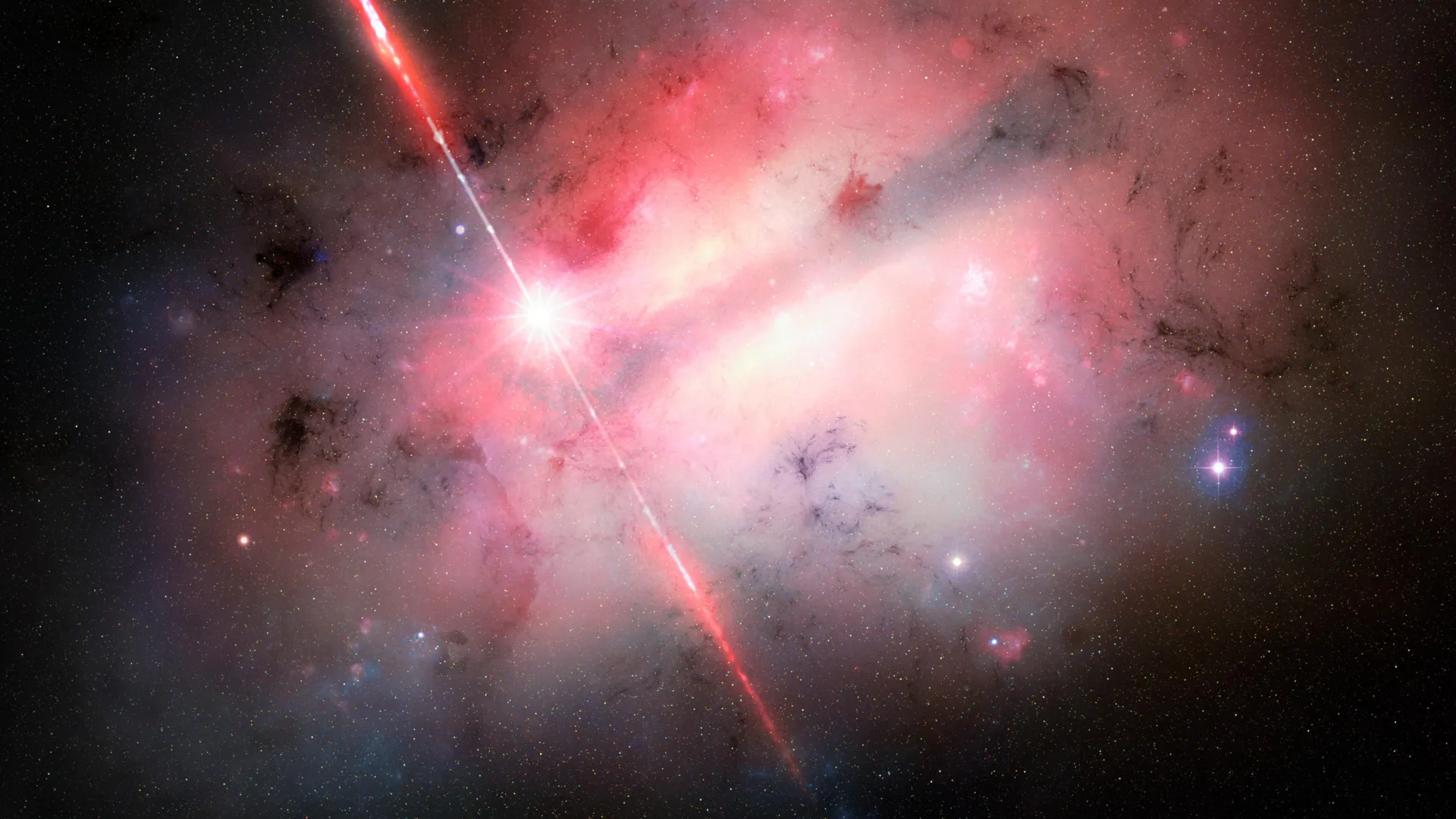
A Rutgers astrophysicist is helping investigate a strange cosmic event that has left astronomers searching for answers. At the center of the mystery is an unusually powerful explosion in space that lasted far longer than anything previously observed.
NASA announced that researchers using the James Webb Space Telescope examined GRB 250702B, a long gamma-ray burst and one of the most energetic types of events in the universe. These bursts typically occur when a massive star collapses into a black hole, producing a brief and intense flash of high-energy gamma rays. This event behaved very differently.
"This object shows extreme properties that are difficult to explain," said Huei Sears, a postdoctoral researcher in the Department of Physics and Astronomy at the Rutgers School of Arts and Sciences who is studying the explosion. "Usually, these bursts are over in less than a minute, but GRB 250702B lasted for hours and even showed signs of X-ray activity a day prior."
Global Observations Reveal Unusual Behavior
Sears explained that observatories around the world are analyzing data from the event. This includes teams working with China's Einstein Probe and the National Science Foundation's Very Large Array, which is widely recognized from its appearance in the science fiction film Contact.
The gamma-ray emission continued for at least seven hours, nearly doubling the duration of the previous record holder. NASA also released an animation showing one possible scenario for the event. In this model, a black hole about three times the mass of the Sun, with an event horizon just 11 miles (18 kilometers) wide, orbits and merges with a companion star.
"This is certainly an outburst unlike any other we have seen in the past 50 years," said Eliza Neights, an astronomer at NASA's Goddard Space Flight Center in Maryland.
Possible Explanations Involving Black Holes
Scientists are considering several explanations. One possibility is that this was an unusually extreme gamma-ray burst. Another is that it was a tidal disruption event, in which a black hole thousands of times more massive than the Sun tears apart a star that ventured too close. A more unusual idea suggests a smaller black hole merged with a stripped helium star and consumed it from within.
Regardless of the exact cause, the black hole did far more than take a small bite. It unleashed powerful jets of energy that shot across space.
Multi-Telescope Effort Captures the Event
NASA's Fermi Gamma-ray Space Telescope first detected the burst on July 2, prompting rapid follow-up observations from other instruments. The event was so intense that no single telescope could capture the full picture. Scientists combined data from space-based and ground-based observatories, collecting gamma rays, X-rays, infrared light, and radio signals. The explosion was not visible in ordinary light.
"Only through the combined power of instruments on multiple spacecraft could we understand this event," said Eric Burns, an astrophysicist at Louisiana State University.
Distant Galaxy Adds to the Mystery
Images from the Hubble Space Telescope revealed an unusual galaxy at the location of the burst. Initially, it appeared as though two galaxies might be merging, or that a single galaxy was split by a dark band of dust. Later, Webb observations showed the galaxy lies about 8 billion light-years away, meaning the explosion occurred long before Earth formed.
To better understand the host galaxy, Sears led follow-up observations using Webb's NIRCam, its main near-infrared imaging instrument, several months after the event.
"In such vibrant and unprecedented detail, we see just one very large galaxy with a dust lane," Sears said. "The galaxy has such complex structure that it's not 100% clear if there's anything left to see of the explosion, but if there is, it's really faint."
Mystery Remains Unsolved
This finding supports the idea that GRB 250702B was a gamma-ray burst rather than a tidal disruption event. Even so, researchers have not reached a definitive conclusion.
"We have only seen a few tidal disruption events of this type, so we don't know for sure how they're supposed to evolve," Sears said. "A lot of the studies on this explosion provide different, and sometimes contradictory, explanations. It's still early in our understanding of what really happened."
Whatever the final explanation, scientists agree the event is both rare and significant.
"This gives us a unique chance to study the extremes of how stars and black holes evolve," Sears said. "GRB 250702B could even be the discovery of something unexpected and new."
The Webb telescope also is supported by the European Space Agency (ESA), and the Canadian Space Agency (CSA).
Story Source:
Materials provided by . Note: Content may be edited for style and length.
Journal Reference:
- Jonathan Carney, Igor Andreoni, Brendan O’Connor, James Freeburn, Hannah Skobe, Lewi Westcott, Malte Busmann, Antonella Palmese, Xander J. Hall, Ramandeep Gill, Paz Beniamini, Eric R. Coughlin, Charles D. Kilpatrick, Akash Anumarlapudi, Nicholas M. Law, Hank Corbett, Tomas Ahumada, Ping Chen, Christopher Conselice, Guillermo Damke, Kaustav K. Das, Avishay Gal-Yam, Daniel Gruen, Steve Heathcote, Lei Hu, Viraj Karambelkar, Mansi Kasliwal, Kathleen Labrie, Dheeraj Pasham, Arno Riffeser, Michael Schmidt, Kritti Sharma, Silona Wilke, Weicheng Zang. Optical/Infrared Observations of the Extraordinary GRB 250702B: A Highly Obscured Afterglow in a Massive Galaxy Consistent with Multiple Possible Progenitors. The Astrophysical Journal Letters, 2025; 994 (2): L46 DOI: 10.3847/2041-8213/ae1d67
Cite This Page: