
Astronomers just found the source of the brightest fast radio burst ever
- Date:
- March 15, 2026
- Source:
- University of Toronto
- Summary:
- Astronomers have discovered the brightest fast radio burst ever detected and traced it to a nearby galaxy using a new network of CHIME Outrigger telescopes. The flash, nicknamed RBFLOAT, lasted only a fraction of a second but briefly outshone every other radio source in its galaxy. Follow-up observations with the James Webb Space Telescope spotted a faint infrared signal at the same location. The burst’s unusual behavior—showing no signs of repeating—may challenge current ideas about what causes these mysterious cosmic flashes.
- Share:
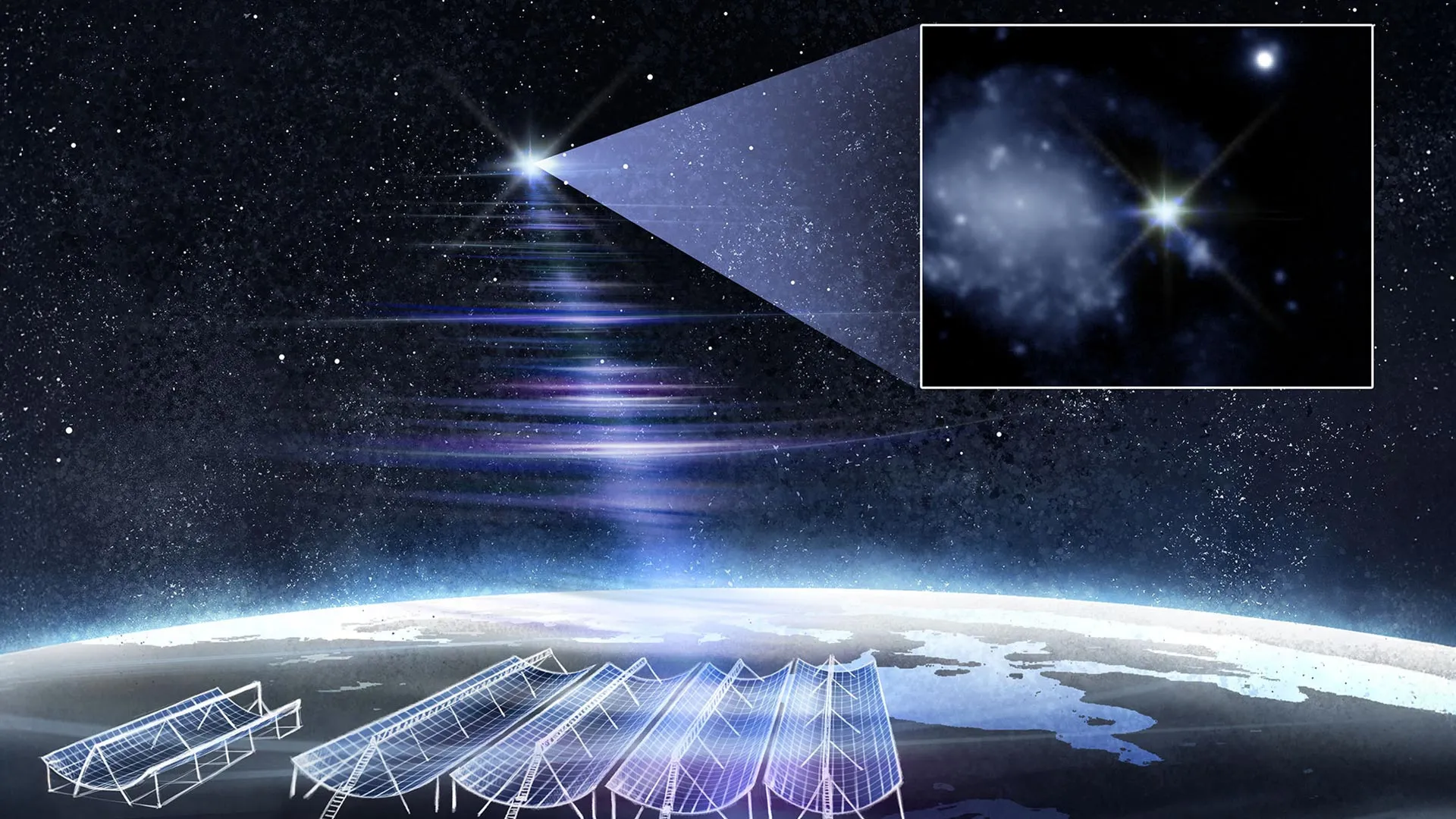
An international team of astronomers, including researchers from the University of Toronto, has identified the brightest Fast Radio Burst (FRB) ever observed and traced its origin to a nearby galaxy using a coordinated network of radio telescopes. FRBs are among the most puzzling phenomena in astronomy, but locating where they come from with precision could mark the start of a new phase in research, allowing scientists to better understand their cosmic origins.
Fast radio bursts are incredibly powerful flashes of radio energy that travel across vast distances in the universe. Scientists believe they are produced by extreme astrophysical events, though the exact cause remains uncertain. Since 2018, the Canadian Hydrogen-Intensity Mapping Experiment, or CHIME, has detected thousands of these bursts. However, determining their exact positions in the sky has remained a major challenge.
CHIME Outrigger Array Pinpoints the Burst
The newly detected signal, named FRB 20250316A and nicknamed RBFLOAT ("Radio Brightest Flash Of All Time"), was localized with remarkable precision using the CHIME/FRB Outrigger array. These smaller versions of the CHIME instrument are installed in British Columbia, Northern California and West Virginia. Working together, they allow astronomers to use Very Long Baseline Interferometry (VLBI), a technique that combines signals from widely separated telescopes to determine an object's position in the sky with exceptional accuracy.
"We were ultimately extremely lucky that we were able to pinpoint the precise sky position of this rare event," said Mattias Lazda, doctoral student at the University of Toronto, and an author on both papers. "A few hours after we detected it, we experienced a power outage at one of our telescope sites that played a critical role in telling us where the burst came from. Had the event happened any later that day, we would've completely missed our chance."
A Powerful Burst From a Nearby Galaxy
Although fast radio bursts rank among the most intense radio sources known, they appear only briefly. Each burst typically lasts from a few milliseconds to a few seconds, temporarily shining brighter than every other radio signal in its host galaxy. RBFLOAT, detected on March 16, 2025, lasted about one fifth of a second.
"Cosmically speaking, this fast radio burst is just in our neighborhood," says Kiyoshi Masui, associate professor of physics and affiliate of MIT's Kavli Institute for Astrophysics and Space Research, and a U of T alum. "This means we get this chance to study a pretty normal FRB in exquisite detail."
The burst appeared exceptionally bright partly because its source lies relatively close to Earth. It originated near the outer region of the galaxy NGC 4141, located about 130 million light-years away in the constellation Ursa Major. Researchers were able to narrow the signal's origin to a region only 45 light-years across, which is smaller than the typical size of a star cluster. Achieving this level of precision is comparable to spotting a guitar pick from 1000 kilometers away.
"The discovery was very exciting, because we had our brightest ever event right after all three outriggers were online," said Amanda Cook, Banting Postdoctoral Researcher at McGill University and a U of T alum who led the paper describing RBFLOAT. "Immediately, even though it was a Sunday afternoon, a bunch of us piled into a zoom room and started hacking away at the research, hoping to get follow-up observations on source as quickly as possible."
JWST Observations Reveal a Faint Infrared Signal
The precise location provided by the CHIME/FRB Outrigger array allowed the team to conduct follow-up observations with the James Webb Space Telescope (JWST). During those observations, scientists detected a faint infrared signal at the same location where RBFLOAT originated. The finding was unexpected, and researchers are still exploring what it might represent. One possibility is that the signal comes from a red giant star, while another idea is that it could be a fading light echo related to the burst itself.
"The high resolution of JWST allows us to resolve individual stars around an FRB for the first time. This opens the door to identifying the kinds of stellar environments that could give rise to such powerful bursts, especially when rare FRBs are captured with this level of detail." said Peter Blanchard, a Harvard postdoctoral fellow and lead author of the companion paper describing the JWST observation.
A Burst That Challenges Current Theories
Even though this event is the brightest FRB ever detected by CHIME, astronomers have not observed any repeat bursts from the same source. Scientists examined hundreds of hours of CHIME data covering the region over more than six years but found no additional signals.
"This burst doesn't seem to repeat, which makes it different from most well-studied FRBs," said Cook. "That challenges a major idea in the field, that all FRBs repeat, and opens the door to reconsidering more 'explosive' origins for at least some of them."
Two scientific papers describing the discovery were published in the Astrophysical Journal Letters. One focuses on the original radio detection and precise localization of the burst, while the other reports the JWST near-infrared observations of the same region. Together, the studies provide new insights into fast radio bursts and suggest they could become valuable tools for studying the universe, rather than remaining mysterious cosmic oddities.
Story Source:
Materials provided by University of Toronto. Note: Content may be edited for style and length.
Journal References:
- Thomas C. Abbott, Daniel Amouyal, Bridget C. Andersen, Shion E. Andrew, Kevin Bandura, Mohit Bhardwaj, Kalyani Bhopi, Yash Bhusare, Charanjot Brar, Alice Cai, Tomas Cassanelli, Shami Chatterjee, Jean-François Cliche, Amanda M. Cook, Alice P. Curtin, Evan Davies-Velie, Matt Dobbs, Fengqiu Adam Dong, Yuxin 雨欣 Dong 董, Gwendolyn Eadie, Tarraneh Eftekhari, Wen-fai Fong, Emmanuel Fonseca, B. M. Gaensler, Nina Gusinskaia, Jason W. T. Hessels, Danté M. Hewitt, Jeff Huang, Naman Jain, Ronniy. C. Joseph, Lordrick Kahinga, Victoria M. Kaspi, Afrasiyab (Afrokk) Khan, Bikash Kharel, Adam E. Lanman, Magnus L’Argent, Mattias Lazda, Calvin Leung, Robert Main, Lluis Mas-Ribas, Kiyoshi W. Masui, Kyle McGregor, Ryan Mckinven, Juan Mena-Parra, Daniele Michilli, Nicole Mulyk, Mason Ng, Kenzie Nimmo, Ayush Pandhi, Swarali Shivraj Patil, Aaron B. Pearlman, Ue-Li Pen, Ziggy Pleunis, J. Xavier Prochaska, Masoud Rafiei-Ravandi, Scott M. Ransom, Gurman Sachdeva, Mawson W. Sammons, Ketan R. Sand, Paul Scholz, Vishwangi Shah, Kaitlyn Shin, Seth R. Siegel, Sunil Simha, Kendrick Smith, Ingrid Stairs, David C. Stenning, Haochen Wang, Thomas Boles, Ismaël Cognard, Tammo Jan Dijkema, Alexei V. Filippenko, Marcin P. Gawroński, Wolfgang Herrmann, Charles D. Kilpatrick, Franz Kirsten, Shawn Knabel, Omar S. Ould-Boukattine, Hadrien Paugnat, Weronika Puchalska, William Sheu, Aswin Suresh, Aaron Tohuvavohu, Tommaso Treu, WeiKang Zheng. FRB 20250316A: A Brilliant and Nearby One-off Fast Radio Burst Localized to 13 pc Precision. The Astrophysical Journal Letters, 2025; 989 (2): L48 DOI: 10.3847/2041-8213/adf62f
- Peter K. Blanchard, Edo Berger, Shion E. Andrew, Aswin Suresh, Kohki Uno, Charles D. Kilpatrick, Brian D. Metzger, Harsh Kumar, Navin Sridhar, Amanda M. Cook, Yuxin 雨欣 Dong 董, Tarraneh Eftekhari, Wen-fai Fong, Walter W. Golay, Daichi Hiramatsu, Ronniy C. Joseph, Victoria M. Kaspi, Mattias Lazda, Calvin Leung, Kiyoshi W. Masui, Juan Mena-Parra, Kenzie Nimmo, Aaron B. Pearlman, Vishwangi Shah, Kaitlyn Shin, Sunil Simha. James Webb Space Telescope Observations of the Nearby and Precisely Localized FRB 20250316A: A Potential Near-IR Counterpart and Implications for the Progenitors of Fast Radio Bursts. The Astrophysical Journal Letters, 2025; 989 (2): L49 DOI: 10.3847/2041-8213/adf29f
Cite This Page: