
Something just hit the Moon and left a bright new scar
- Date:
- April 8, 2026
- Source:
- Universe Today
- Summary:
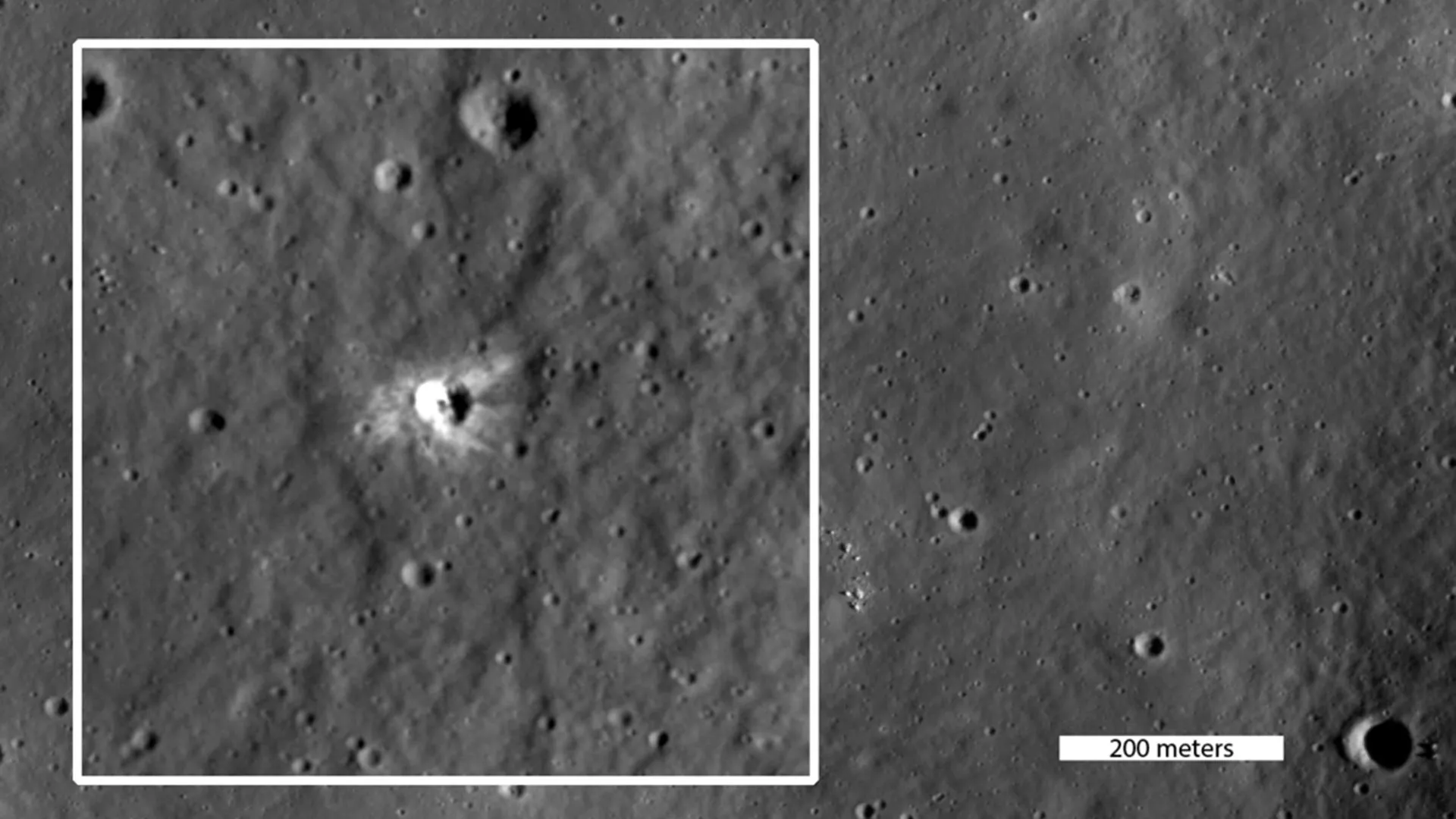
- For all its ancient, familiar features, the Moon is still changing—and sometimes in dramatic ways. Scientists recently identified a fresh 22-meter-wide crater by comparing orbital images taken years apart, revealing a relatively recent impact that no one actually saw happen. The collision blasted bright material outward in striking rays, making the new crater stand out sharply against the darker lunar surface.
- Share:
I'll admit something surprising. Even after years of stargazing, tracking planets, and scanning deep sky objects through a telescope, I only clearly noticed the Man in the Moon about five years ago. While studying the familiar dark plains and bright highlands, I somehow overlooked a pattern people have recognized for thousands of years.
The Moon has endured constant bombardment over its 4.5 billion year history. The large dark regions that form the "seas" of the Man in the Moon are actually vast impact basins created during a period of intense collisions that ended around 3.8 billion years ago. Although those massive impacts are no longer common, smaller asteroids and comets still strike the Moon today, leaving behind fresh craters.
How Scientists Found a New Lunar Crater
Catching one of these impacts as it happens is extremely difficult. Instead, scientists look for evidence after the fact. The Lunar Reconnaissance Orbiter Camera team discovered a new crater by carefully comparing images of the same area taken at different times. By identifying changes between photos captured before December 2009 and after December 2012, they were able to narrow down when the impact occurred, even though no one actually saw it happen.
This newly identified crater is about 22 meters wide, roughly the size of a large house. What makes it stand out is not its size, but how bright it appears. The impact threw material outward for tens of meters, forming striking rays that spread out in a sunburst pattern. This freshly exposed material is much brighter than the surrounding darker regolith, making the crater look like a new mark on an otherwise familiar surface.
Why Bright Craters Fade Over Time
That brightness will not last. Space weathering, caused by solar wind particles, micrometeorite impacts, and cosmic radiation, slowly darkens exposed material. Over thousands to millions of years, the crater's rays will fade until they blend in with older features. This process explains why ancient craters lack bright rays, while younger ones like Tycho, which formed about 108 million years ago, still display prominent streaks visible from Earth.
Finding new craters is more than just an interesting discovery. It helps scientists better estimate how often impacts occur, which is important for assessing risks to spacecraft and future human missions. It also allows researchers to refine methods used to determine the ages of different lunar surfaces by studying how quickly craters and their features change over time.
The Moon Is Still Changing
For anyone who enjoys observing the Moon, there is something remarkable about knowing it is not a static object. The surface we have looked at for generations continues to evolve, gaining new features as it travels through space. These fresh craters are a reminder that the Moon is still being shaped by ongoing impacts, and that the Solar System remains active and occasionally violent.
Story Source:
Materials provided by Universe Today. Original written by Mark Thompson. Note: Content may be edited for style and length.
Cite This Page: