
NASA’s Psyche spacecraft captures stunning Mars images during high-speed flyby
- Date:
- May 23, 2026
- Source:
- NASA's Jet Propulsion Laboratory
- Summary:
- NASA’s Psyche spacecraft skimmed past Mars in a precision flyby that helped catapult it deeper into space toward its ultimate target: the bizarre metal-rich asteroid Psyche. During the encounter, it snapped detailed images of heavily cratered Martian terrain, including the striking double-ring Huygens crater. The flyby gave the spacecraft a critical gravity boost without using extra fuel.
- Share:
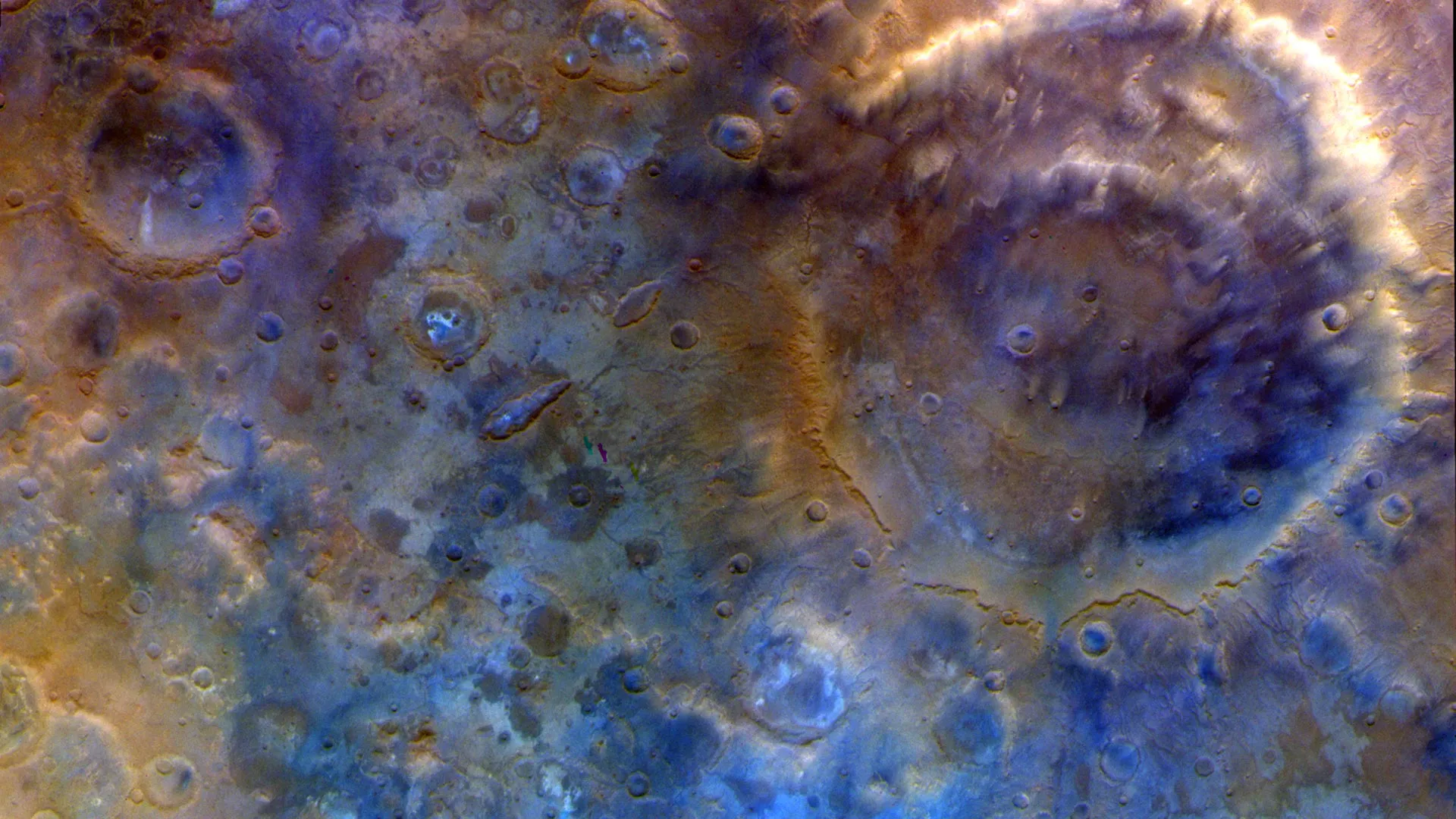
NASA's Psyche spacecraft made a close pass by Mars on May 15, flying within 2,864 miles (4,609 kilometers) of the planet's surface as it continued its long journey through deep space. During the encounter, the spacecraft captured a series of images, including a striking view of the double-ring Huygens crater surrounded by the heavily cratered southern highlands of Mars.
The image was taken using Psyche's multispectral imager instrument and highlights the rugged ancient terrain of the Red Planet.
Mars Gravity Assist Boosts Psyche Mission
The Mars flyby was far more than a photo opportunity. NASA used the planet's gravity to increase the spacecraft's speed and adjust its trajectory without consuming onboard fuel. This technique, known as a gravity assist, helped place Psyche on the correct path toward its ultimate destination, the metal-rich asteroid Psyche.
By using Mars' gravitational pull, mission planners were able to give the spacecraft a major boost while conserving valuable propellant for later stages of the mission.
Journey to a Possible Planetary Core
NASA expects the Psyche spacecraft to arrive at the asteroid in August 2029. Once there, it will enter orbit and begin mapping the asteroid's surface while collecting scientific data.
Researchers are especially interested in Psyche because it may represent the exposed metallic core of an ancient planetesimal, a building block of planets that formed early in the solar system's history. If that theory is correct, the asteroid could provide scientists with a rare opportunity to study material normally hidden deep inside rocky planets like Earth.
Story Source:
Materials provided by NASA's Jet Propulsion Laboratory. Note: Content may be edited for style and length.
Cite This Page: