
Gravitational waves may have created dark matter in the early universe
What if the universe’s oldest ripples forged the dark matter that holds everything together?
- Date:
- April 25, 2026
- Source:
- Johannes Gutenberg Universitaet Mainz
- Summary:
- In the chaotic first moments after the Big Bang, ripples in spacetime may have done more than just echo through the cosmos—they could have helped create dark matter itself. New research suggests that faint, ancient gravitational waves might have transformed into particles that eventually became the invisible substance shaping galaxies today.
- Share:
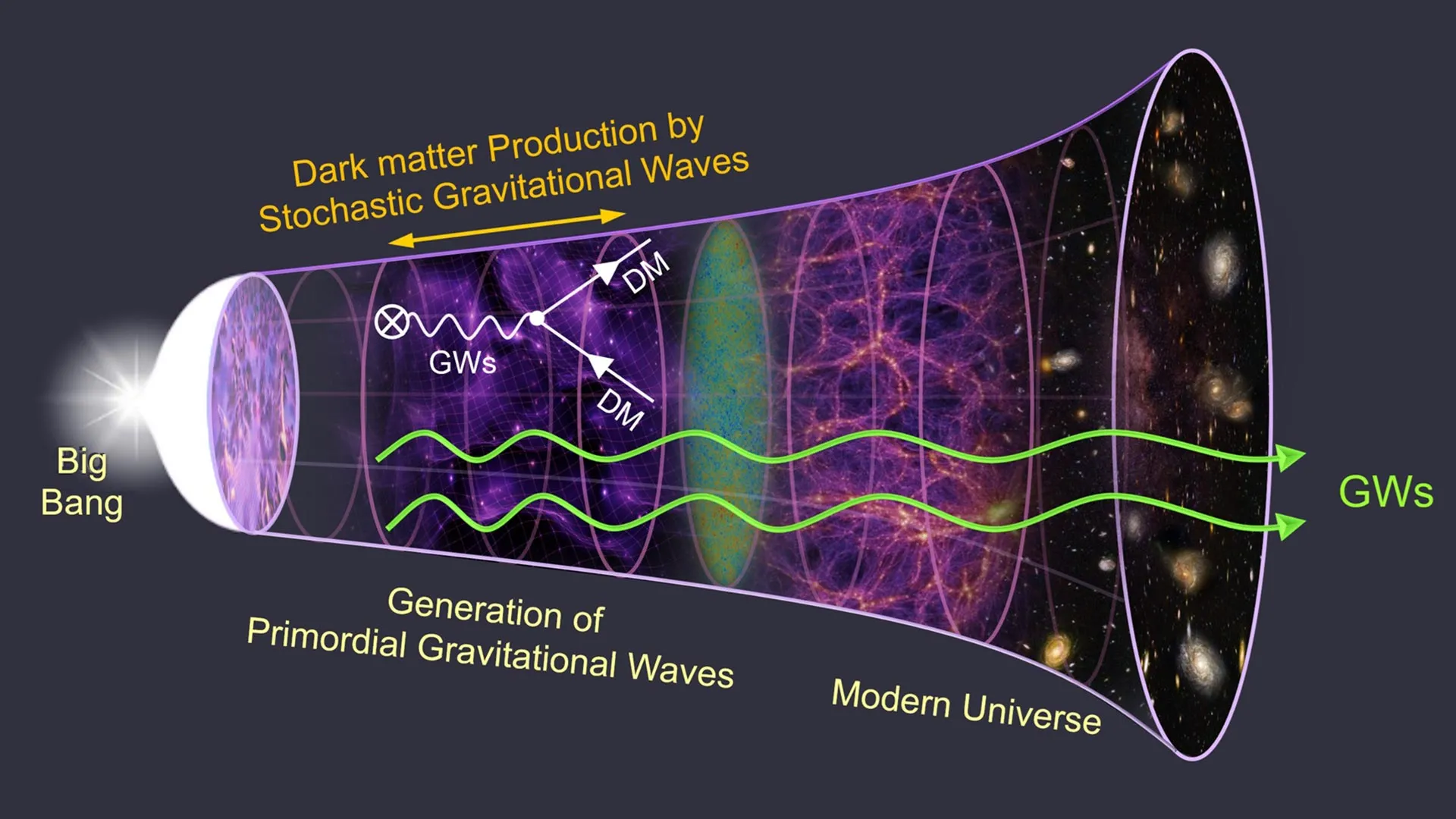
Gravitational waves may have played a key role in creating dark matter during the universe's earliest moments, according to a new study by Professor Joachim Kopp of Johannes Gutenberg University Mainz (JGU) and the PRISMA++ Cluster of Excellence, working with Dr. Azadeh Maleknejad from Swansea University. Published in Physical Review Letters, the research introduces fresh calculations that point to a previously unexplored process in which so-called stochastic gravitational waves could give rise to dark matter.
This work addresses one of the biggest unanswered questions in particle physics. Everything we can see, including planets, stars, and life on Earth, is made of visible matter, yet this accounts for only about four percent of the universe. Most of the cosmos remains unseen, made up of dark matter and dark energy. Dark matter alone represents roughly 23 percent of the universe.
Observations show that dark matter is spread throughout space, shaping galaxies and the largest cosmic structures. Despite its enormous influence, scientists still do not know what dark matter is made of. Numerous theories and experiments are underway to uncover its true nature.
Gravitational Waves and a New Path to Particle Formation
Gravitational waves are ripples in spacetime produced by some of the most energetic events in the universe, such as collisions between black holes or neutron stars. However, not all gravitational waves come from such dramatic events. A different type, known as stochastic gravitational waves, arises from a range of processes that do not involve massive objects.
These waves are much weaker and form part of the background signal that fills the universe. Many of them are extremely ancient, dating back to the earliest phases after the Big Bang. They may have been generated during key moments in cosmic history, including phase transitions as the universe cooled or from primordial magnetic fields.
"In this article, we investigate the possibility of gravitational waves -- which are believed to have been ubiquitous in the early universe -- being partially converted into dark matter particles," Kopp explained. "This leads to a new mechanism of dark matter production that has not been researched before."
From Early Universe Waves to Dark Matter Particles
The study suggests that these early gravitational waves could have produced fermions that initially had little or no mass. Fermions are a broad class of particles that includes familiar examples such as electrons, protons, and neutrons. According to the researchers, these early fermions may have later gained mass and evolved into the dark matter particles that exist today.
What Comes Next for This Theory
"The next step in developing this line of research is to go beyond our analytical estimates and conduct numerical calculations to improve the accuracy of our predictions. Another avenue for future research is the investigation of further possible effects of gravitational waves in the early universe. One example for this would be a mechanism that could account for the well-known difference in particles and antiparticles produced," said Kopp.
Story Source:
Materials provided by Johannes Gutenberg Universitaet Mainz. Note: Content may be edited for style and length.
Journal Reference:
- Azadeh Maleknejad, Joachim Kopp. Gravitational-Wave Induced Freeze-In of Fermionic Dark Matter. Physical Review Letters, 2026; 136 (13) DOI: 10.1103/lr69-45v8
Cite This Page: