
This donut-shaped discovery just shattered a 150-year math rule
- Date:
- April 22, 2026
- Source:
- Technical University of Munich
- Summary:
- A 150-year-old rule in geometry has been proven wrong. Mathematicians found two different doughnut-shaped surfaces that look identical when measured locally but are actually different overall. For decades, researchers suspected this might be possible but couldn’t prove it—until now. The breakthrough reshapes how mathematicians understand the relationship between local measurements and global form.
- Share:
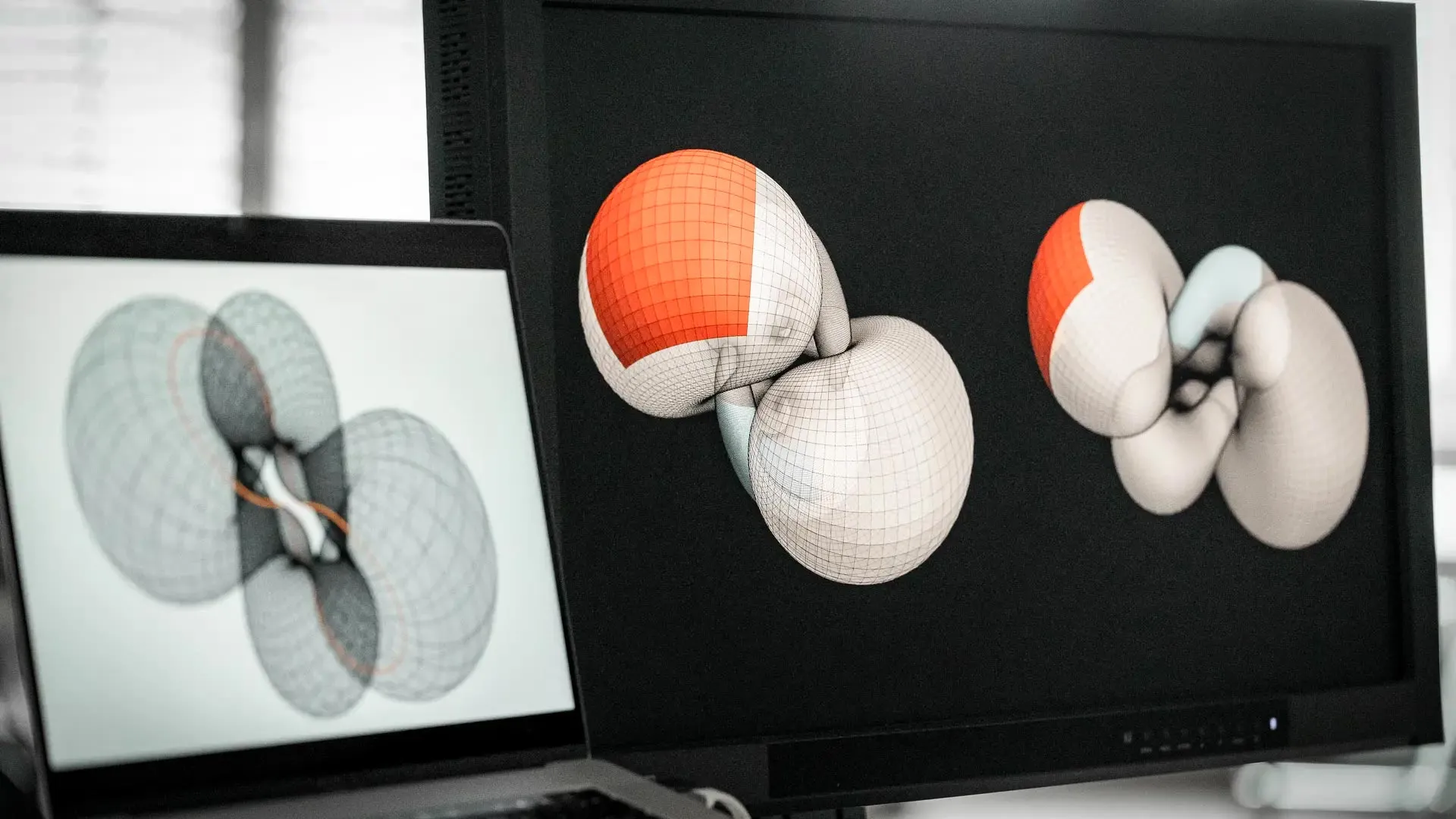
For more than 150 years, a guiding idea in geometry has shaped how mathematicians think about surfaces. Originating with the French mathematician Pierre Ossian Bonnet, the principle states that if you know two key properties of a compact surface at every point, its metric and its mean curvature, then you can determine its exact shape. A new result from mathematicians at the Technical University of Munich (TUM), the Technical University of Berlin, and North Carolina State University now shows that this assumption does not always hold.
To challenge the long-accepted idea, the researchers built two compact, self-contained surfaces shaped like doughnuts, known as tori. These two surfaces share identical values for both metric and mean curvature, yet their overall structures are not the same. This type of example had been sought for decades but had never been found until now.
The metric describes distances along a surface, meaning how far apart two points are when measured across it. Mean curvature captures how the surface bends in space, indicating whether it curves inward or outward and by how much.
Limits of Bonnet's Rule for Surface Geometry
Mathematicians were already aware that Bonnet's rule does not apply in every situation. Known exceptions involved non-compact surfaces, which either extend infinitely, like a flat plane, or have edges where they end. In contrast, compact surfaces such as spheres were thought to follow the rule, with metric and mean curvature fully determining their shape.
For torus-shaped surfaces, earlier work showed that a single set of metric and mean curvature values could correspond to as many as two different shapes. However, no one had been able to produce a clear, concrete example to demonstrate this possibility.
A Long-Sought Counterexample Finally Found
The new work fills that gap. By constructing a pair of tori that match in local measurements but differ globally, the team has provided the first explicit example of this phenomenon.
"After many years of research, we have succeeded for the first time in finding a concrete case that shows that even for closed, doughnut-like surfaces, local measurement data do not necessarily determine a single global shape," says Tim Hoffmann, Professor of Applied and Computational Topology at the TUM School of Computation, Information and Technology. "This allows us to solve a decades-old problem in differential geometry for surfaces."
The finding resolves a long-standing question in geometry and highlights a deeper insight. Even with complete local information, a surface's full shape cannot always be uniquely determined.
Story Source:
Materials provided by Technical University of Munich. Note: Content may be edited for style and length.
Journal Reference:
- Alexander I. Bobenko, Tim Hoffmann, Andrew O. Sageman-Furnas. Compact Bonnet pairs: isometric tori with the same curvatures. Publications Mathématiques de l\'IHÉS, 2025; 142: 241 DOI: 10.1007/s10240-025-00159-z
Cite This Page: