
New MRI breakthrough reveals the brain and eye like never before
A breakthrough MRI antenna could make scans faster, sharper, and far more effective at revealing parts of the body that have long been difficult to image.
- Date:
- July 10, 2026
- Source:
- Max Delbrück Center for Molecular Medicine in the Helmholtz Association
- Summary:
- Scientists have redesigned a key piece of MRI hardware using metamaterials, allowing existing scanners to produce clearer images of difficult-to-see parts of the body in less time. The breakthrough could improve diagnoses, make scans more comfortable, and open the door to new medical imaging and treatment applications.
- Share:
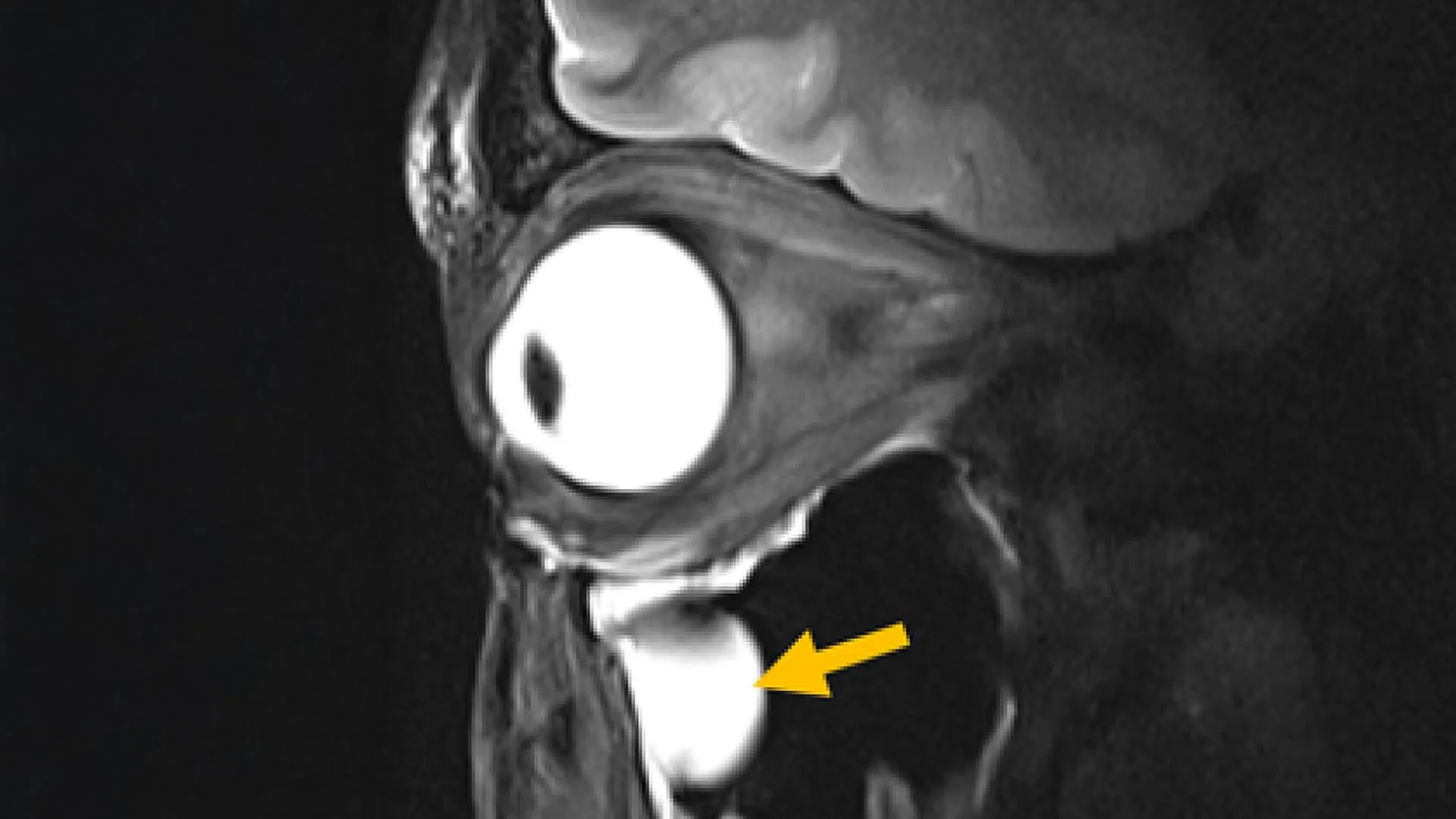
Magnetic resonance imaging (MRI) is one of the most valuable tools doctors use to diagnose disease. Yet even with today's advanced scanners, producing clear images of some areas remains difficult. Deep brain structures and the delicate tissues of the eye and surrounding orbit are especially challenging because of the hardware responsible for transmitting and receiving radiofrequency signals.
Now, a team led by Nandita Saha, a doctoral student in Professor Thoralf Niendorf's Experimental Ultrahigh Field Magnetic Resonance laboratory at the Max Delbrück Center, has developed a new MRI antenna based on advanced engineered materials. The innovation produces sharper images in less time and can be integrated into existing MRI systems rather than requiring entirely new machines. Their findings were published in Advanced Materials.
The project brought together experts in MRI physics, clinical ophthalmology, and translational imaging from the Max Delbrück Center and Rostock University Medical Center. Researchers in Rostock are also helping validate the technology for future clinical use.
"By using concepts from metamaterials, we were able to guide radiofrequency fields more efficiently and demonstrate how advanced physics can directly improve medical imaging," says Niendorf, senior author of the paper. "This work shows a pathway toward faster, clearer MRI scans that could benefit patients in many clinical areas."
Metamaterials Improve MRI Performance
MRI scanners create images by sending radiofrequency (RF) signals into the body while a powerful magnetic field is applied. As tissues respond to those signals, the scanner collects the information needed to generate an image. Stronger signals generally produce clearer, more detailed scans.
Traditional MRI antennas, also known as RF coils, often have trouble collecting enough signal from tissues located deep inside the body or in anatomically complex regions. As a result, image quality can suffer and scanning sessions may take longer.
To overcome this limitation, the researchers incorporated metamaterials directly into the MRI antenna. Metamaterials are specially engineered structures that interact with electromagnetic waves in ways that natural materials cannot. In testing, the new antenna strengthened signals from targeted tissues, increased spatial resolution, improved image sharpness, and accelerated data collection.
An important advantage is that the antenna is compatible with existing MRI equipment, eliminating the need for costly new infrastructure. The researchers tested the design by imaging the eye and orbit in volunteers using a 7.0 Tesla MRI scanner.
"Our research demonstrates clear relevance for ophthalmological applications as it can facilitate anatomically detailed, high-spatial resolution MRI of the eye," says Professor Oliver Stachs, a co-author of the paper at University Medicine Rostock. "It offers the potential to open a window into the eye and into (patho)physiological processes that in the past have been largely inaccessible."
Potential Beyond Eye Imaging
"Our goal was to rethink MRI hardware from the modern physics of antenna design," adds Saha.
She says the technology could also be adapted to help protect sensitive parts of the body during MRI exams by reducing unwanted heating around medical implants. In addition, it may improve MRI guided cancer treatments by directing RF energy more precisely for procedures such as tumor hyperthermia or thermal tissue ablation.
Faster Scans and Better Diagnoses
MRI exams can be lengthy and uncomfortable, particularly when scans need to be repeated because important anatomical details are difficult to capture. By producing clearer images more quickly, the new antenna could shorten scan times while giving physicians greater confidence in their diagnoses.
Because the antenna is compact and lightweight, it can also be customized for different parts of the body, potentially improving patient comfort during imaging.
Niendorf says the design could eventually be adapted for MRI systems operating at magnetic field strengths both lower and higher than 7.0 T. It could also be tailored for imaging organs beyond the eye, orbit, and brain, or used to monitor metabolism and track how drugs move through the body.
The technology may also improve specialized MRI techniques that image atoms other than hydrogen, including sodium and fluorine, by generating stronger signals and higher quality images.
"Innovations in imaging hardware have the potential to transform diagnostics, and this study is an important step toward next-generation MRI technology," says Dr. Ebba Beller, a co-author of the paper at Rostock University Medical Center.
Next Steps
The research team is preparing larger clinical studies involving multiple hospitals while modifying the antenna for additional organs, including the heart and kidneys. The long-standing collaboration between Stachs and Niendorf will also continue through reciprocal visiting scientist appointments.
The project was funded by the DFG as a joint collaboration between the Max Delbrück Center and the Medical University Rostock.
Story Source:
Materials provided by Max Delbrück Center for Molecular Medicine in the Helmholtz Association. Note: Content may be edited for style and length.
Journal Reference:
- Nandita Saha, Bilguun Nurzed, Mostafa Berangi, Andre Kuehne, Helmar Waiczies, Igor Fabian Tellez Ceja, Xiang Hu, Thomas Gladytz, Lisa Krenz, Dave Huebler, Beate Endemann, Claudia Brockmann, Ebba Beller, Oliver Stachs, Thoralf Niendorf. Metamaterial Antennas Enhance MRI of the Eye and Occipital Brain. Advanced Materials, 2026; 38 (32) DOI: 10.1002/adma.202517760
Cite This Page: