
Sun-like star caught after eating one of its own planets
A distant Sun-like star appears to have eaten one of its planets, leaving behind a chemical clue that helped astronomers crack the case.
- Date:
- July 16, 2026
- Source:
- University of Michigan
- Summary:
- A distant Sun-like star appears to have devoured one of its planets, leaving behind a surprising chemical fingerprint. Researchers found an unusually high concentration of lithium, a strong sign that planetary material was mixed into the star. Careful comparisons with dozens of similar stars confirmed the signal is highly unusual, and scientists think a massive brown dwarf companion may have helped send the planet on its fatal plunge.
- Share:
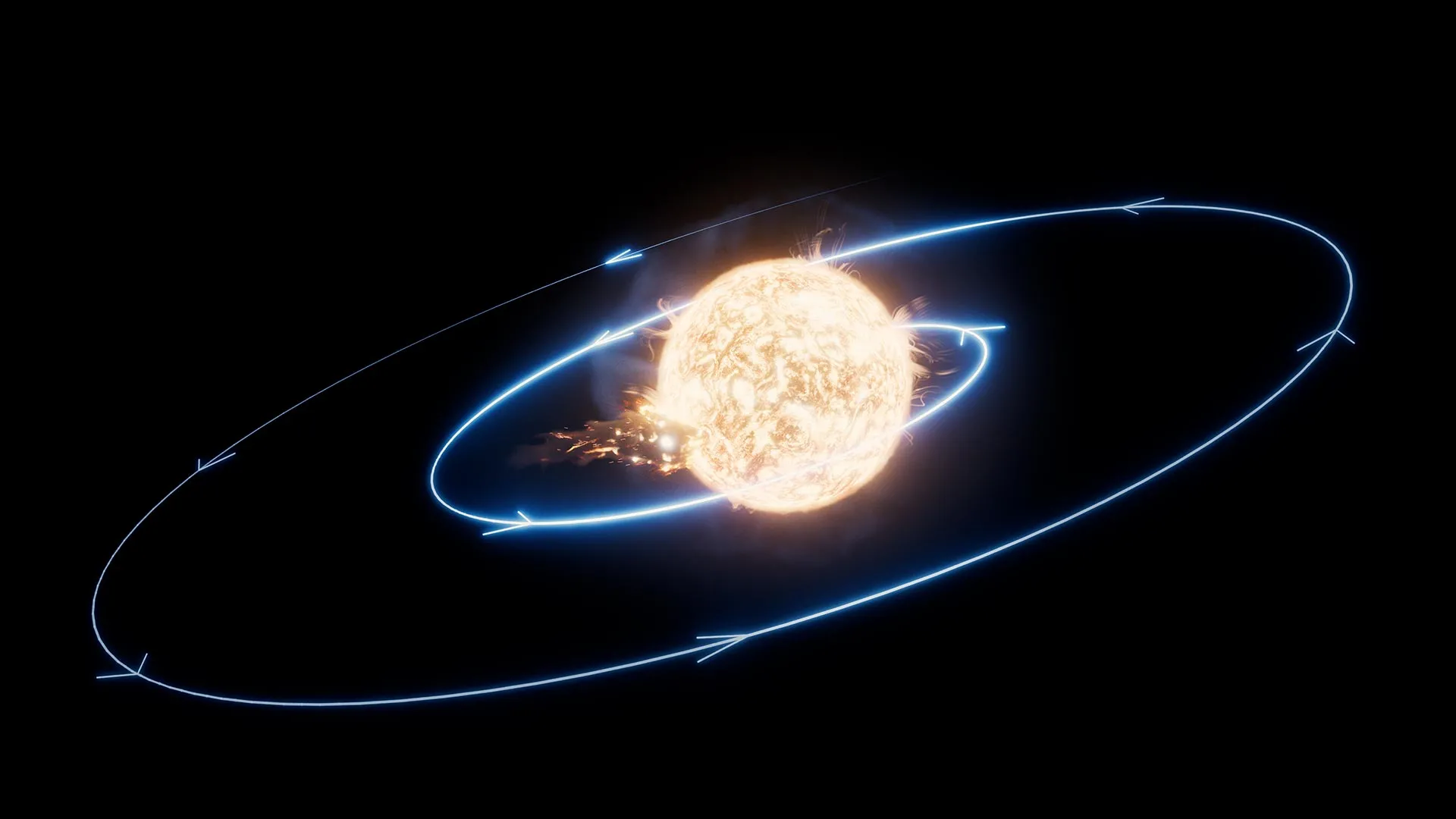
Astronomers have found strong evidence that TOI-5882, a sun-like star about 1,300 light-years from Earth, may have consumed one of its own planets.
The team, led by University of Michigan astronomer Brooke Kotten, discovered an important clue in the star's chemical makeup. TOI-5882 contains far more lithium than researchers would normally expect to find in a star of its type.
"You are what you eat, right?" said Kotten, a graduate student researcher in the U-M Department of Astronomy and lead author of the new report in The Astrophysical Journal. "We know that there's much more lithium in planetary material than there is in stars. So if a star eats a planet, it's going to take on a bunch of lithium."
The research was supported, in part, by federal funding from NASA and the U.S. National Science Foundation.
How Stars Swallow Planets
Astronomers use the term engulfment to describe what happens when a star consumes a planet. These events unfold extremely quickly on cosmic timescales, sometimes lasting only days or weeks.
Because the process is so brief, scientists are unlikely to catch a star in the act. Instead, they must search for chemical traces and other evidence that remain after the planet is gone.
"That's what makes this field so exciting. You really are solving a mystery," said Kotten, who started working on the study as an undergraduate student as part of the Lamat Program at the University of California, Santa Cruz. "We can't just watch the crime happen, so we have to work with all the clues we're given to figure out whodunit."
Learning how to identify these events could help astronomers determine how often stars consume planets and what circumstances cause it to happen.
Our own solar system is expected to experience a similar fate in the distant future. In roughly 5 billion years, the sun will reach a late stage of its life and expand into a red giant. As it grows, it will engulf Mercury, Venus and possibly Earth.
A Brown Dwarf May Have Played a Role
TOI-5882 has not yet expanded enough for its size alone to explain how it could have swallowed a planet. That led the researchers to consider another possibility.
The star may have had help.
A massive gaseous object also orbits TOI-5882. It is more than 20 times as massive as Jupiter but is still too small to ignite and become a true star. Astronomers classify this type of object as a brown dwarf.
The brown dwarf may have disrupted the missing planet's orbit and sent it plunging into TOI-5882. Kotten said that possibility will be investigated in a separate study.
Lithium Provides a Chemical Fingerprint
Lithium offers astronomers a valuable way to investigate planetary engulfment. Stars naturally contain some lithium, but planets generally hold much larger concentrations of the element, said Seth Jacobson, a senior author of the study and assistant professor at Michigan State University.
"Lithium atoms delivered by planetary engulfment to a star are like sports fans arriving at a stadium," he said. "There may already be a few early arriving fans present, representing the initial amount of lithium in the stellar atmosphere, but they are quickly outnumbered."
Judging from the amount of lithium detected in TOI-5882, the researchers estimate that the swallowed planet may have been somewhere between a couple of Earth masses and the mass of Neptune.
"The fact that we can look at a star 1,300 light-years away and say with confidence, 'This star has more lithium than you would expect,' is a testament to both the precision of modern instrumentation and the hard interpretive work that goes into making sense of that signal," said Melinda Soares-Furtado, a senior author of the study and assistant professor at the University of Wisconsin.
Comparing TOI-5882 With Similar Stars
The project brought together 14 researchers from the U.S. and Chilé. The team used spectroscopy, a method that reveals a star's chemical composition by analyzing its light, to search TOI-5882 for signs of lithium.
The observations showed that the star contained a large amount of the element. The next challenge was proving that its lithium level was genuinely unusual rather than normal for a star with similar characteristics.
To test that, the researchers assembled a comparison group of 62 stars with similar ages, masses and temperatures. They then evaluated TOI-5882 against those stars using several different methods.
"And it's not like you have to cherry-pick the data to make it stand out. It's robust," Soares-Furtado said. "No matter how you slice it, TOI-5882 is so enriched in lithium it shows up as being at least in the 97th percentile."
A Rare Star That Preserved the Evidence
The work builds on earlier research by Soares-Furtado that identified the kinds of stars most likely to preserve evidence of planetary engulfment.
Many stars are poor candidates because chemical signatures from swallowed planets can fade or become difficult to distinguish. TOI-5882, however, appeared to be one of the rare stars in which the evidence could still be detected.
A few stars in the comparison group also showed unexpectedly high lithium levels. That finding suggests that planetary engulfment may not be the only process capable of enriching a star with lithium, creating another question for astronomers to investigate.
For Kotten, the uncertainty is part of the appeal.
"When I was growing up, I dreamed about becoming a private investigator," she said. "I think that explains a lot about where I ended up. I do feel like a detective."
Story Source:
Materials provided by University of Michigan. Note: Content may be edited for style and length.
Journal Reference:
- Brooke Kotten, Melinda Soares-Furtado, Ricardo Yarza, Andrew C. Nine, Seth A. Jacobson, Noah Vowell, Olivia Maynard, Allyson Bieryla, Andrew Vanderburg, Jack Schulte, Claudia Aguilera-Gómez, Enrico Ramirez-Ruiz, Joseph E. Rodriguez, David W. Latham. Lithium Enrichment in a Subgiant Star with a Brown Dwarf Companion: A Planetary Engulfment Candidate. The Astrophysical Journal, 2026; 1004 (2): 193 DOI: 10.3847/1538-4357/ae71bb
Cite This Page: