
New quantum gravity theory links entropy, dark energy, and life
Cosmic expansion may allow order and life to emerge even as the Universe’s total entropy relentlessly increases.
- Date:
- July 20, 2026
- Source:
- Queen Mary University of London
- Summary:
- A new theoretical study offers a possible explanation for how the Universe can grow more complex without violating the second law of thermodynamics. Using a quantum gravity framework called Gravity from Entropy, mathematician Ginestra Bianconi found that the Universe’s total entropy may rise as space expands, even while entropy within each unit of volume falls. That decline could leave room for galaxies, stars, planets, and life to form locally amid an overall increase in cosmic entropy.
- Share:
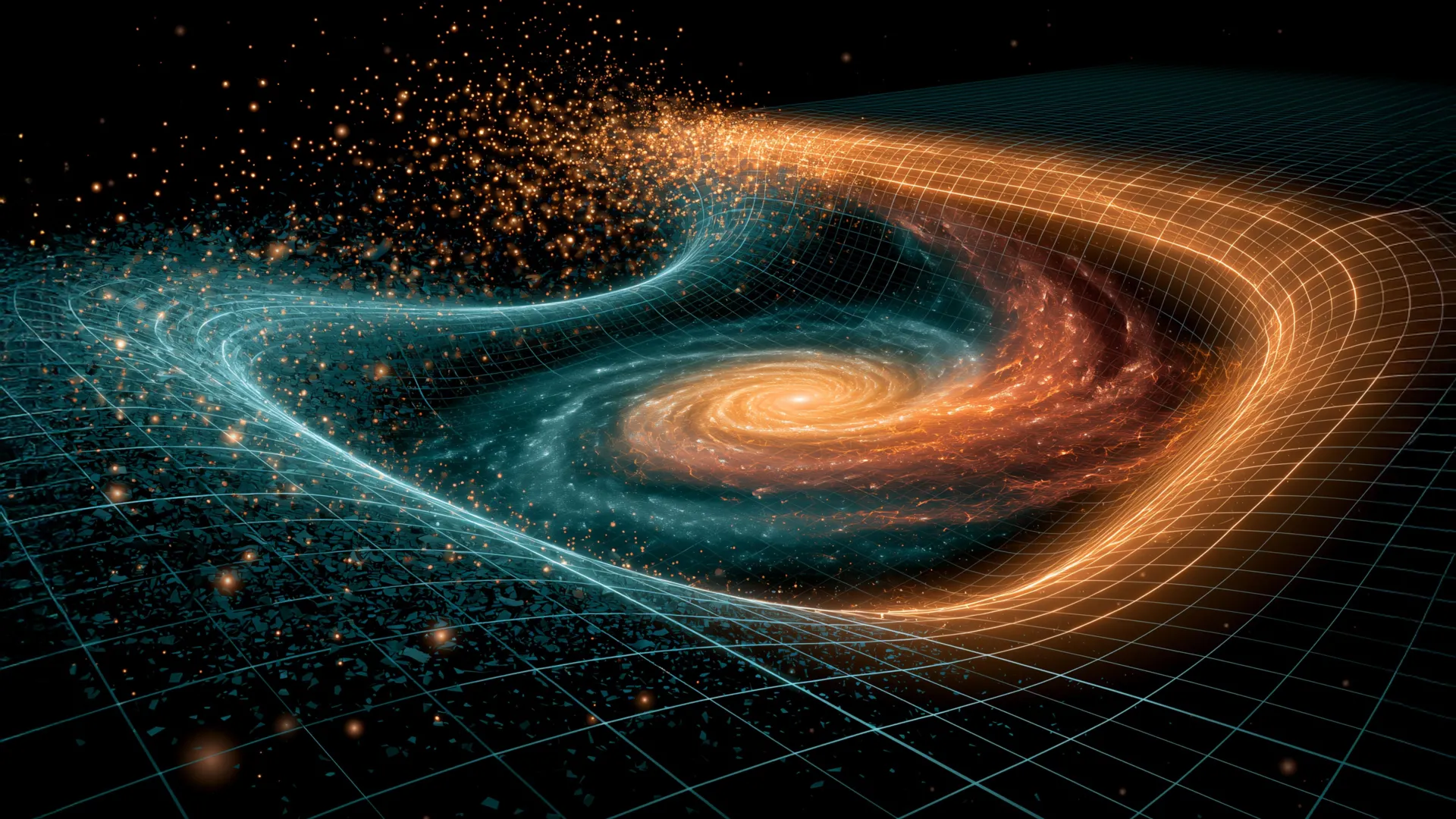
A new theoretical study offers a possible way to address one of modern physics' most difficult puzzles: how did the Universe produce galaxies, stars, planets, and life while continuing to follow the second law of thermodynamics?
The research was led by Professor Ginestra Bianconi, a mathematician at Queen Mary University of London. Her work examines whether a theory known as Gravity from Entropy can help explain how cosmic complexity emerges even as the Universe's total entropy increases.
The Universe's Entropy Puzzle
Einstein famously stated that "The second law of thermodynamics occupies a unique position among the laws of Nature," reflecting his view that it was one of the most secure and fundamental principles in physics.
The second law says that the total entropy of an isolated system generally increases over time. Entropy is often described as a measure of disorder, although it more precisely reflects how energy and information can be distributed within a system.
That principle creates a major challenge for cosmology. Scientists generally think the early Universe began in a state of low entropy and has steadily moved toward higher entropy. At the same time, matter has organized itself into increasingly elaborate structures, from galaxies and stars to planets and living organisms.
Explaining how this growing complexity can coexist with the continual rise of entropy remains an unresolved problem.
A New View Through Gravity From Entropy
In a paper published in Physical Review D, Bianconi investigates the puzzle using Gravity from Entropy (GfE), a proposed approach to quantum gravity.
The theory uses ideas from statistical mechanics to describe gravity as something that emerges from the microscopic properties of spacetime geometry. Rather than treating gravity only as a fundamental force or as the curvature of spacetime, GfE connects it to information and entropy at the quantum level.
Bianconi's analysis reveals a potentially important distinction. Although the Universe's total entropy increases over time, the amount of entropy per unit of volume decreases as the Universe expands.
This behavior could offer a new way to understand how organized structures can develop locally without violating the second law of thermodynamics.
Black Holes Connected Gravity and Heat
The idea that gravity and thermodynamics are deeply linked dates back to the pioneering work of Jacob Bekenstein and Stephen Hawking in the 1970s.
Their discoveries showed that black holes have entropy and can emit thermal radiation. These findings transformed the scientific understanding of black holes and pointed to a much deeper connection among spacetime, information, gravity, and heat.
Gravity from Entropy builds on this broader relationship.
According to GfE, gravity emerges from an informational tension between the actual spacetime metric and another metric produced by matter fields and spacetime curvature. A metric is the mathematical structure used to describe distances and geometry in spacetime.
This interpretation is expressed through the GfE Lagrangian, which is defined by the Quantum Geometric Relative Entropy (QGRE) between the two metrics.
A Possible Link to Dark Energy
At low energies and under conditions of weak spacetime curvature, the equations of Gravity from Entropy reproduce General Relativity. Under more extreme conditions, however, the predictions begin to differ.
Beyond this weak limit, the GfE equations produce a changing dark energy contribution. Because this term evolves dynamically, it could potentially generate predictions that researchers might eventually test through cosmological observations.
The study examines these thermodynamic effects in Friedmann-Robertson-Walker cosmological spacetimes, which are mathematical models commonly used to describe a Universe that expands uniformly on large scales.
The results indicate that the local geometric components of spacetime obey a version of the first law of thermodynamics. In this description, the emerging dark energy contribution acts as internal energy, while the Quantum Geometric Relative Entropy (QGRE) represents the local entropy per unit of volume.
Quantities corresponding to effective temperature and pressure also arise naturally from the theory. Together, these results suggest that the quantum state underlying Gravity from Entropy may have an inherent thermal character.
Expansion Spreads Entropy Across Space
The study also emphasizes the importance of the local volume element determined by the physical spacetime metric.
As the Universe expands, its volume grows. Within the GfE framework, that increasing volume causes total entropy to rise, even as the local QGRE within each unit of volume gradually declines.
In other words, the Universe can contain more entropy overall while entropy becomes more widely distributed across expanding space. This unusual thermodynamic pattern may help clarify how localized regions of structure and complexity can arise.
Gravity and Spacetime May Be Thermodynamic
The findings support the possibility that gravity and spacetime have both informational and thermodynamic foundations.
Such an interpretation could provide new ways to investigate the relationships among gravity, quantum theory, dark energy, cosmic evolution, and the emergence of complex structures.
The proposal remains at an early theoretical stage. However, the researchers say it may contribute to efforts to connect general relativity, thermodynamics, quantum mechanics, and cosmology within a broader framework.
"This work reveals how the Gravity from Entropy theory can tackle the challenging question to reconcile the second principle of thermodynamics with the emergence of complexity in our Universe. These results may open new avenues for investigating the long-standing problem of reconciling the foundations of cosmological irreversibility, the emergence of complex structures, and ultimately life, with fundamental gravitational dynamics," says Professor Bianconi.
Story Source:
Materials provided by Queen Mary University of London. Note: Content may be edited for style and length.
Journal Reference:
- Ginestra Bianconi. Thermodynamics of the gravity from entropy theory. Physical Review D, 2026; 114 (2) DOI: 10.1103/26kn-thgp
Cite This Page: