
Black holes may spit out nearly as much matter as they swallow
Black holes may be less like bottomless pits and more like cosmic digestive systems that swallow, process, and spit matter back into space.
- Date:
- July 31, 2026
- Source:
- University of Warwick
- Summary:
- A black hole observed during a dramatic 2023 eruption did not simply devour gas from its nearby companion star. It also expelled large amounts of material through powerful jets and winds, even after the outburst had nearly faded. The results suggest black holes may continue reshaping their surroundings long after their brightest fireworks end.
- Share:
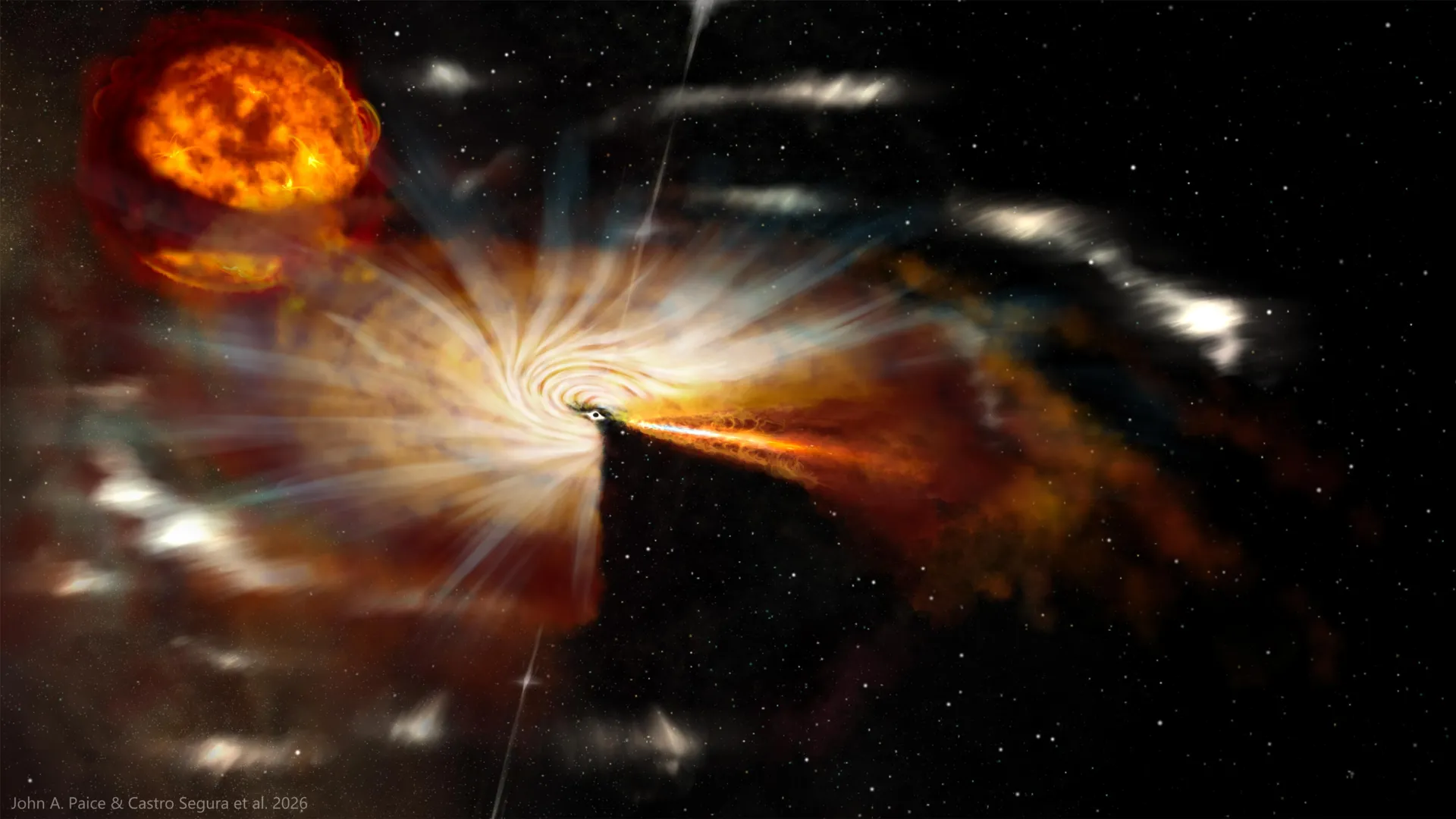
Astronomers led by the University of Warwick have uncovered what they describe as a kind of cosmic digestive system around a black hole. Their observations show that even when a black hole appears faint, it may still be actively expelling large amounts of matter rather than simply swallowing everything nearby.
Black holes are often pictured as unstoppable cosmic gluttons. However, new observations of a dramatic outburst led by Warwick Postdoctoral Fellow Dr. Noel Castro Segura reveal a far more complicated feeding process.
Using the European Southern Observatory's Very Large Telescope (VLT), the team tracked the recently discovered black hole system Swift J1727.8−1613 throughout a spectacular eruption in 2023.
A Black Hole That Eats and Expels Matter
As the black hole pulled gas from a nearby star, it also sent some of that material back into space through powerful jets and winds. The researchers found that these large outflows can continue even when the black hole becomes extremely faint and its activity falls to levels much lower than scientists previously expected.
The results suggest that black holes may not behave like bottomless pits. Instead, they may act more like powerful cosmic digestive systems that take in matter, process it, and eject a surprising portion back into space.
"People often imagine black holes simply swallowing everything around them," said lead author Dr. Noel Castro Segura, a Postdoctoral Fellow at the University of Warwick. "What we're seeing is a much more complex process. Matter falls in, the system processes it, and a surprising amount is expelled again."
The research produced one of the most detailed optical records ever assembled of a black hole outburst. Rather than capturing only a few isolated moments, astronomers were able to follow the system as it moved through several different stages of activity.
A Rare View of a Black Hole Feeding in Real Time
Swift J1727.8−1613 was discovered after it suddenly erupted in 2023 and quickly became one of the brightest X-ray sources in the sky. The system contains a black hole drawing gas away from a nearby star, forming a rapidly spinning disc of superheated material around it.
Because the outburst was observed in such detail, astronomers were able to watch the feeding process evolve in real time. Events like this have rarely been monitored with such high quality across so many stages.
One of the most striking discoveries came when the black hole launched a powerful jet. At the same time, the disc supplying material to the black hole underwent major changes.
This gave researchers an unusually clear look at the relationship between matter moving inward toward a black hole and matter being thrown outward into space.
Powerful Winds Continued After the Outburst Faded
The biggest surprise appeared after the black hole's feeding frenzy had mostly died down. Even when Swift J1727 had dimmed to roughly one hundredth of its peak activity, astronomers still detected dense gas being blown away from the system.
This finding indicates that black holes may continue producing strong outflows long after their brightest phase has ended. The amount of material expelled could even be comparable to the amount that the black hole eventually consumes.
Reflecting on the digestive process of black holes, Dr. Noel Castro Segura continued, "if black holes can continue shedding material even after their largest outbursts, it means they may be much less efficient eaters than we previously assumed. A significant fraction of the meal may never reach the black hole at all, changing our understanding of how binary stars in galaxies evolve."
Black Holes May Be Inefficient Eaters
The observations add to growing evidence that black holes do more than consume matter. They are active systems that can redistribute material throughout their surroundings by drawing gas inward and then returning a substantial portion through jets and winds.
Commenting on the research, Kyle Solomons, Doctoral Researcher at the University of Cape Town, said: "We usually gravitate towards the dramatic fireworks when a black hole outburst begins, but our observations show that the finale can be just as intense. Even as the system's X-ray emission dropped to a fraction of its peak, it still had enough power to generate a massive expulsion of gas."
By following Swift J1727.8−1613 through an entire outburst, astronomers were able to observe nearly the full cycle of feeding, transformation, and expulsion. The result provides one of the clearest views yet of how black holes consume matter, respond to changing conditions, and shape the space around them.
Story Source:
Materials provided by University of Warwick. Note: Content may be edited for style and length.
Journal Reference:
- N Castro Segura, K Solomons, J M Corral-Santana, C Knigge, P A Charles, M Brigitte, S Fijma, M Díaz Trigo, A Gúrpide, D A H Buckley, F Carotenuto, A J Castro-Tirado, D L Coppejans, M Georganti, A Hughes, K S Long, J Matthews, I Monageng, I Pelisoli, T D Russell, D Steeghs, J Svoboda, A J Tetarenko, F M Vincentelli, A G W Wallis. Optical outburst evolution of the transient black hole X-ray binary Swift J1727.8−1613: disc response to jet ejections and late-outburst emergence of powerful disc winds. Monthly Notices of the Royal Astronomical Society, 2026; 550 (4) DOI: 10.1093/mnras/stag1175
Cite This Page: