
Smaller EV batteries, longer range? Scientists may have found a way
- Date:
- October 28, 2026
- Source:
- The Korea Advanced Institute of Science and Technology (KAIST)
- Summary:
- Scientists have developed a new technology that could make electric vehicle batteries smaller, lighter, and longer-lasting, potentially allowing cars to travel farther on a single charge. By borrowing precision manufacturing techniques from computer chip production, they found a way to prevent damaging lithium buildup that has held back next-generation batteries.
- Share:
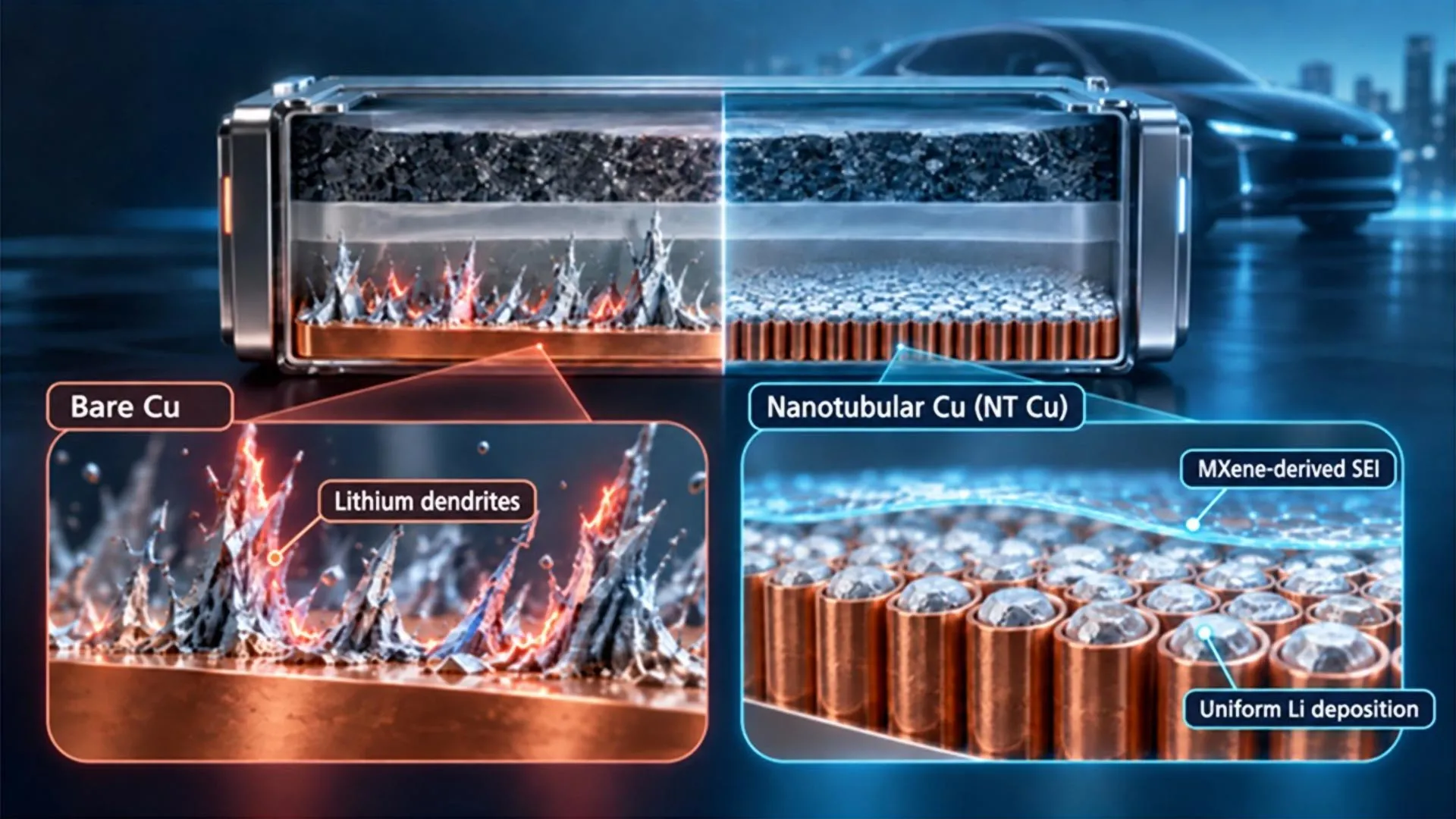
Researchers in South Korea have developed a new technology that could lead to smaller, lighter electric vehicle (EV) batteries capable of delivering longer driving ranges on a single charge. Scientists at KAIST have found a way to address a major weakness of anode-free batteries, which eliminate conventional materials such as graphite to reduce battery size and weight. Although these batteries can store more energy in less space, their lifespan is often limited by the formation of sharp lithium structures during charging. The researchers tackled this problem by adapting precision manufacturing techniques from the semiconductor industry, allowing lithium to accumulate more evenly while encouraging the development of a durable protective layer.
On September 22, KAIST (President Choongsik Bae) announced the breakthrough by a collaborative team led by Professors Jinwoo Lee and Hee-Tae Jung of its Department of Chemical and Biomolecular Engineering. The project also involved scientists from Kyungpook National University (President Heo Young-woo) and the National NanoFab Center (President Park Heung Soo). By applying extremely precise fabrication methods traditionally used to manufacture semiconductor devices, the researchers developed an approach that extends the operating life of anode-free batteries without significantly increasing their size or weight.
Why Anode-Free Batteries Could Transform Electric Vehicles
In conventional lithium-ion batteries, lithium is stored in an anode made from materials such as graphite when the battery charges. Anode-free batteries operate differently. Instead of relying on a separate anode material, they allow lithium to accumulate directly on a thin sheet of copper foil.
Removing the conventional anode eliminates material that would otherwise contribute to the battery's overall weight and thickness. This makes it possible to store more energy within the same amount of space, potentially allowing electric vehicles to travel farther without requiring larger or heavier battery packs.
However, this promising design comes with a serious drawback. As the battery repeatedly charges and discharges, lithium does not always spread evenly across the copper surface. Instead, it can accumulate in branching or needle-like formations called dendrites.
These structures interfere with battery performance, while the protective layer surrounding the lithium can also become unstable. Together, these problems cause the battery to deteriorate more quickly, making limited lifespan one of the biggest barriers to bringing anode-free batteries into widespread commercial use.
Previous attempts to address this issue have included supplying additional lithium to replace material lost during operation or covering the electrode with a thicker protective coating. Although these approaches can help compensate for degradation or shield the surface, they also introduce additional material. The resulting increase in thickness and weight undermines the main advantage of anode-free battery technology.
Borrowing Semiconductor Technology To Prevent Lithium Spikes
Rather than adding substantial amounts of material, the KAIST-led team focused on changing the structure of the copper foil where lithium accumulates.
The researchers created a carefully arranged pattern of microscopic tubes across the copper surface. The concept resembles dividing a large parking lot into many individual spaces. Instead of allowing lithium to collect unevenly in certain areas, the tiny structures provide a more uniform distribution of locations where it can settle.
To produce these features, the team adapted a semiconductor manufacturing technique known as secondary sputtering lithography (SSL). This process makes it possible to fabricate extremely small structures with high precision.
Each tube measured approximately 300 nanometers across and 150 nanometers tall. Despite their tiny dimensions, the structures increased the copper foil's available surface area for lithium deposition to roughly four times that of an ordinary flat sheet.
The expanded surface helps distribute lithium more evenly, reducing the concentrated buildup that can lead to damaging spikes. This approach improves the conditions for stable lithium deposition without relying on large amounts of additional material.
An Ultrathin Protective Coating Helps Batteries Last Longer
The researchers went a step further by applying a coating of MXene, a two-dimensional material, to the copper foil. The coating was approximately 10 nanometers thick, equivalent to only a few thousandths of the thickness of a human hair.
Instead of functioning as the battery's final protective barrier, the MXene acts as a foundation that encourages a stronger protective layer to develop during operation. Much like a primer prepares a surface for paint, it helps bring together the ingredients needed to create a stable coating.
In the LiPF6-based electrolyte used in the experiments, the MXene surface promotes the formation of a protective layer containing high concentrations of lithium fluoride (LiF).
This layer helps limit unwanted chemical reactions between the lithium and the electrolyte while also restricting the growth of damaging lithium spikes. By stabilizing the electrode surface, it addresses two important causes of deterioration in anode-free batteries.
To understand how the protective layer develops, the scientists examined the electrode surfaces and internal cross sections while carefully limiting their exposure to air. Their observations confirmed that a nanoscale protective layer forms evenly along the MXene surface and helped explain the process responsible for its formation.
The investigation involved several advanced analytical methods, including X-ray photoelectron spectroscopy (XPS), time-of-flight secondary ion mass spectrometry (ToF-SIMS), and transmission electron microscopy (TEM).
A Promising Step Toward Smaller, Longer-Lasting EV Batteries
Professor Jinwoo Lee said, "This study shows how ultrafine fabrication techniques used in semiconductor manufacturing can create both uniform sites for lithium deposition and a stable protective layer without changing the bulk electrolyte formulation or adding excess lithium."
He also explained that the findings could help accelerate the commercial development of high-energy anode-free batteries. By improving battery lifespan while keeping additional weight and volume to a minimum, the technology could support the development of more compact energy storage systems for future electric vehicles.
KAIST researchers Eunji Kim, Hyunju Jung, and Jinuk Kim served as co-first authors of the study. The findings were published online on September 1 in the international journal Advanced Functional Materials.
The research received funding from the Nano&Material Technology Development Program through the National Research Foundation of Korea (NRF), supported by the Ministry of Science and ICT (RS-2026-25542167). Additional support came from the Global Semiconductor Advanced Fab Utilization Project through the National Nano Fab Center (NNFC) and the Semiconductor-Secondary Battery Interfacing Platform Technology Development Project of NNFC.
Story Source:
Materials provided by The Korea Advanced Institute of Science and Technology (KAIST). Note: Content may be edited for style and length.
Journal Reference:
- Eunji Kim, Hyunju Jung, Jinuk Kim, Sung‐Jin Chang, Gyungtae Kim, Yun Chang Park, Yoon Kyung Seo, Kyung Jin Park, Sodam Choi, Kwangduck Seo, Hee Han, Su‐Ho Cho, Chi Won Ahn, Vy Thuy Nguyen, Hyeyoung Shin, Minji Lim, Hee‐Tae Jung, Yonghee Lee, Jinwoo Lee. Anion‐Interactive Anode Interfaces for Stable Anode‐Free Lithium Metal Batteries. Advanced Functional Materials, 2026; 36 (80) DOI: 10.1002/adfm.77931
Cite This Page: