
ESA’s Hera spacecraft is flying rectangles around NASA’s asteroid crash site
- Date:
- November 15, 2026
- Source:
- European Space Agency (ESA)
- Summary:
- Europe’s Hera spacecraft has arrived at the scene of NASA’s historic asteroid collision to uncover what really happened when a spacecraft slammed into Dimorphos in 2022. Its close-up investigation could reveal whether the impact left a crater or reshaped the asteroid entirely, providing crucial clues for protecting Earth from future threats.
- Share:
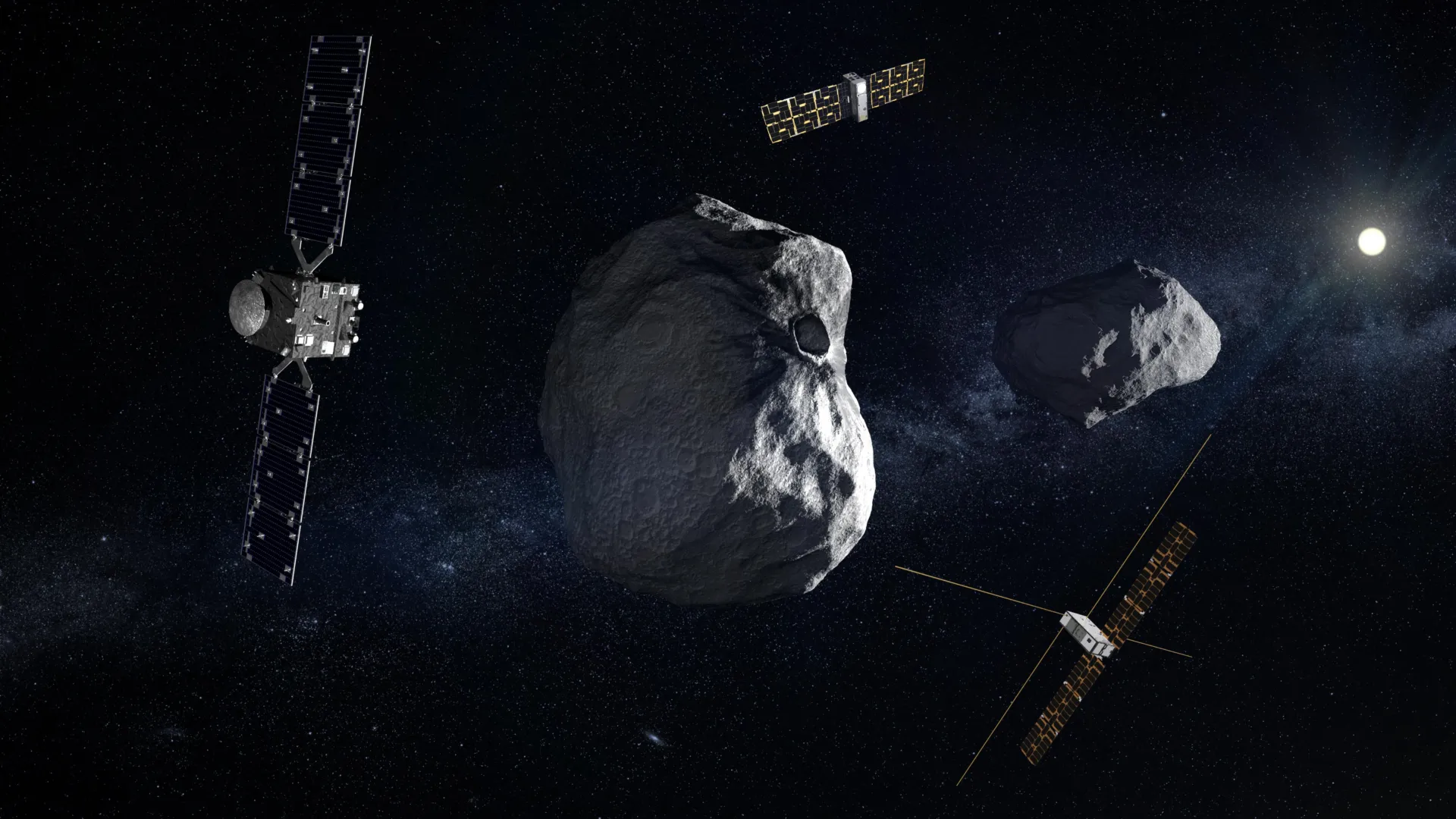
The European Space Agency's Hera spacecraft has reached its destination, arriving near two asteroids that could help scientists learn how to protect Earth from dangerous space rocks. The spacecraft, which is roughly the size of a small car, is now traveling about 25 to 30 kilometers from the Didymos asteroid system as it begins its first scientific observations.
This initial stage, known as the "early characterization phase," is designed to give researchers a broad understanding of the two asteroids and their surroundings. Of particular interest is Dimorphos, the smaller asteroid that NASA deliberately struck with its DART spacecraft in 2022 to test whether a collision could change an asteroid's path.
"Our aim right now is to gather the big-picture findings of relevance to supporting the mission's planetary defense goals," explains mission scientist Michael Kueppers.
"During this phase, our images will reveal for the first time what a small asteroid looks like globally, having experienced a hypervelocity impact in the context of the first asteroid deflection test, when NASA's DART spacecraft impacted it to change its orbit in 2022."
"Previous predictions by our impact models suggested many different ways the asteroid body might react, but Hera will reveal which forecast was the correct one - if any!"
Why Hera Is Flying in Rectangles Around Two Asteroids
Navigating around asteroids presents challenges that are very different from those encountered by spacecraft exploring planets. The main asteroid, Didymos, measures approximately 780 meters across and has gravitational pull about 40,000 times weaker than Earth's. Its smaller companion, Dimorphos, is just 151 meters wide and has gravity roughly 200,000 times weaker than Earth's.
With gravity this weak, maintaining a conventional circular orbit is not practical. Hera instead travels around the shared center of gravity of the two asteroids, moving at a remarkably slow speed of approximately 12 centimeters per second. That is comparable to the pace of an insect crawling quickly across the ground.
Rather than following a smooth circular path, Hera moves along nearly straight trajectories. At alternating intervals of three and four days, the spacecraft fires its thrusters while moving away from the asteroids, changing direction by 90 degrees. These carefully timed maneuvers create a series of unusual "rectangular orbits" that keep Hera approximately 25 to 30 kilometers from the asteroid pair.
The unusual navigation strategy builds on experience gained during ESA's Rosetta comet mission. It also provides an important safety advantage. If a planned thruster firing fails, Hera will naturally drift farther from the asteroids instead of moving toward a potentially dangerous collision. Because the spacecraft travels so slowly, each course correction requires very little propellant.
Hera Prepares for a Closer Look at the Asteroids
Next month, Hera is expected to begin its "detailed characterization phase," bringing it significantly closer to Didymos and Dimorphos. During this stage, the spacecraft will switch from rectangular flight paths to more complex hyperbolic trajectories shaped like bowties, beginning at distances of approximately 20 kilometers.
The mission is directed from ESA's ESOC mission control center in Darmstadt, Germany. Despite Hera being approximately 196.5 million kilometers from Earth, controllers maintain contact with the spacecraft for about eight hours each day.
Communication is handled through four enormous Deep Space Antennas, each measuring 35 meters in diameter, at facilities in Argentina, Spain, and Australia.
The mission control team also works closely with ESA's Flight Dynamics team. Using data transmitted by Hera, these specialists calculate its exact location relative to the two asteroids and develop the commands needed to guide it safely from one planned position to another.
Investigating NASA's Historic Asteroid Collision
Hera's observations will help answer some of the biggest questions left unanswered by NASA's first asteroid deflection experiment.
On September 26, 2022, NASA's DART spacecraft deliberately collided with Dimorphos. The 580-kilogram spacecraft struck the asteroid at approximately 6.1 kilometers per second, producing a massive cloud of debris that spread across 10,000 kilometers of space.
The impact successfully changed Dimorphos' motion, shortening the time it takes to orbit Didymos by about 33 minutes. This was a major achievement for planetary defense, demonstrating that deliberately crashing a spacecraft into an asteroid could alter its trajectory.
However, the experiment also raised important questions. Scientists still do not know exactly how the impact changed Dimorphos itself. Did the collision excavate a large crater, or did it significantly reshape the entire asteroid?
Researchers also need more precise information about Dimorphos' composition, internal structure, and mass. Understanding these properties could explain why the impact produced a much larger orbital change than computer simulations had predicted.
These details are essential for developing the collision method, known as kinetic impact, into a dependable planetary defense strategy. If scientists can determine how different types of asteroids respond to being struck, they will be better equipped to predict the results of future attempts to redirect potentially hazardous objects.
A Close-Up Investigation of the Asteroid Crash Site
Over the coming months, Hera will conduct a detailed investigation of Dimorphos, effectively examining the scene of NASA's historic collision.
The spacecraft will use several scientific instruments to study the asteroid and will release two small CubeSats, each about the size of a shoebox. These miniature spacecraft will travel even closer to the asteroid to collect additional measurements, with the mission eventually advancing to landing operations.
Together, the observations should provide scientists with a much clearer understanding of how Dimorphos responded to DART's impact and why the experiment worked so effectively. That knowledge could prove crucial if Earth ever faces a dangerous asteroid on a collision course.
Story Source:
Materials provided by European Space Agency (ESA). Note: Content may be edited for style and length.
Cite This Page: