
A tiny ocean worm just revealed a big secret about how eyes evolve
Light-sensitive stem cells help bristleworms keep growing their eyes, revealing a surprising evolutionary link to vertebrates.
- Date:
- December 2, 2025
- Source:
- University of Vienna
- Summary:
- Scientists found that adult bristleworm eyes grow continuously thanks to a rim of neural stem cells similar to those in vertebrate eyes. This growth is surprisingly regulated by environmental light via a vertebrate-like c-opsin. The discovery reveals deep evolutionary parallels between distant species and raises questions about how light shapes nervous systems beyond vision. It hints at hidden complexity in creatures long assumed to be simple.
- Share:
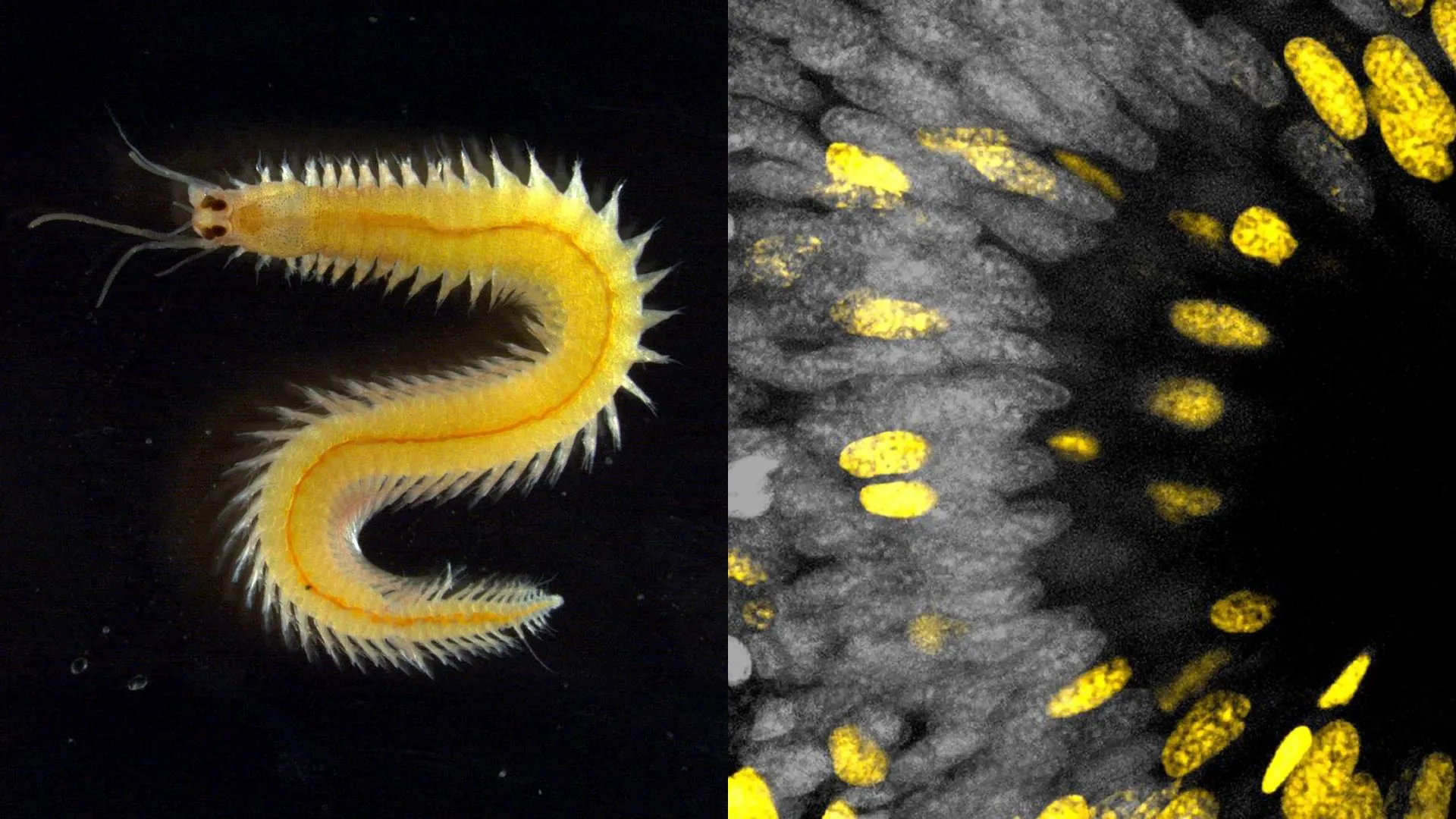
A research team from the University of Vienna and the Alfred Wegener Institute in Bremerhaven has uncovered how the eyes of adult marine bristleworms continue to increase in size throughout their entire lifespan. The work shows that this constant growth is powered by a ring of neural stem cells that resembles similar structures found in vertebrate eyes. These stem cells are also responsive to light in the environment. The study, published in Nature Communications, provides new perspectives on eye evolution and highlights how light can influence the adult nervous system, even in species often viewed as biologically simple.
People typically associate complex eyes with mammals, birds, or perhaps octopuses. However, marine annelid worms such as the bristleworm Platynereis dumerilii possess eyes with a camera-like design similar to those in vertebrates and cephalopods, and some species can see with surprising detail. Scientists have long wondered how these invertebrate eyes continue growing during adulthood. A collaborative team from the University of Vienna, the Alfred Wegener Institute in Bremerhaven, and the University of Oldenburg set out to investigate this question and uncovered findings that challenge traditional assumptions.
Parallel Evolution and Hidden Growth Zones
Camera-type eyes in both vertebrates and invertebrates are classic examples of parallel evolution, arising independently as comparable solutions to similar biological needs. To understand how such eyes keep developing after maturity, the researchers examined the adult eyes of Platynereis, a well-established model organism for studying photoreceptors and brain evolution.
Using single-cell RNA sequencing, first author Nadja Milivojev of the Department of Neurosciences and Developmental Biology, University of Vienna, identified molecular signatures associated with stem cells and charted their location and behavior in the worm retina. Her work revealed a distinct region along the rim of the retina that is densely filled with dividing neural stem cells whenever the adult eye is expanding. "It was remarkable to find dividing cells at the edge of the worm's retina -- the same place where some groups of vertebrates maintain their retinal stem cells for life-long eye growth," Milivojev says.
This region, known as the "ciliary marginal zone," is believed to support continuous eye growth, a pattern now also observed in the bristleworm retina. Senior author Florian Raible, University of Vienna, notes that in vertebrates such as fishes and amphibians, this region produces new retinal neurons while the organism continues to grow. He explains, "Remarkably, Nadja's work showed that bristleworm eyes can also add new photoreceptor cells and expand their size -- a trait that has not been well studied outside the vertebrate lineage."
Light-Responsive Mechanisms in Eye Development
The team also found that light in the worms' surroundings plays a direct role in regulating eye growth. Genetic and molecular analyses revealed that a light-sensitive protein called c-opsin is responsible for this effect. This molecule is also found in vertebrate rod and cone cells. Earlier research suggested that worm eyes relied on a different class of opsins, so the presence of a vertebrate-type c-opsin came as an unexpected discovery. Milivojev and colleagues determined that this molecule appears in early precursors of the worm's photoreceptor cells, indicating that it acts as a molecular switch connecting light exposure to stem cell activity. These results show that visual systems not only detect light but can also adjust their development in response to it.
Evolutionary Connections and New Questions
The findings address a long-standing gap in understanding how both vertebrate and invertebrate eyes continue growing and sustaining themselves. Showing that Platynereis eyes depend on a ring of neural stem cells brings researchers closer to uncovering universal principles that guide the evolution of sensory organs. The results also raise several new questions. Could other stem cell populations in the body react to environmental light? And how might artificial lighting interfere with these natural biological processes? The researchers hope that future studies exploring the worm's stem cell systems will help answer these questions, offering new insight into how the nervous system adapts and repairs itself. Senior author Kristin Tessmar-Raible (University of Vienna, Alfred Wegener Institute, University of Oldenburg) emphasizes that "basic research to uncover the unexpected is essential to understand the biological complexity of life and the possible consequences of anthropgenic impacts."
Summary
- Researchers from the University of Vienna and the Alfred-Wegener Institute studied adult marine bristleworms, a valuable model for uncovering how eyes and brains develop and how light influences biology beyond vision.
- The team found that the eyes of Platynereis dumerilii keep growing throughout the worm's entire life. This ongoing growth is powered by a ring of neural stem cells similar to the growth zone seen in certain vertebrates that continue expanding their eyes as adults.
- Their work helps resolve a long-standing question about how camera-type eyes in both invertebrates and vertebrates grow and maintain themselves. The findings suggest that even across very different evolutionary paths, many animals rely on shared cellular strategies for growth and flexibility.
- By showing that Platynereis eyes depend on this stem cell ring, the study brings scientists closer to identifying universal rules that shape the evolution of sensory organs.
Story Source:
Materials provided by University of Vienna. Note: Content may be edited for style and length.
Journal Reference:
- Nadja Milivojev, Federico Scaramuzza, Pedro Ozório Brum, Camila L. Velastegui Gamboa, Gabriele Andreatta, Florian Raible, Kristin Tessmar-Raible. Light-modulated stem cells in the camera-type eye of an annelid model for adult brain plasticity. Nature Communications, 2025; 16 (1) DOI: 10.1038/s41467-025-65631-0
Cite This Page: