
Monumental Roman basin hidden for 2,000 years unearthed near Rome
- Date:
- December 2, 2025
- Source:
- University of Missouri-Columbia
- Summary:
- Archaeologists excavating the ancient Roman city of Gabii have uncovered a massive stone-lined basin that may represent one of Rome’s earliest monumental civic structures. Its central placement hints that early Romans were already experimenting with dramatic public spaces centuries before the iconic Forum took shape. The site’s remarkable preservation—made possible because Gabii was abandoned early—offers an unprecedented look at how Romans adapted Greek architectural ideas into powerful symbols of politics, ritual, and identity.
- Share:
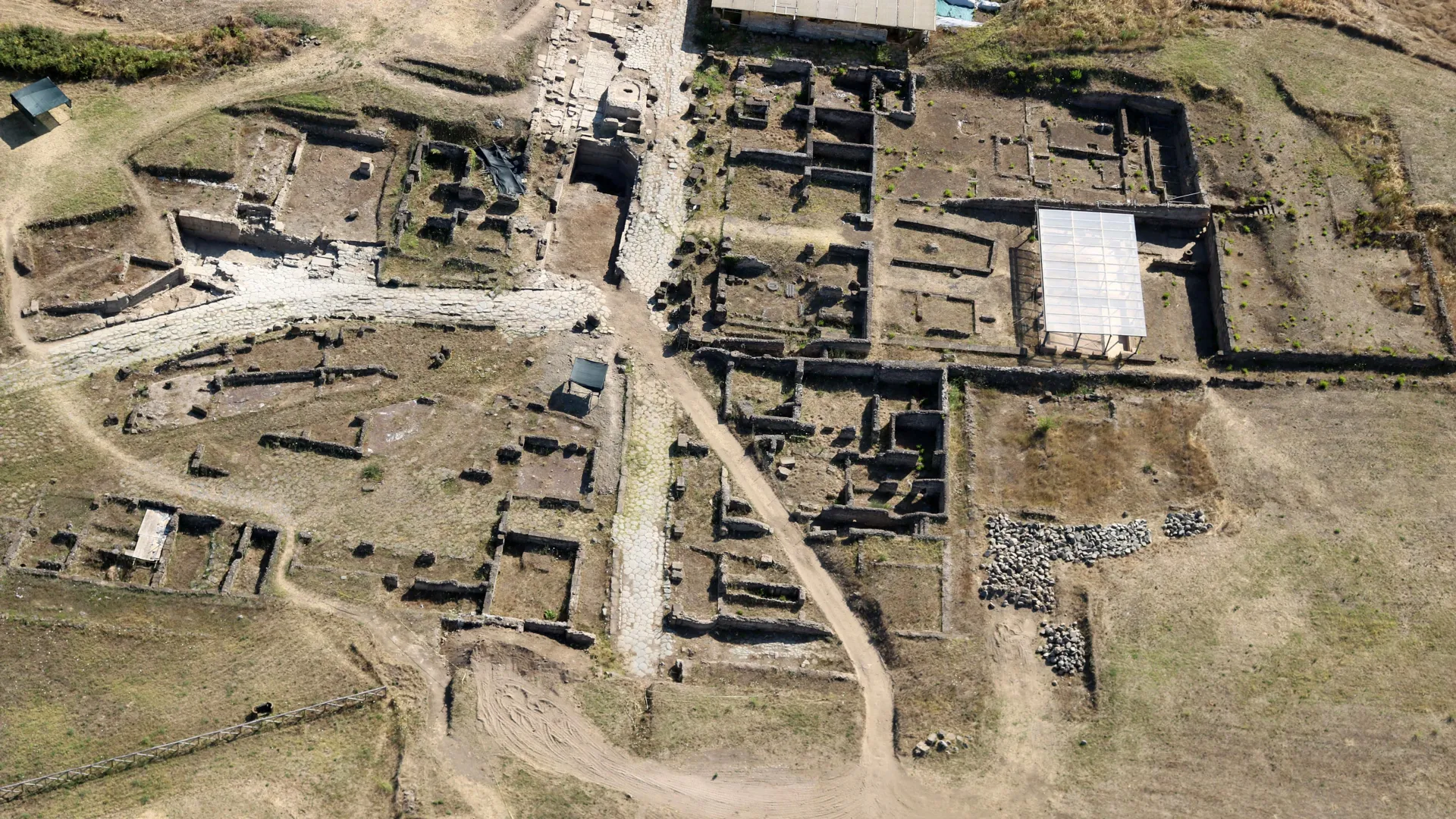
In the center of the ancient Roman city of Gabii, located about 11 miles east of modern Rome, a research team led by University of Missouri professor Marcello Mogetta has uncovered an extraordinary find: a huge stone-lined basin with portions cut directly into the natural bedrock.
Dating to around 250 B.C., and possibly earlier in some sections, the structure is believed to be one of the earliest known examples of large-scale Roman architecture outside of temples and defensive walls.
Mogetta, who chairs Mizzou's Department of Classics, Archaeology and Religion, explained that monumental construction served purposes beyond practical use. He noted that it also functioned as a strong form of political messaging.
"This discovery gives us a rare look at how the early Romans experimented with city planning," he said. "Its location -- at the center of the city near the main crossroads -- suggests it may have been a monumental pool that was part of the city's forum, or the heart of public life in Roman towns. Since archaeologists still don't fully know what the early Roman Forum truly looked like, Gabii provides an invaluable window into its development."
Connections to Earlier Excavations and Greek Influence
This new basin builds on the team's previous findings at Gabii. One earlier feature, known as the "Area F Building," is a terraced complex carved into the slope of the ancient volcanic crater around which the settlement formed.
Taken together, these discoveries indicate that early Roman builders drew significant inspiration from Greek architectural traditions. Greek cities featured paved civic spaces, dramatic terraces and grand gathering areas that communicated both cultural prestige and political power. Early Romans appear to have adapted many of these ideas for their own urban centers.
Why Gabii Matters for Understanding Early Rome
Gabii occupies a unique place in the study of Roman history. Mogetta explained that "while Rome's earliest layers were buried beneath centuries of later construction, Gabii -- a once-powerful neighbor and rival of Rome, first settled in the Early Iron Age -- was largely abandoned by 50 B.C. and later reoccupied on a much smaller scale." Because of this, he said, the ancient city's original layout and building foundations remain unusually intact, offering a clear view of early Roman urban life.
Italy's Ministry of Culture has designated the area as an archaeological park, now managed as part of the Musei e Parchi Archeologici di Praeneste e Gabii. This status has allowed teams of researchers, including the international Gabii Project, to systematically excavate and study the site. Mogetta became the director of this research group last year.
Next Steps in Excavation and Investigation
Supported by the General Directorate of Museums in Italy, the Gabii Project plans to continue excavating the basin and the surrounding stone-paved zone next summer. Researchers also intend to study a nearby "anomaly" detected through thermal imaging. Early indications suggest it could be a temple or another large civic structure.
"If it's a temple, it could help us explain some of the artifacts we've already found in the abandonment levels of the basin, such as intact vessels, lamps, perfume containers and cups inscribed with unusual markings," Mogetta said. "Some of these objects may have been deliberately placed there as religious offerings or discarded in connection with the ritual closing of the pool around 50 C.E. -- thus underscoring the crucial role played by water management in ancient cities."
The continuation of the Gabii Project aims to protect the site's heritage while allowing scholars and visitors to better understand its history.
Unanswered Questions About Early Roman Society
One major question researchers hope to address is whether civic areas were developed before religious buildings, or the other way around. The answer could shed light on whether political activities or spiritual practices held greater influence in shaping the earliest Roman monumental landscapes.
By gathering evidence from the basin and surrounding structures, Mogetta and his team aim to reconstruct the full story of Gabii, from its growth and height of power to its later decline. Their work also contributes to a broader understanding of early Roman architecture and how it helped shape the urban world that followed.
Story Source:
Materials provided by University of Missouri-Columbia. Original written by Eric Stann. Note: Content may be edited for style and length.
Cite This Page: