
A simple turn reveals a 1,500-year-old secret on Roman glass
- Date:
- December 16, 2025
- Source:
- Washington State University
- Summary:
- A museum visit sparked a revelation when a Roman glass cup was turned around and its overlooked markings came into focus. These symbols, once dismissed as decoration, appear to be workshop identifiers used by teams of skilled artisans. The findings challenge centuries of assumptions about how Roman glass was made. They also restore identity and agency to the anonymous makers behind these stunning objects.
- Share:
In the quiet glow of a museum gallery, Hallie Meredith noticed something unexpected about ancient Roman glass that had gone unnoticed for generations.
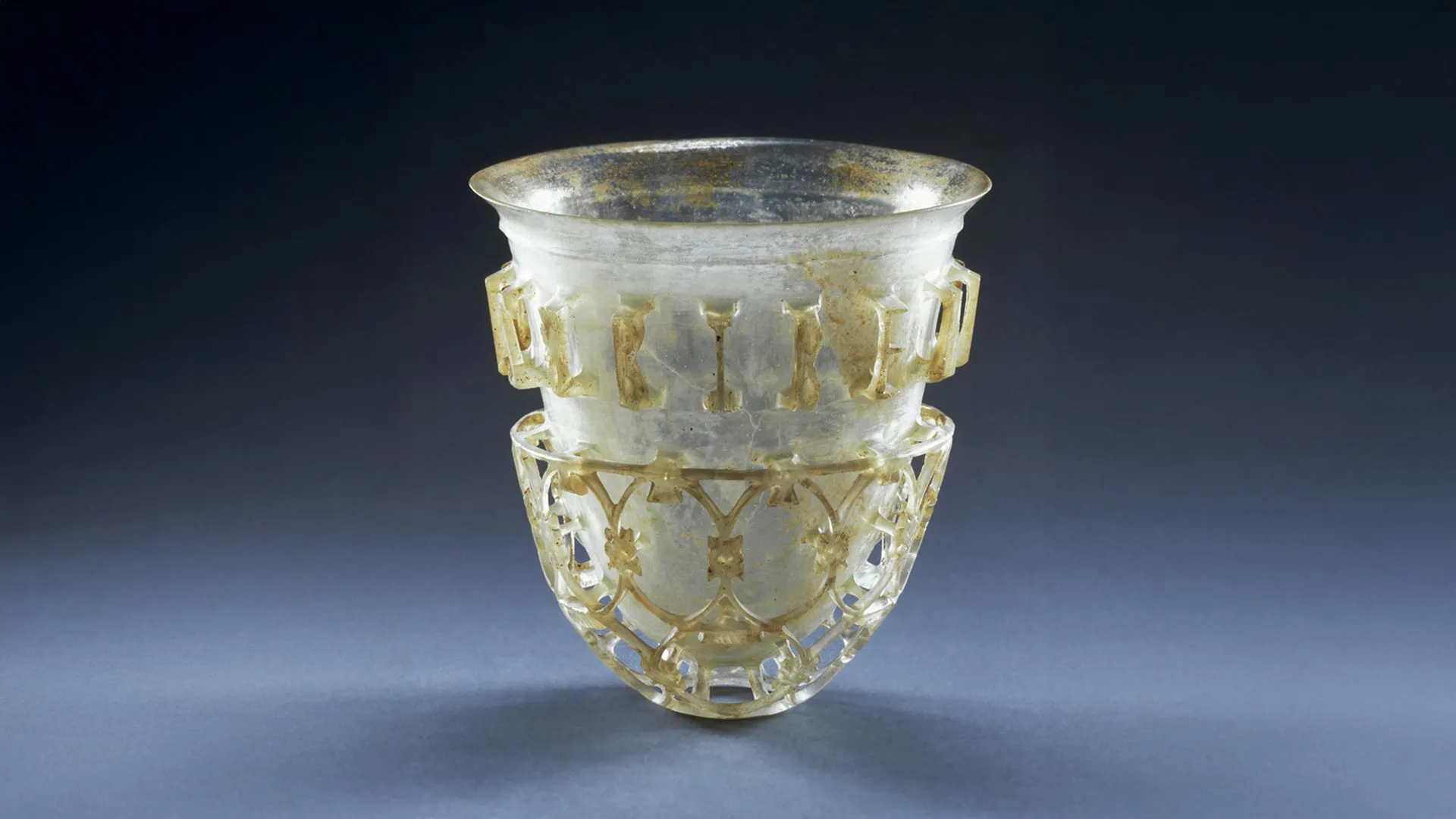
In February 2023, the Washington State University art history professor and practicing glassblower was studying a private collection of Roman glass cage cups at the Metropolitan Museum of Art in New York City. These rare luxury vessels, carved from a single block of glass between 300 and 500 CE, have long been admired and analyzed for their craftsmanship. Meredith's insight did not come from new technology or specialized imaging. It came from curiosity and a simple physical action. She turned one of the cups around.
Overlooked Symbols and Ancient Makers' Marks
On the back of the late Roman vessel, Meredith noticed abstract openwork shapes carved alongside a short inscription wishing the owner a long life. The designs included (such as, diamonds, leaves, or crosses). For decades, these elements were treated as ornamental details. Meredith's research suggests a different interpretation. She believes these symbols functioned as makers' marks, identifying the workshops and artisans responsible for producing some of the most complex glass objects in the Roman world.
"Because I am trained as a maker, I kept wanting to flip things over," Meredith said. She began glassblowing as an undergraduate and has continued the practice throughout her career. "When that happens, patterns appear that everyone else has literally photographed out of the frame."
Tracing a Network of Roman Glassworkers
That moment of observation led Meredith to a broader investigation into how Roman glassmakers organized their work. In two recent academic papers, one published in April in the Journal of Glass Studies and another in October in World Archaeology, she documented the same symbols appearing on multiple carved glass objects. The repeated marks point to a shared visual system used by glassworkers between the fourth and sixth centuries CE.
By analyzing tool marks, inscriptions, and unfinished pieces, Meredith found evidence that these vessels were created by teams rather than individual artisans. Engravers, polishers, and apprentices appear to have worked together in coordinated workshops. What began as a simple act of turning a vessel revealed a previously unrecognized community of makers whose identities had faded from view.
Rethinking How Roman Glass Was Made
For more than two centuries, scholars have debated how Roman openwork glass vessels were produced. Theories have ranged from hand carving to casting or blowing. Much of this discussion focused narrowly on manufacturing techniques and inscriptions. Meredith's findings suggest that a fuller understanding requires attention to the people involved, not just the methods they used.
Each vessel, known as a diatretum, started as a thick-walled glass form that was carefully carved into two concentric layers connected by thin glass bridges. The finished lattice appears remarkably delicate, yet producing it demanded extraordinary time and physical endurance. Meredith's research indicates that multiple specialists collaborated on a single cup over extended periods. She argues that the abstract symbols marked workshop identity rather than individual authorship. "They weren't personal autographs," she said. "They were the ancient equivalent of a brand."
A Broader History of Ancient Craft Labor
Meredith expands on these ideas in her forthcoming book, The Roman Craftworkers of Late Antiquity: A Social History of Glass Production and Related Industries. The monograph is currently in production with Cambridge University Press and is expected to be released in 2026 or 2027.
Her hands-on experience as a glassblower strongly informs her academic work. She understands the physical demands of working molten glass and applies that practical knowledge to her study of ancient objects. At WSU, she teaches a course called Experiencing Ancient Making. Students recreate artifacts using 3D printing, attempt traditional making techniques, and use a digital app she developed to virtually disassemble historical objects. "The goal isn't perfect replication," she said. "It's empathy. Ancient craftworkers can be understood differently when their production processes are experienced."
Restoring Visibility to Ancient Artisans
That emphasis on empathy shapes Meredith's broader goal of bringing attention back to the laborers behind ancient material culture. "There's been a static picture of people who do the work," she said. "We presume we understand them because we focus on elites. But when the evidence is assembled, far more is known about these craftworkers than previously thought."
Her next research project combines art history with data science. Collaborating with WSU computer science students, Meredith is creating a searchable database that tracks unconventional writing across thousands of portable artifacts. The database includes misspellings, mixed alphabets, and coded inscriptions. She believes these features, once dismissed as meaningless errors, may reflect multilingual artisans adjusting written language for diverse audiences.
Seeing Ancient Objects Through New Eyes
Meredith's work encourages scholars and museum visitors alike to reconsider what ancient artifacts can reveal. When light catches the lattice of a diatretum, the glass shows more than technical brilliance. It also reflects the skill, collaboration, and creativity of the people who shaped it centuries ago.
Story Source:
Materials provided by Washington State University. Original written by Will Ferguson. Note: Content may be edited for style and length.
Journal References:
- Hallie G. Meredith. An approach to craft and craftworkers in process: re-examining late 3rd-6th century CE Roman carvings, inscriptions, and engraved symbols. World Archaeology, 2025; 56 (3): 310 DOI: 10.1080/00438243.2025.2570270
- Hallie G. Meredith. Looking for—and Finding?—Workshop Makers’ Marks on Late Roman Diatreta. Journal of Glass Studies, 2025; 66 (0) DOI: 10.3998/jgs.6943
Cite This Page: