
Scientists discover why anacondas stayed giants for 12 million years
- Date:
- December 3, 2025
- Source:
- University of Cambridge
- Summary:
- Ancient anaconda fossils show that the snakes became giants soon after emerging in Miocene South America. Their size has stayed stable for over 12 million years, even though other huge reptiles went extinct. Surprisingly, warmer periods didn’t make anacondas bigger—just more widespread. Today they remain large thanks to surviving patches of ideal wetland habitat.
- Share:
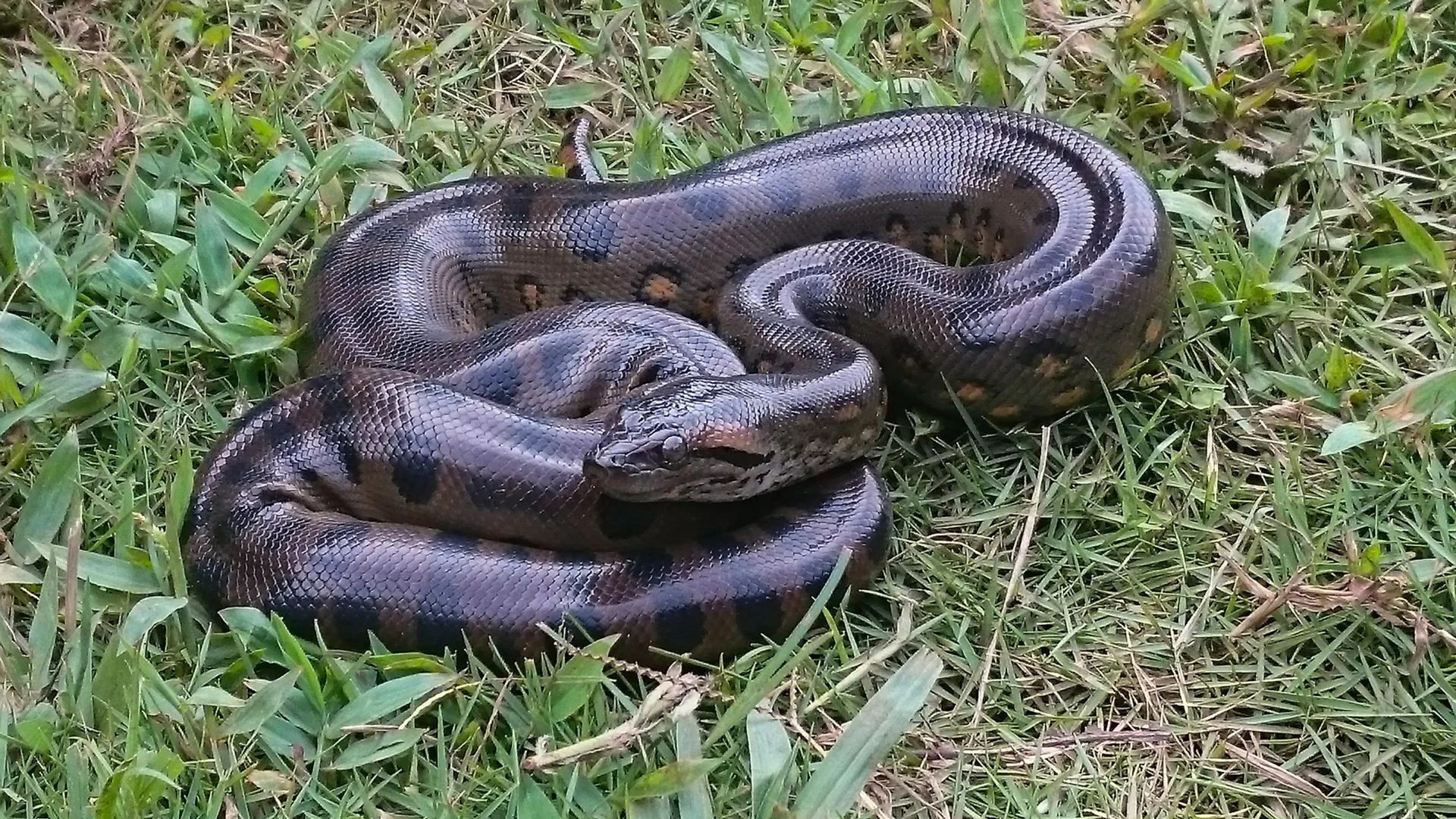
A research group led by the University of Cambridge examined giant anaconda fossils found in South America and determined that these snakes reached their full body size about 12.4 million years ago. According to their analysis, anacondas have remained exceptionally large ever since.
During the period from 12.4 to 5.3 million years ago, known as the 'Middle to Upper Miocene', many animals grew far larger than their modern counterparts. This increase in size was influenced by higher global temperatures, widespread wetlands and abundant sources of food.
While several of these Miocene giants -- including the 12-meter caiman (Purussaurus) and the 3.2-meter giant freshwater turtle (Stupendemys) -- eventually disappeared, anacondas (Eunectes) persisted as a large-bodied lineage rather than shrinking or dying out.
Measuring Fossils to Reveal Ancient Snake Size
Modern anacondas are among the heaviest and longest snakes in existence. They generally grow to four or five meters, and in rare cases can reach seven meters.
To compare ancient and modern sizes, the researchers examined 183 fossilized backbone segments belonging to at least 32 individual anacondas. These fossils were uncovered in Falcón State in Venezuela. When the team combined these measurements with fossil data from other South American sites, they concluded that ancient anacondas measured roughly four to five metres, a size comparable to today's snakes.
The findings were published on December 1 in the Journal of Vertebrate Paleontology.
Why Anacondas Survived as Giants
"Other species like giant crocodiles and giant turtles have gone extinct since the Miocene, probably due to cooling global temperatures and shrinking habitats, but the giant anacondas have survived -- they are super-resilient," said Andrés Alfonso-Rojas, a PhD student and Gates Cambridge Scholar in the Department of Zoology at the University of Cambridge and the study's lead author.
He continued: "By measuring the fossils we found that anacondas evolved a large body size shortly after they appeared in tropical South America around 12.4 million years ago, and their size hasn't changed since," said Alfonso-Rojas.
To confirm his measurements, Alfonso-Rojas applied a second technique called 'ancestral state reconstruction'. This method uses a family tree of snakes to infer the body lengths of ancient anacondas and related modern species such as tree boas and rainbow boas. The analysis supported the conclusion that early anacondas averaged four to five meters when they first emerged during the Miocene.
Ancient Habitats and Modern Survivors
Anacondas currently live in wetlands, marshes and major rivers including the Amazon. During the Miocene, northern South America looked much like today's Amazon Basin, which allowed anacondas to occupy a far wider range. Although their distribution has since contracted, enough suitable habitat remains, along with prey such as capybaras and fish, to support their continued large size.
Scientists previously assumed that ancient anacondas would have been even larger than modern ones because snakes are highly sensitive to temperature and the Miocene climate was warmer. Alfonso-Rojas addressed this directly: "This is a surprising result because we expected to find the ancient anacondas were seven or eight meters long. But we don't have any evidence of a larger snake from the Miocene when global temperatures were warmer."
Improved Fossil Evidence Sheds Light on Evolutionary Timing
Before this project, researchers lacked enough fossil material to determine exactly when anacondas developed their enormous size. Since these snakes have more than 300 vertebrae, the size of individual fossilized vertebrae offers a dependable way to estimate full body length.
The fossils analyzed in this study were gathered over several field seasons by collaborators at the University of Zurich and the Museo Paleontológico de Urumaco in Venezuela.
Story Source:
Materials provided by University of Cambridge. Note: Content may be edited for style and length.
Journal Reference:
- Andrés F. Alfonso-Rojas, Jorge D. Carrillo-Briceño, Rodolfo Sánchez, Marcelo R. Sánchez-Villagra, Jason J. Head. An early origin of gigantism in anacondas (Serpentes: Eunectes ) revealed by the fossil record. Journal of Vertebrate Paleontology, 2025; DOI: 10.1080/02724634.2025.2572967
Cite This Page: