
The solar mission that survived disaster and found 5,000 comets
- Date:
- December 3, 2025
- Source:
- European Space Agency
- Summary:
- For thirty years, SOHO has watched the Sun from a stable perch in space, revealing the inner workings of our star and surviving crises that nearly ended the mission. Its long-term observations uncovered a single global plasma conveyor belt inside the Sun, detailed how solar brightness subtly shifts over the solar cycle, and turned SOHO into an unexpected comet-hunting champion with more than 5,000 discoveries.
- Share:
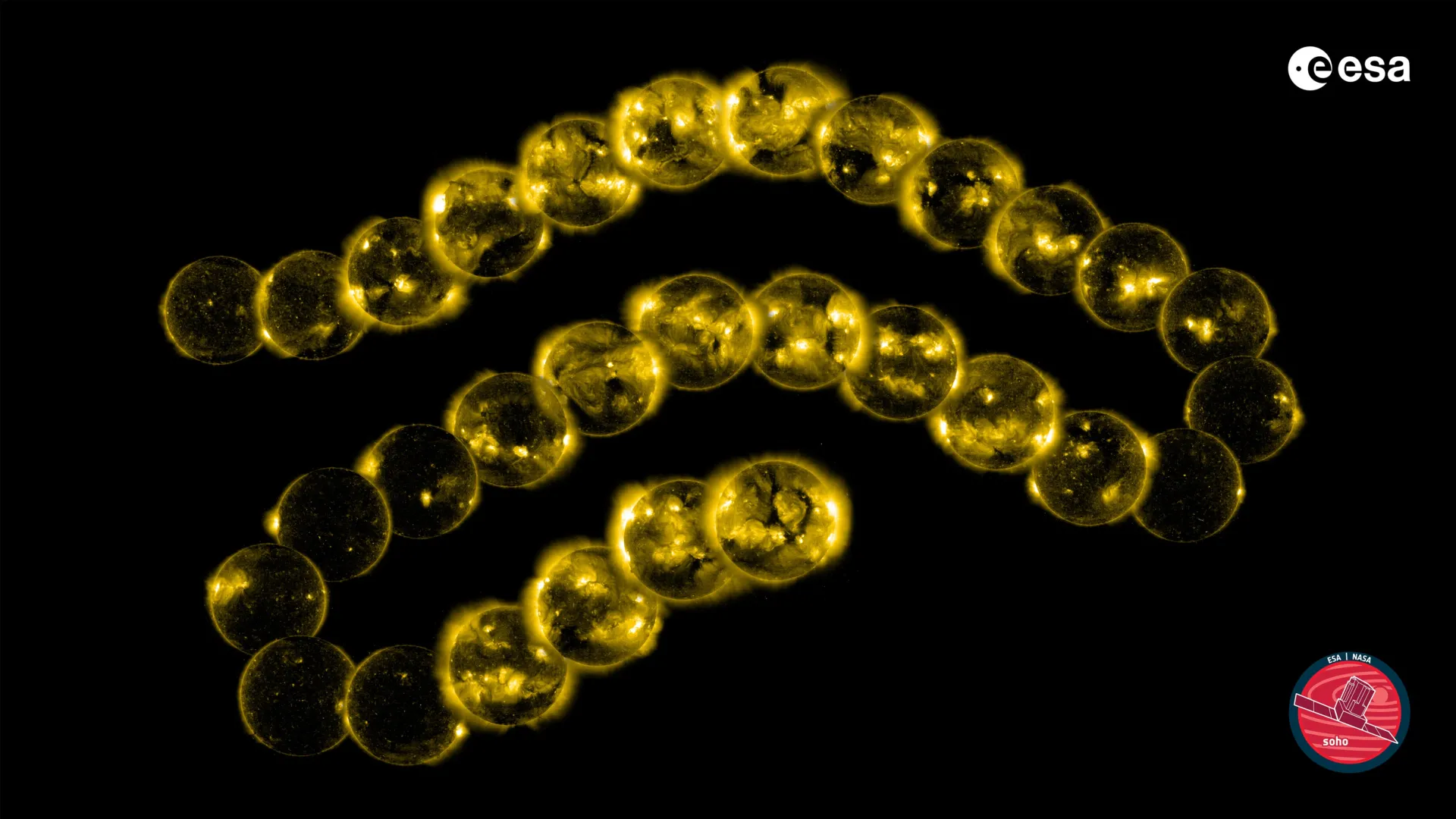
On December 2, 1995, the ESA/NASA Solar and Heliospheric Observatory (SOHO) lifted off for what was originally planned as a two-year mission.
From a position 1.5 million km away from Earth, located between our planet and the Sun, SOHO has an uninterrupted view of the solar surface. Since launch, it has provided an almost unbroken record of solar activity spanning nearly three full 11-year solar cycles.
"It is testament to the ingenuity of our engineers, operators and scientists, and to international collaboration, that this mission has exceeded all expectations," says Prof. Carole Mundell, ESA Director of Science. "SOHO has overcome nail-biting challenges to become one of the longest-operating space missions of all time."
"The SOHO mission is a great example of the incredible partnerships between NASA and ESA," adds Nicky Fox, associate administrator, Science Mission Directorate at NASA Headquarters in Washington. "Congratulations to the NASA and ESA teams on an amazing thirty years working together."
Despite its achievements, SOHO's journey has not been smooth. About two-and-a-half years after launch, the spacecraft experienced a major malfunction that sent it into an uncontrolled spin and severed communications with Earth. For three months, an international team worked continuously to find the spacecraft and bring it back to life.
Another serious setback occurred in November and December 1998, when its stabilizing gyroscopes failed. Engineers quickly developed new software, and by February 1999, SOHO could operate without gyroscopes. This breakthrough allowed it to continue gathering data that would go on to reshape the field of solar science.
"SOHO pioneered new fields in solar science. It is a game-changer in the study of space weather, providing real-time monitoring of the Sun to forecast potentially dangerous solar storms heading towards Earth, and its legacy continues to guide future missions," says Daniel Müller, ESA Project Scientist for SOHO and Solar Orbiter.
"SOHO is still producing high-quality data on a daily basis, and with hundreds of papers being published every year, its scientific productivity remains very high."
Daniel's new paper 'SOHO's 30-year legacy of observing the Sun' was published in Nature Astronomy on December 2, 2025.
Here are five highlights from the last five years:
1. A single plasma conveyor belt
SOHO became a leading instrument in the development of helioseismology, which studies how sound waves move through the Sun in a way similar to how seismic waves reveal the interior of Earth. Early in the mission, SOHO captured the first images of plasma flows (electrically charged material) beneath the solar surface, giving scientists an unprecedented look inside the Sun.
Because SOHO has remained active for so long, researchers have been able to answer a long-standing question: plasma circulates in a single loop, or cell, within each hemisphere of the Sun, instead of in multiple cells as once believed.
The observations show that plasma takes roughly 22 years to complete this full circuit. It rises from regions near the equator toward the poles before sinking deep inside the Sun and moving back toward the equator. This timing matches the Sun's magnetic cycle and helps explain why sunspots, which are produced when strong magnetic fields break through the surface, tend to appear progressively closer to the equator as each solar cycle unfolds.
2. Does the Sun shine steadily?
Measuring the energy emitted by the Sun is essential for understanding how solar heating influences Earth's atmosphere and climate. SOHO's long-running record, paired with earlier datasets, now provides nearly fifty years of high-quality observations.
Scientists have found that the Sun's total energy output changes very little, varying by only about 0.06% over the solar cycle. However, its extreme ultraviolet radiation changes far more significantly, doubling between solar minimum and solar maximum. This form of radiation affects the chemistry and temperature in Earth's upper atmosphere, but it is not a direct cause of the long-term warming trend near the planet's surface.
3. Solar storm monitoring made law
SOHO has played such a pivotal role in the development of real-time space weather monitoring systems that it was signed into United States law in October 2020.
The 'Promoting Research and Observations of Space Weather to Improve the Forecasting of Tomorrow' (PROSWIFT) act specifically mentions SOHO's Large Angle and Spectrometric Coronagraph (LASCO) instrument.
LASCO is a coronagraph, a telescope with a disc masking the centre of view. By blocking out the direct light coming from the Sun, the instrument can see light from the surrounding atmosphere, called the corona. This allows us to see coronal mass ejections -- large eruptions of solar material and magnetic fields -- as they set off from the Sun, providing up to three days warning of potentially disruptive incoming space weather reaching Earth.
4. 5,000 comets -- and counting!
The telescope's prowess as a comet hunter was unplanned, but turned out to be an unexpected success. Thanks to the screening effect of SOHO's coronagraph, 'sungrazer' comets -- those that approach the Sun at very close distances -- also become visible.
Not all comets seen by SOHO are sungrazers. For example, it also beautifully captured Comet Tsuchinshan-ATLAS, also called the Great Comet of 2024, a non-periodic comet from the outer reaches of the Solar System.
SOHO discovered its 5,000th comet in March 2024, making it the most prolific comet-discoverer in history. Most of these have been found by citizen scientists worldwide through the Sungrazer Project. The observations have provided valuable data on the movement, composition and dust production of comets.
5. Enabling future discoveries
SOHO's longevity and accomplishments have influenced the design, goals, and collaborative approach of new solar observatories. It has also helped set standards for open data and international cooperation in solar research.
For example, the ESA-led Solar Orbiter mission is imaging the solar poles from higher latitude and flying much closer to the Sun, with many of its instruments being successors of SOHO's. Similarly, NASA's Solar Dynamics Observatory carries improved versions of SOHO's instruments to continue the legacy that SOHO began in areas of full-disc imaging and helioseismology. Moreover, SOHO frequently contributes to 'multipoint' measurements, providing essential context for Solar Orbiter and NASA's Parker Solar Probe as they fly along their own unique orbits around the Sun.
Even more recently, ESA's Proba-3 took to the skies to open up new views of the Sun's faint corona, while the Agency's upcoming Vigil mission will be the first to monitor the Sun from the 'side', detecting solar storms before they roll into SOHO's line-of-sight.
"SOHO is an all-round shining success, thanks to the dedication of the teams keeping this incredible machine flying," says Daniel. "Its science remains valuable and relevant, serving generations of scientists, and I'm certain that its legacy will continue to guide solar science for decades to come."
Story Source:
Materials provided by European Space Agency. Note: Content may be edited for style and length.
Journal Reference:
- Daniel Müller, Jack Ireland, Anik De Groof, George Dimitoglou, Bernhard Fleck. SOHO’s 30-year legacy of observing the Sun. Nature Astronomy, 2025; DOI: 10.1038/s41550-025-02687-4
Cite This Page: