
Stunning blue pigment on a 13,000-year-old artifact surprises scientists
A rare blue pigment on an ancient tool reveals a far more colorful Paleolithic world than anyone imagined.
- Date:
- December 9, 2025
- Source:
- Aarhus University
- Summary:
- Researchers uncovered rare azurite traces on a Final Paleolithic artifact, overturning assumptions that early Europeans used only red and black pigments. The find suggests ancient people possessed deeper knowledge of minerals and colors than believed. It also hints at vanished forms of decoration or artistic practices. The discovery opens new avenues for exploring identity and symbolism in Ice Age cultures.
- Share:
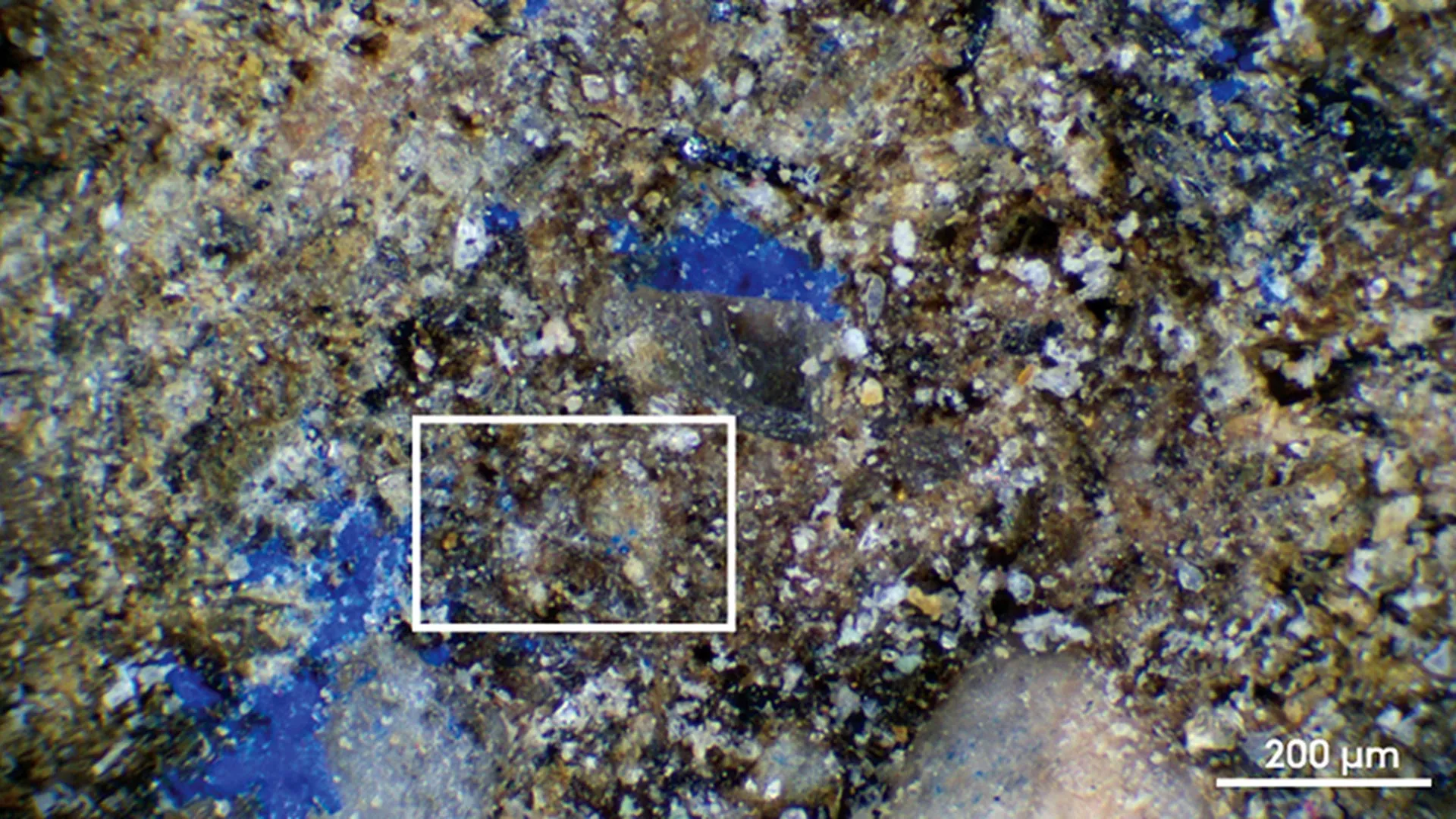
At the Final Paleolithic site of Mühlheim-Dietesheim in Germany, researchers from Aarhus University identified faint blue traces on a stone artifact that dates to roughly 13,000 years ago. After applying a variety of advanced scientific techniques, the team determined that the residue came from azurite, a bright blue mineral pigment that has not previously been documented in Paleolithic art in Europe.
"This challenges what we thought we knew about Paleolithic pigment use," said Dr. Izzy Wisher, the lead author of the study.
Rethinking Color in Paleolithic Art
For many years, experts assumed that Ice Age artists relied almost entirely on red and black pigments, since nearly all surviving artwork from this time uses those colors. The limited palette was often attributed to a scarcity of blue minerals or to the belief that blue held little appeal. Because blue pigments rarely appear in the known artistic record, the new evidence hints that early people may have used them for personal decoration or for coloring textiles - practices that typically leave only subtle archaeological traces.
"The presence of azurite shows that Paleolithic people had a deep knowledge of mineral pigments and could access a much broader color palette than we previously thought - and they may have been selective in the way they used certain colors," Izzy Wisher says.
A New Interpretation of an Ancient Tool
The stone containing the azurite residue was initially classified as an oil lamp. Current analysis suggests it functioned instead as a surface for preparing pigments, possibly serving as a palette for grinding or mixing blue materials. This interpretation points to artistic or cosmetic traditions that seldom survive in the archaeological record.
Broader Implications for Early Human Culture
The discovery encourages a fresh evaluation of how color shaped Paleolithic expression. It raises new questions about how early humans conveyed identity, status, and cultural beliefs through materials that were likely more diverse and visually striking than previously assumed.
The research involved collaboration with Rasmus Andreasen, James Scott and Christof Pearce from the Department of Geoscience at Aarhus University, along with Thomas Birch, who is affiliated with both the Department of Geoscience, AU, and the National Museum of Denmark. Additional partners from Germany, Sweden and France also contributed to the work.
The full study is published in Antiquity.
Story Source:
Materials provided by Aarhus University. Note: Content may be edited for style and length.
Journal Reference:
- Izzy Wisher, Thomas Birch, Rasmus Andreasen, Elyse Canosa, Sara Norrehed, Solenn Reguer, Quentin Lemasson, Ester Oras, Kristiina Johanson, Tim Kinnaird, Thomas Birndorfer, Jesper Borre Pedersen, James Scott, Christof Pearce, Felix Riede. The earliest evidence of blue pigment use in Europe. Antiquity, 2025; 99 (408): 1464 DOI: 10.15184/aqy.2025.10184
Cite This Page: