
New cosmic lens measurements deepen the Hubble tension mystery
New lensing-based measurements sharpen the Hubble tension, hinting at possible new physics shaping cosmic expansion.
- Date:
- December 9, 2025
- Source:
- University of Tokyo
- Summary:
- Scientists are testing a novel way to measure cosmic expansion using time delays in gravitationally lensed quasars. Their results match “local” measurements but clash with early-universe estimates, strengthening the mysterious Hubble tension. This mismatch could point to new physics rather than observational error. Researchers now aim to boost precision to solve the puzzle.
- Share:
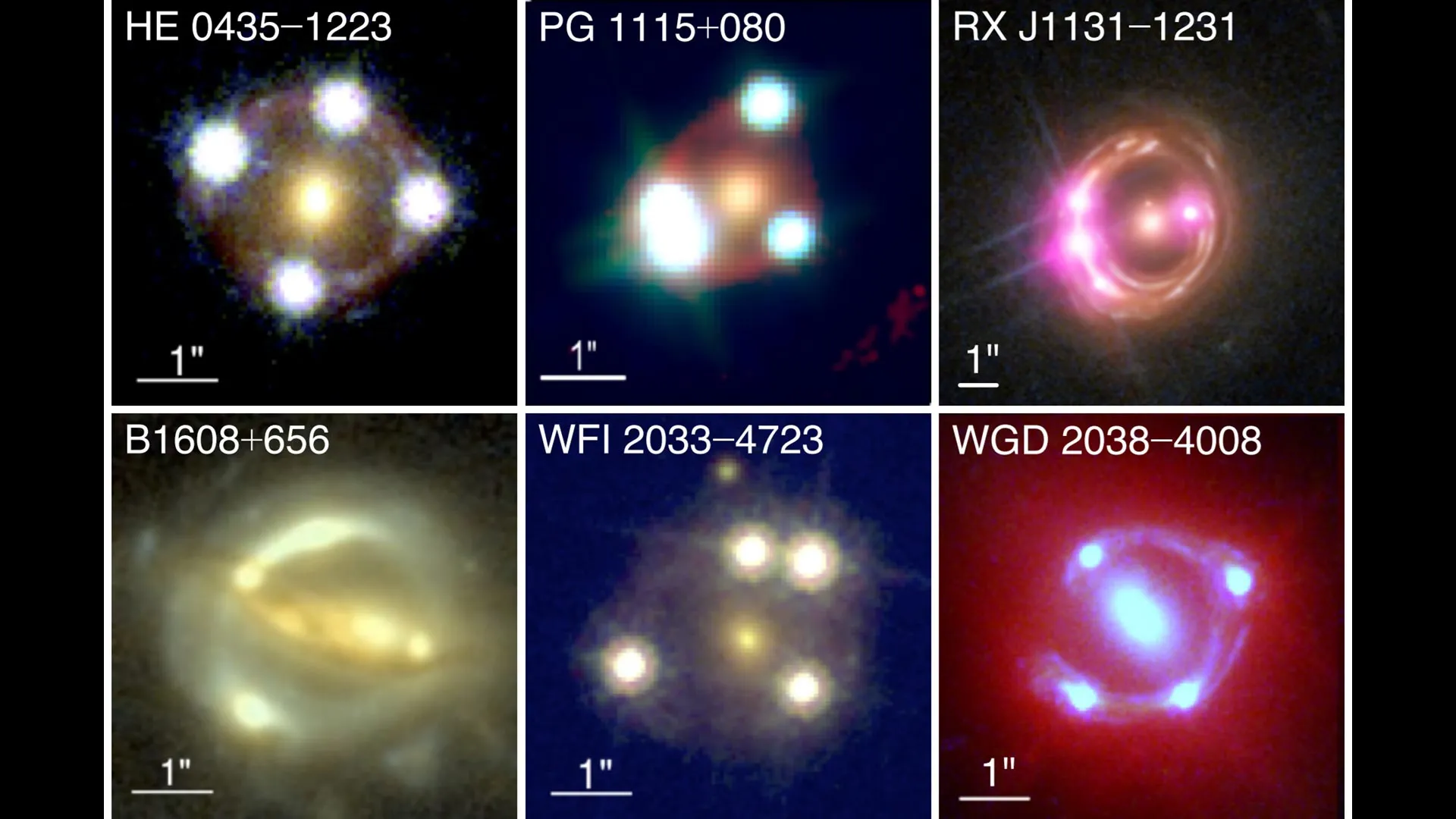
Cosmologists are grappling with a major unresolved puzzle: they do not all agree on how fast the universe is expanding, and solving this puzzle could point to new physics. To check for hidden errors in traditional measurements that rely on markers such as supernovae, astronomers continually look for fresh ways to track cosmic expansion. In recent work, researchers including scientists at the University of Tokyo measured the universe's growth using new techniques and data from some of the most advanced telescopes available. Their approach takes advantage of the fact that light from extremely distant objects can travel to us along several different paths. Comparing these different routes helps refine models of what is happening on the very largest scales in the universe, including how space itself is stretching.
How fast is the universe expanding?
We know that the universe is enormous, and it is steadily growing larger. Its exact size is unknown, but its rate of expansion can be measured. This turns out to be more complicated than it sounds, because the expansion appears faster when we look at more distant regions of space. For every 3.3 million light years (or one megaparsec) of distance from Earth, objects at that distance appear to be moving away from us at about 73 kilometers per second. Put another way, the universe expands at 73 kilometers per second per megaparsec (km/s/Mpc), a value known as the Hubble constant.
Distance ladders and a new way to measure the Hubble constant
Scientists have developed several methods to estimate the Hubble constant, but until now they have all relied on so-called distance ladders. These ladders are built from objects such as supernovae and special stars called Cepheid variable stars. Because these objects are considered well understood, astronomers assume that even when they are observed in other galaxies, they can be used to estimate distances with high precision. Over decades of observations of many such objects, the allowed range for the Hubble constant has become narrower. However, some uncertainty has always remained about how reliable this approach is, so cosmologists are eager to test alternatives.
In their latest study, a team of astronomers that includes Project Assistant Professor Kenneth Wong and postdoctoral researcher Eric Paic from the University of Tokyo's Research Center for the Early Universe has successfully demonstrated a technique called time-delay cosmography. They argue that this method can reduce the field's dependence on distance ladders and could also have valuable applications in other branches of cosmology.
Using gravitational lensing as a cosmic measurement tool
"To measure the Hubble constant using time-delay cosmography, you need a really massive galaxy that can act as a lens," said Wong. "The gravity of this 'lens' deflects light from objects hiding behind it around itself, so we see a distorted version of them. This is called gravitational lensing. If the circumstances are right, we'll actually see multiple distorted images, and each will have taken a slightly different pathway to get to us, taking different amounts of time. By looking for identical changes in these images that are slightly out of step, we can measure the difference in time they took to reach us. Coupling this data with estimates on the distribution of the mass of the galactic lens that's distorting them is what allows us to calculate the acceleration of distant objects more accurately. The Hubble constant we measure is well within the ranges supported by other modes of estimation."
The Hubble tension: conflicting views of the expanding universe
It may seem puzzling that researchers invest so much effort to refine a number that has already been measured many times. The reason is that this value sits at the heart of how scientists reconstruct the history and evolution of the universe, and there is a serious unresolved discrepancy. The value of 73 km/s/Mpc for the Hubble constant agrees with observations of relatively nearby objects. However, there are other ways to infer the cosmic expansion rate that look much farther back in time. One key method uses the radiation that fills the universe and traces back to the big bang, known as the cosmic microwave background (CMB). When scientists analyze the CMB to estimate the Hubble constant, they obtain a lower value of 67 km/s/Mpc.
This mismatch between 73 km/s/Mpc and 67 km/s/Mpc is called the Hubble tension. The work by Wong, Paic and their colleagues helps illuminate what might be causing this tension, at a time when it is still unclear whether the discrepancy is simply due to experimental uncertainties or points to something deeper.
Is the Hubble tension pointing to new physics?
"Our measurement of the Hubble constant is more consistent with other current-day observations and less consistent with early-universe measurements. This is evidence that the Hubble tension may indeed arise from real physics and not just some unknown source of error in the various methods," said Wong. "Our measurement is completely independent of other methods, both early- and late-universe, so if there are any systematic uncertainties in those methods, we should not be affected by them."
"The main focus of this work was to improve our methodology, and now we need to increase the sample size to improve the precision and decisively settle the Hubble tension," said Paic. "Right now, our precision is about 4.5%, and in order to really nail down the Hubble constant to a level that would definitively confirm the Hubble tension, we need to get to a precision of around 1-2%."
More lenses, more quasars, and higher precision
The researchers are optimistic that they can reach this higher level of accuracy. In the current study, they analyzed eight time-delay lens systems. Each system contains a foreground galaxy that acts as a lens and blocks our direct view of a distant quasar (a supermassive black hole that is accreting gas and dust, causing it to shine brightly). They also incorporated new observations from cutting-edge space-based and ground-based observatories, including the James Webb Space Telescope. Looking ahead, the team plans to expand the number of lens systems they study, refine their measurements, and carefully identify or eliminate any remaining systematic sources of error.
Mass distribution uncertainties and a global cosmology effort
"One of the largest sources of uncertainty is the fact that we don't know exactly how the mass in the lens galaxies is distributed. It is usually assumed that the mass follows some simple profile that is consistent with observations, but it is hard to be sure, and this uncertainty can directly influence the values we calculate," said Wong. "The Hubble tension matters, as it may point to a new era in cosmology revealing new physics. Our project is the result of a decades-long collaboration between multiple independent observatories and researchers, highlighting the importance of international collaboration in science."
Funding: This work was supported by NASA (grants 80NSSC22K1294 and HST-AR-16149), the Max Planck Society (Max Planck Fellowship), the Deutsche Forschungsgemeinschaft under Germany's Excellence Strategy (EXC-2094, 390783311), the U.S. National Science Foundation (grants NSF-AST-1906976, NSF-AST-1836016, NSF-AST-2407277), the Moore Foundation (grant 8548), and JSPS KAKENHI (grant numbers JP20K14511, JP24K07089, JP24H00221).
Story Source:
Materials provided by University of Tokyo. Note: Content may be edited for style and length.
Journal Reference:
- Simon Birrer, Elizabeth J. Buckley-Geer, Michele Cappellari, Frédéric Courbin, Frédéric Dux, Christopher D. Fassnacht, Joshua A. Frieman, Aymeric Galan, Daniel Gilman, Xiang-Yu Huang, Shawn Knabel, Danial Langeroodi, Huan Lin, Martin Millon, Takahiro Morishita, Veronica Motta, Pritom Mozumdar, Eric Paic, Anowar J. Shajib, William Sheu, Dominique Sluse, Alessandro Sonnenfeld, Chiara Spiniello, Massimo Stiavelli, Sherry H. Suyu, Chin Yi Tan, Tommaso Treu, Lyne Van de Vyvere, Han Wang, Patrick Wells, Devon M. Williams, Kenneth C. Wong. TDCOSMO 2025: Cosmological constraints from strong lensing time delays. Astronomy, 2025; 704: A63 DOI: 10.1051/0004-6361/202555801
Cite This Page: