
Astronomers watched a sleeping neutron star roar back to life
A decade of dramatic brightening and spin-up in P13 exposes new clues to the physics of supercritical accretion.
- Date:
- December 14, 2025
- Source:
- Ehime University
- Summary:
- Astronomers tracked a decade of dramatic changes in P13, a neutron star undergoing supercritical accretion. Its X-ray luminosity rose and fell by factors of hundreds while its rotation rate accelerated. These synchronized shifts suggest the accretion structure itself evolved over time. The findings offer fresh clues to how ultraluminous X-ray sources reach such extreme power.
- Share:
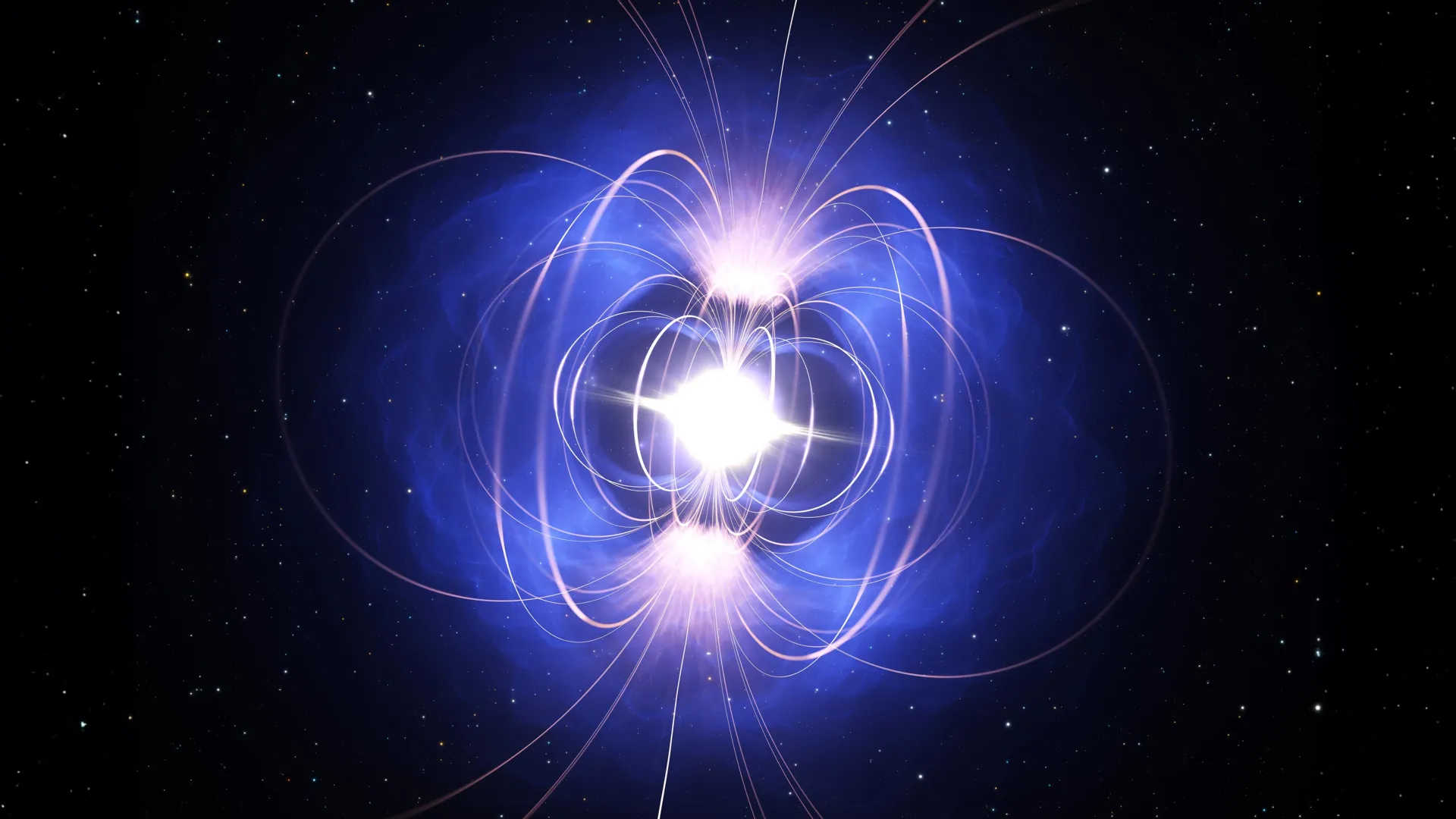
When gas falls onto a compact object, such as a neutron star or black hole, due to its strong gravity (a process called accretion), it emits electromagnetic waves. High-sensitivity observations have discovered objects with extremely high X-ray luminosities. One possible explanation for the ultraluminosity is that an extraordinary amount of gas falls onto a compact object through a process called supercritical accretion. However, the mechanism of supercritical accretion remains unclear.
The research team focused on NGC 7793 P13 (hereafter, P13), which is a neutron star in supercritical accretion, located in the galaxy NGC 7793 (about 10 million light-years from the Earth). As gas falls onto a neutron star, it forms a column structure (called an accretion column) on magnetic poles, from which intense X-ray is thought to be emitted. Then, coherent X-ray pulsation accompanied by the rotation of a neutron star can be detected. According to previous studies, P13 rotates with a period of 0.4 s with a constant acceleration rate. Moreover, the luminosity changed by more than two orders of magnitude in about 10 years. Both rotation velocity and luminosity are effective parameters to estimate the amount of gas accreted. However, the relation between them was not found for P13.
The research team investigated the long-term evolution of the X-ray luminosity and rotation period of P13 from 2011 to 2024, using the archival data of XMM-Newton, Chandra, NuSTAR, and NICER. It was found that P13 was in a faint phase in 2021 and started to be bright again in 2022. By 2024, it reached a high luminosity, more than two orders of magnitude higher than in 2021. Moreover, in the rebrightening phase in 2022, the acceleration rate of the rotation velocity was increased by a factor of 2, and it was maintained until 2024. This result suggests a relationship between X-ray luminosity and rotation velocity, and that the accretion system changed during the faint phase. The research team then focused on the pulsation and performed detailed analyses. It was suggested that the height of the accretion column was changed with the 10-year flux modulation. Those results are expected to be clues to reveal the mechanism of supercritical accretion.
Story Source:
Materials provided by Ehime University. Note: Content may be edited for style and length.
Journal Reference:
- Marina Yoshimoto, Tomokage Yoneyama, Shogo B. Kobayashi, Hirokazu Odaka, Taiki Kawamuro, Hironori Matsumoto. Monitoring of the Spectral and Timing Properties of the Ultraluminous X-Ray Pulsar NGC 7793 P13. The Astrophysical Journal Letters, 2025; 993 (1): L26 DOI: 10.3847/2041-8213/ae018f
Cite This Page: