
Physicists found a way to see heat in empty space
- Date:
- December 16, 2025
- Source:
- Stockholm University
- Summary:
- Physicists have found a clever way to detect the elusive Unruh effect without extreme accelerations. By using atoms that emit light cooperatively between mirrors, acceleration subtly shifts when a powerful light burst appears. That early flash acts like a timestamped signature of the effect. The method could make once-theoretical physics experimentally reachable.
- Share:
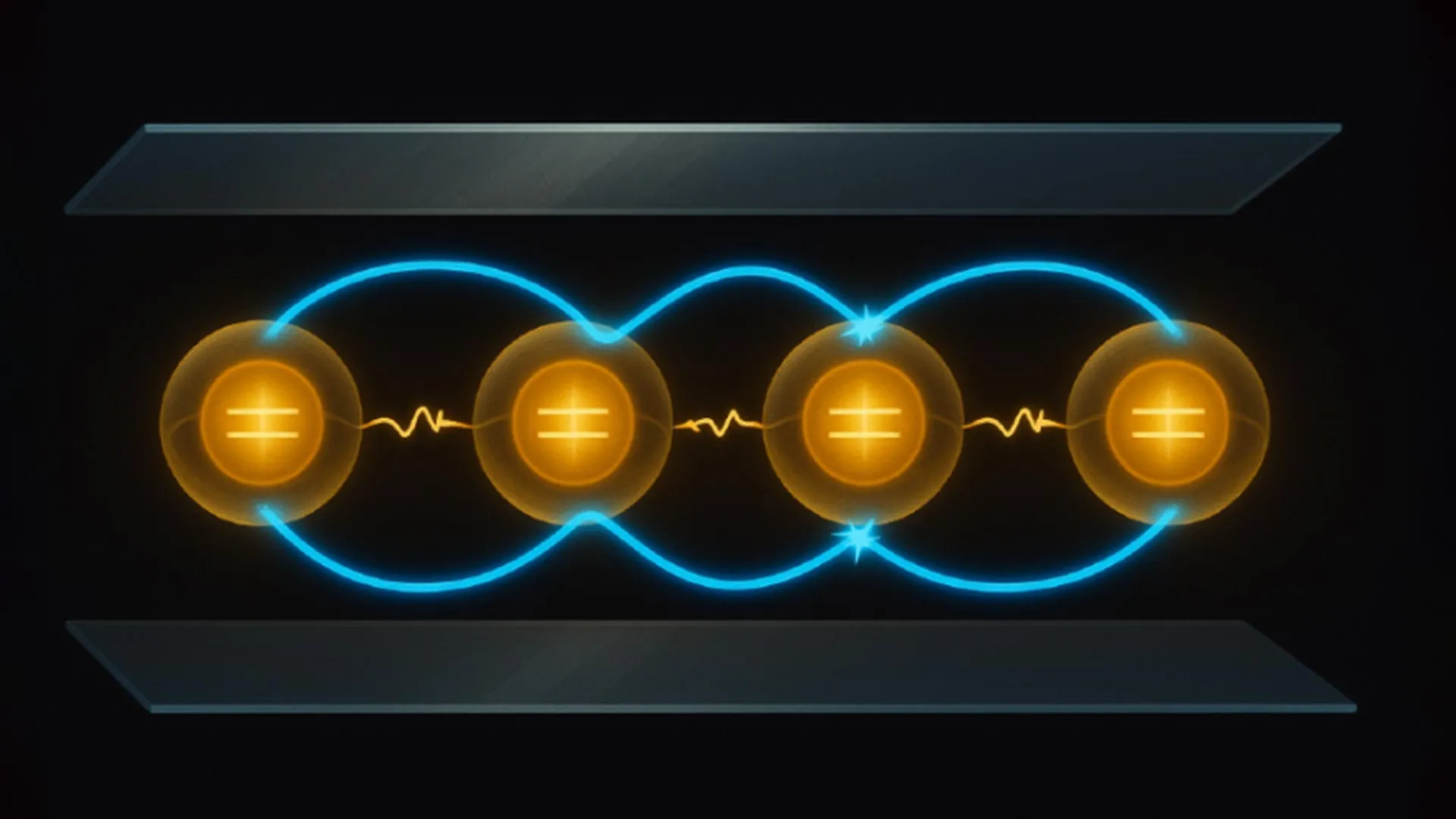
Scientists at Stockholm University and the Indian Institute of Science Education and Research (IISER) Mohali have outlined a realistic strategy to observe one of the most unusual ideas in modern physics: the Unruh effect. This effect predicts that an object that is speeding up (accelerating) would experience empty space as slightly warm. In practice, however, producing enough acceleration to directly heat something is far beyond what laboratory experiments can achieve. The researchers instead describe how this extremely weak effect could be transformed into a distinct, precisely timed burst of light.
The basic setup is easier to picture than the underlying physics. Consider a collection of atoms placed between two parallel mirrors. These mirrors can influence how quickly the atoms release light. Under the right conditions, the atoms stop acting independently and instead emit light together, like a choir singing in unison -- much louder than solo singers. This phenomenon is known as superradiance.
According to the new work, if the atoms experience the subtle warmth associated with the Unruh effect, that influence gently shifts their behavior. The result is that the collective flash of light occurs slightly earlier than it would if the atoms were not accelerating. This advance in timing becomes a clear and measurable sign of the Unruh effect.
Turning a Whisper Into a Clear Signal
"We've found a way to turn the Unruh effect's whisper into a shout," said Akhil Deswal, a PhD student at IISER Mohali. "By using carefully spaced high-quality mirrors, we make ordinary background signals quieter while the acceleration-seeded burst comes out early and clean."
An important advantage of this approach is that it dramatically reduces how much acceleration is needed. Without high-quality mirrors, the required acceleration would be far greater and well beyond practical limits.
Why Timing Makes the Difference
"Timing is the key," added Navdeep Arya, a postdoctoral researcher at Stockholm University. "The choir of atoms is not only louder but also shouts earlier if they feel the faint Unruh effect-related warmth of empty space. That simple clock-like marker can make it easier to separate the Unruh signal from everyday noise."
By focusing on when the light appears rather than how intense it is, the method offers a new way to isolate the desired signal from background effects that normally overwhelm it.
Connecting Laboratory Experiments to Extreme Physics
By tackling a detection problem that has challenged physicists for decades, the proposal helps narrow the gap between standard laboratory equipment and phenomena usually associated with extreme environments. Since acceleration and gravity are closely linked, similar timing-based methods could eventually allow scientists to study delicate quantum effects driven by gravity -- right on the lab bench.
The research, co-authored with Kinjalk Lochan and Sandeep K. Goyal of IISER Mohali, has been published in Physical Review Letters.
Story Source:
Materials provided by Stockholm University. Note: Content may be edited for style and length.
Journal Reference:
- Akhil Deswal, Navdeep Arya, Kinjalk Lochan, Sandeep K. Goyal. Time-Resolved and Superradiantly Amplified Unruh Effect. Physical Review Letters, 2025; 135 (18) DOI: 10.1103/6z1l-kkmk
Cite This Page: