
Astronomers just watched a black hole twist spacetime
For the first time, scientists have watched a black hole twist spacetime itself—just as Einstein predicted a century ago.
- Date:
- December 18, 2025
- Source:
- Cardiff University
- Summary:
- Astronomers have detected spacetime itself being dragged and twisted by a spinning black hole for the first time. The discovery, seen during a star’s violent destruction, confirms a prediction made over 100 years ago and reveals new clues about how black holes spin and launch jets.
- Share:
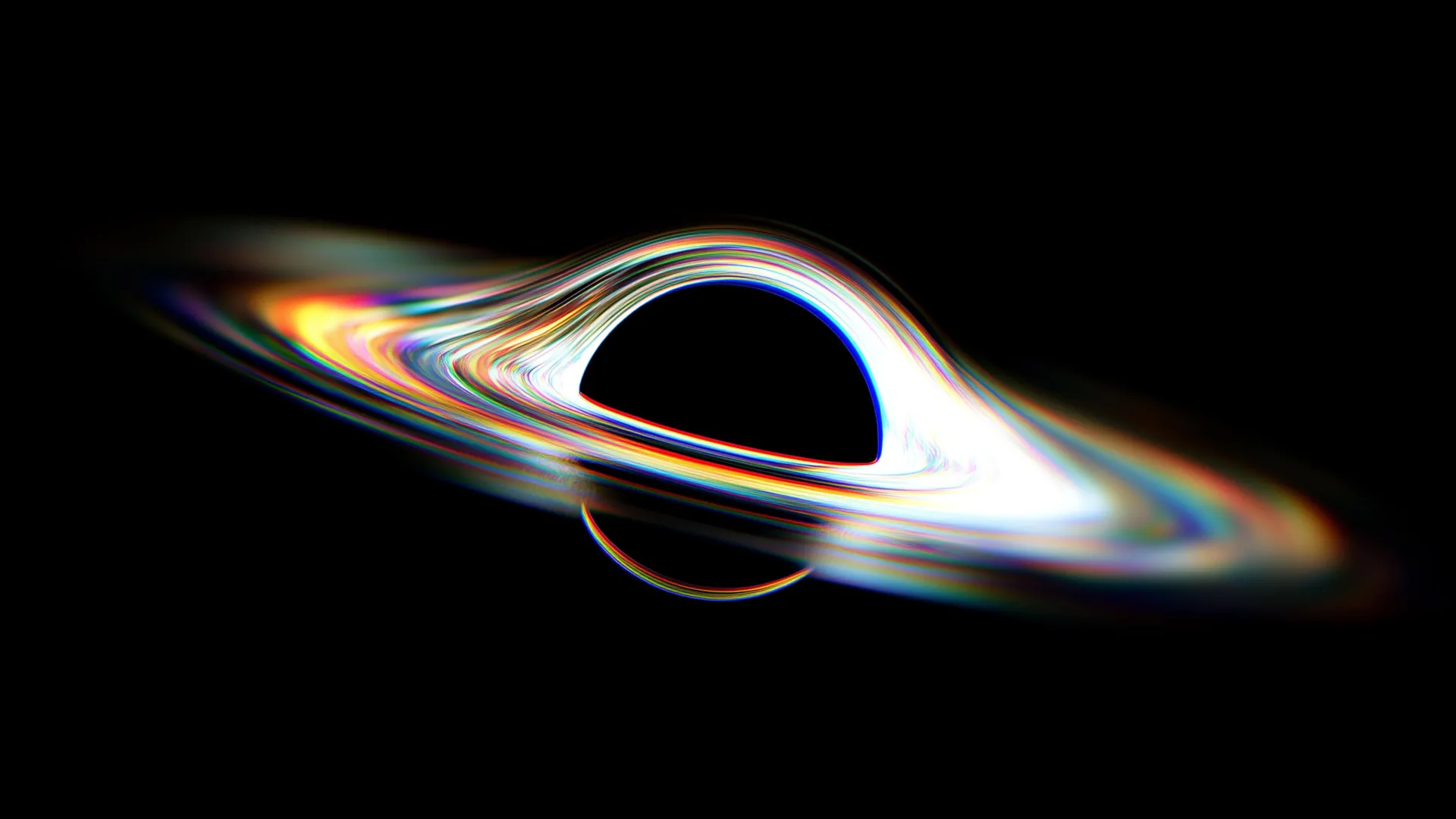
The universe has delivered a rare breakthrough for researchers chasing one of the hardest effects to catch in the night sky.
In findings reported in Science Advances, scientists describe the first observations of a spiraling swirl in spacetime linked to a fast spinning black hole.
First evidence of black hole frame dragging
This phenomenon is called Lense-Thirring precession or frame-dragging. It refers to the way a rotating black hole twists the spacetime around it, tugging on nearby matter such as stars and causing their paths to wobble.
The research team was led by the National Astronomical Observatories at the Chinese Academy of Sciences, with support from Cardiff University. They focused on AT2020afhd, a tidal disruption event (TDE) where a star was ripped apart by a supermassive black hole.
As the star was destroyed, its remains formed a spinning disk around the black hole. From this disk, intense jets of material were launched at nearly the speed of light.
A 20 day cosmic wobble seen in X rays and radio
By tracking repeating patterns in both X ray and radio signals from the event, the researchers found that the disk and the jet were wobbling together. The motion repeated on a 20 day cycle.
Einstein first proposed the idea behind this effect in 1913, and it was later put into mathematical form by Lense and Thirring in 1918. These new measurements support a key prediction of general relativity and could help scientists investigate black hole spin, accretion physics, and how jets form.
Dr. Cosimo Inserra, a Reader in the School of Physics and Astronomy at Cardiff University and one of the paper's co-authors, said: "Our study shows the most compelling evidence yet of Lense-Thirring precession -- a black hole dragging space time along with it in much the same way that a spinning top might drag the water around it in a whirlpool.
"This is a real gift for physicists as we confirm predictions made more than a century ago. Not only that, but these observations also tell us more about the nature of TDEs -- when a star is shredded by the immense gravitational forces exerted by a black hole.
"Unlike previous TDEs studied, which have steady radio signals, the signal for AT2020afhd showed short-term changes, which we were unable to attribute to the energy release from the black hole and its surrounding components. This is further confirmed the dragging effect in our minds and offers scientists a new method for probing black holes."
Swift and VLA data plus spectroscopy
To pin down the frame dragging signal, the team analyzed X ray observations from the Neil Gehrels Swift Observatory (Swift) and radio measurements from the Karl G. Jansky Very Large Array (VLA).
They also examined the composition, structure and behavior of the material involved using electromagnetic spectroscopy, which helped them describe and identify the effect.
"By showing that a black hole can drag space time and create this frame-dragging effect, we are also beginning to understand the mechanics of the process," explains Dr. Inserra.
"So, in the same way a charged object creates a magnetic field when it rotates, we're seeing how a massive spinning object -- in this case a black hole -- generates a gravitomagnetic field that influences the motion of stars and other cosmic objects nearby.
"It's a reminder to us, especially during the festive season as we gaze up at the night sky in wonder, that we have within our grasp the opportunity to identify ever more extraordinary objects in all the variations and flavors that nature has produced."
The paper, 'Detection of disk-jet coprecession in a tidal disruption event', is published in Science Advances.
Story Source:
Materials provided by Cardiff University. Note: Content may be edited for style and length.
Journal Reference:
- Yanan Wang, Zikun Lin, Linhui Wu, Wei-Hua Lei, Shuyuan Wei, Shuang-Nan Zhang, Long Ji, Santiago del Palacio, Ranieri D. Baldi, Yang Huang, Ji-Feng Liu, Bing Zhang, Aiyuan Yang, Ru-Rong Chen, Yangwei Zhang, Ai-Ling Wang, Lei Yang, Panos Charalampopoulos, David R. A. Williams-Baldwin, Zhu-Heng Yao, Fu-Guo Xie, Defu Bu, Hua Feng, Xinwu Cao, Hongzhou Wu, Wenxiong Li, Erlin Qiao, Giorgos Leloudas, Joseph P. Anderson, Xinwen Shu, Dheeraj R. Pasham, Hu Zou, Matt Nicholl, Thomas Wevers, Tomás E. Müller-Bravo, Jing Wang, Jian-Yan Wei, Yu-Lei Qiu, Wei-Jian Guo, Claudia P. Gutiérrez, Mariusz Gromadzki, Cosimo Inserra, Lydia Makrygianni, Francesca Onori, Tanja Petrushevska, Diego Altamirano, Lluís Galbany, Miguel Peréz-Torres, Ting-Wan Chen. Detection of disk-jet coprecession in a tidal disruption event. Science Advances, 2025; 11 (50) DOI: 10.1126/sciadv.ady9068
Cite This Page: