
Astronomers discover one of the Universe’s largest spinning structures
- Date:
- December 25, 2025
- Source:
- University of Oxford
- Summary:
- Scientists have discovered a giant cosmic filament where galaxies spin in sync with the structure that holds them together. The razor-thin chain of galaxies sits inside a much larger filament that appears to be slowly rotating as a whole. This coordinated motion is far stronger than expected by chance and hints that galaxy spin may be inherited from the cosmic web itself. The finding opens a new window into how galaxies formed and how matter flows across the Universe.
- Share:
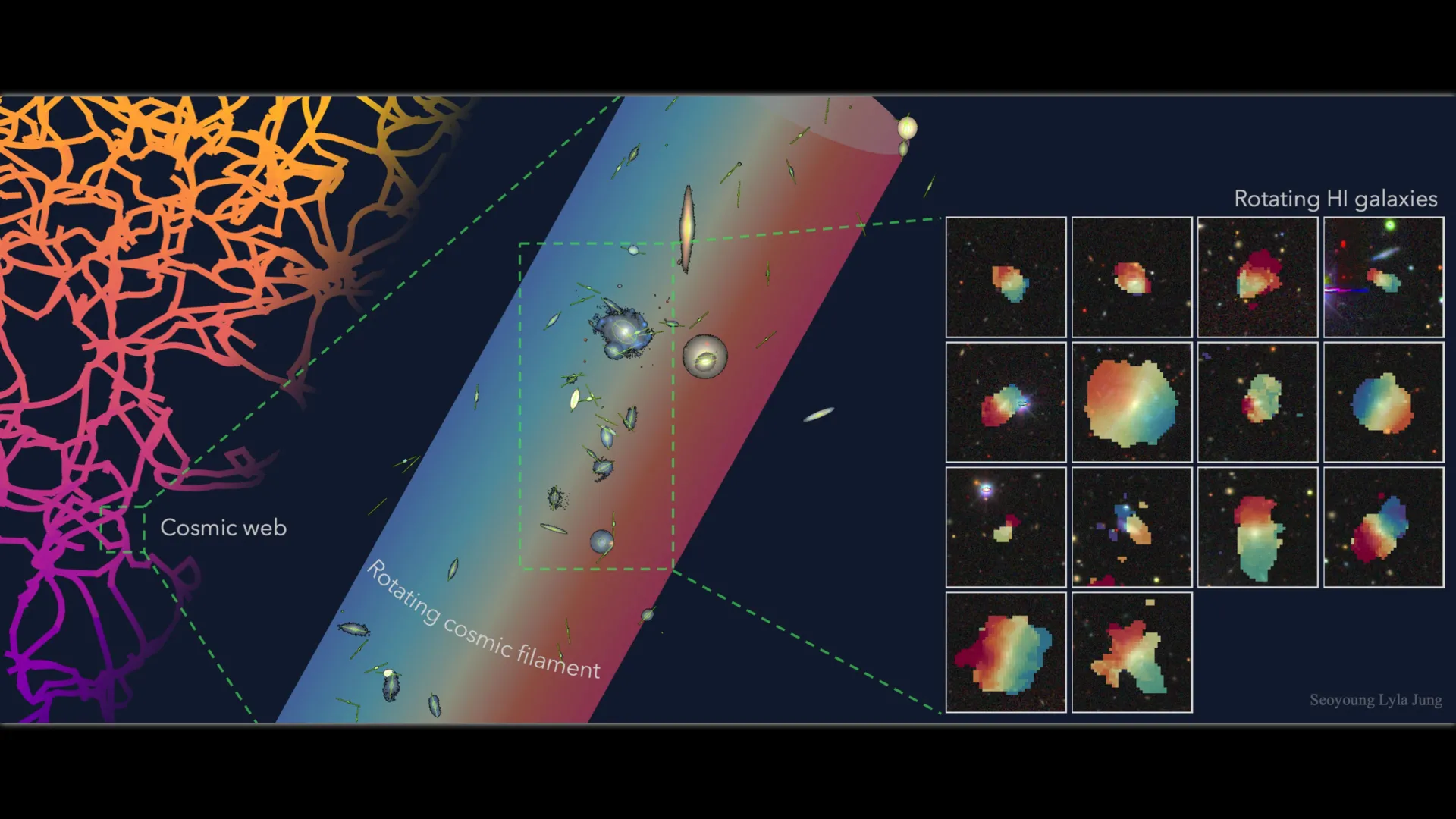
An international research team led by the University of Oxford has identified one of the largest rotating structures ever observed. The object is a razor thin chain of galaxies embedded within a vast cosmic filament located about 140 million light years from Earth. The results were published in Monthly Notices of the Royal Astronomical Society and may provide important clues about how galaxies formed in the early Universe.
Cosmic filaments are the biggest known structures in the Universe. They are enormous thread like networks of galaxies and dark matter that create the framework of the cosmic web. These filaments also act as pathways that funnel matter and angular momentum into galaxies. Nearby filaments where many galaxies spin in the same direction, and where the entire structure itself appears to rotate, are especially valuable for studying how galaxies acquired their spin and gas. They also offer a way to test ideas about how rotation develops across tens of millions of light years.
A Razor Thin Line of Gas Rich Galaxies
In this study, researchers identified 14 nearby galaxies rich in hydrogen gas arranged in a narrow, elongated line measuring about 5.5 million light years in length and roughly 117,000 light years across. This thin structure lies within a much larger cosmic filament that stretches about 50 million light years and contains more than 280 additional galaxies. Many of the galaxies in the thin strand appear to be rotating in the same direction as the filament itself, far more often than would be expected if their orientations were random. This finding challenges existing models and suggests that large scale cosmic structures may shape galaxy rotation more strongly or over longer periods than previously believed.
The team also found that galaxies on opposite sides of the filament's central spine are moving in opposite directions. This pattern indicates that the entire filament is rotating as a single structure. By applying models of filament dynamics, the researchers estimated a rotation speed of about 110 km/s and calculated that the dense central region of the filament has a radius of approximately 50 kiloparsecs (about 163,000 light years).
Galaxies Like Teacups on a Spinning Ride
Co lead author Dr. Lyla Jung (Department of Physics, University of Oxford) explained why the discovery stands out: "What makes this structure exceptional is not just its size, but the combination of spin alignment and rotational motion. You can liken it to the teacups ride at a theme park. Each galaxy is like a spinning teacup, but the whole platform- the cosmic filament -is rotating too. This dual motion gives us rare insight into how galaxies gain their spin from the larger structures they live in."
The filament appears to be relatively young and largely undisturbed. Its abundance of gas rich galaxies and its low internal motion, described as a so called "dynamically cold" state, suggest it is still in an early stage of development. Because hydrogen is the key ingredient for forming new stars, galaxies with large hydrogen reserves are actively collecting or holding onto the fuel needed for star formation. Studying these systems offers a valuable view into early or ongoing phases of galaxy evolution.
Tracing Gas Flows Through the Cosmic Web
Hydrogen rich galaxies also serve as effective tracers of how gas moves along cosmic filaments. Atomic hydrogen is easily influenced by motion, making it especially useful for revealing how gas flows through filaments and into galaxies. These observations help scientists understand how angular momentum moves through the cosmic web and shapes galaxy structure, rotation, and star formation.
The discovery may also help refine models of intrinsic galaxy alignments, which can interfere with measurements in upcoming weak lensing surveys. These include missions such as the European Space Agency's Euclid spacecraft and observations from the Vera C. Rubin Observatory in Chile.
Co lead author Dr. Madalina Tudorache (Institute of Astronomy, University of Cambridge / Department of Physics, University of Oxford) said: "This filament is a fossil record of cosmic flows. It helps us piece together how galaxies acquire their spin and grow over time."
Combining Powerful Telescopes and Surveys
The research team used data from South Africa's MeerKAT radio telescope, one of the most powerful radio observatories in the world, made up of 64 interconnected dishes. The spinning filament was identified through a deep sky survey known as MIGHTEE, led by Professor of Astrophysics Matt Jarvis (Department of Physics, University of Oxford). The radio data were combined with optical observations from the Dark Energy Spectroscopic Instrument (DESI) and the Sloan Digital Sky Survey (SDSS), revealing a cosmic filament that shows both coordinated galaxy spin and large scale rotation.
Professor Jarvis said: "This really demonstrates the power of combining data from different observatories to obtain greater insights into how large structures and galaxies form in the Universe. Such studies can only be achieved by large groups with diverse skillsets, and in this case, it was really made possible by winning an ERC Advanced Grant/UKIR Frontiers Research Grant, which funded the co-lead authors."
The study also included researchers from University of Cambridge, University of the Western Cape, Rhodes University, South African Radio Astronomy Observatory, University of Hertfordshire, University of Bristol, University of Edinburgh, and University of Cape Town.
Story Source:
Materials provided by University of Oxford. Note: Content may be edited for style and length.
Journal Reference:
- Madalina N Tudorache, S L Jung, M J Jarvis, I Heywood, A A Ponomareva, A A Vărăşteanu, N Maddox, T Yasin, M Glowacki. A 15 Mpc rotating galaxy filament at redshift z = 0.032. Monthly Notices of the Royal Astronomical Society, 2025; 544 (4): 4306 DOI: 10.1093/mnras/staf2005
Cite This Page: