
This ancient fossil could rewrite the story of human origins
A seven-million-year-old fossil may rewrite human origins, showing our ancestors were walking upright far earlier than anyone expected.
- Date:
- January 3, 2026
- Source:
- New York University
- Summary:
- Scientists may have cracked the case of whether a seven-million-year-old fossil could walk upright. A new study found strong anatomical evidence that Sahelanthropus tchadensis was bipedal, including a ligament attachment seen only in human ancestors. Despite its ape-like appearance and small brain, its leg and hip structure suggest it moved confidently on two legs. The finding places bipedalism near the very root of the human family tree.
- Share:
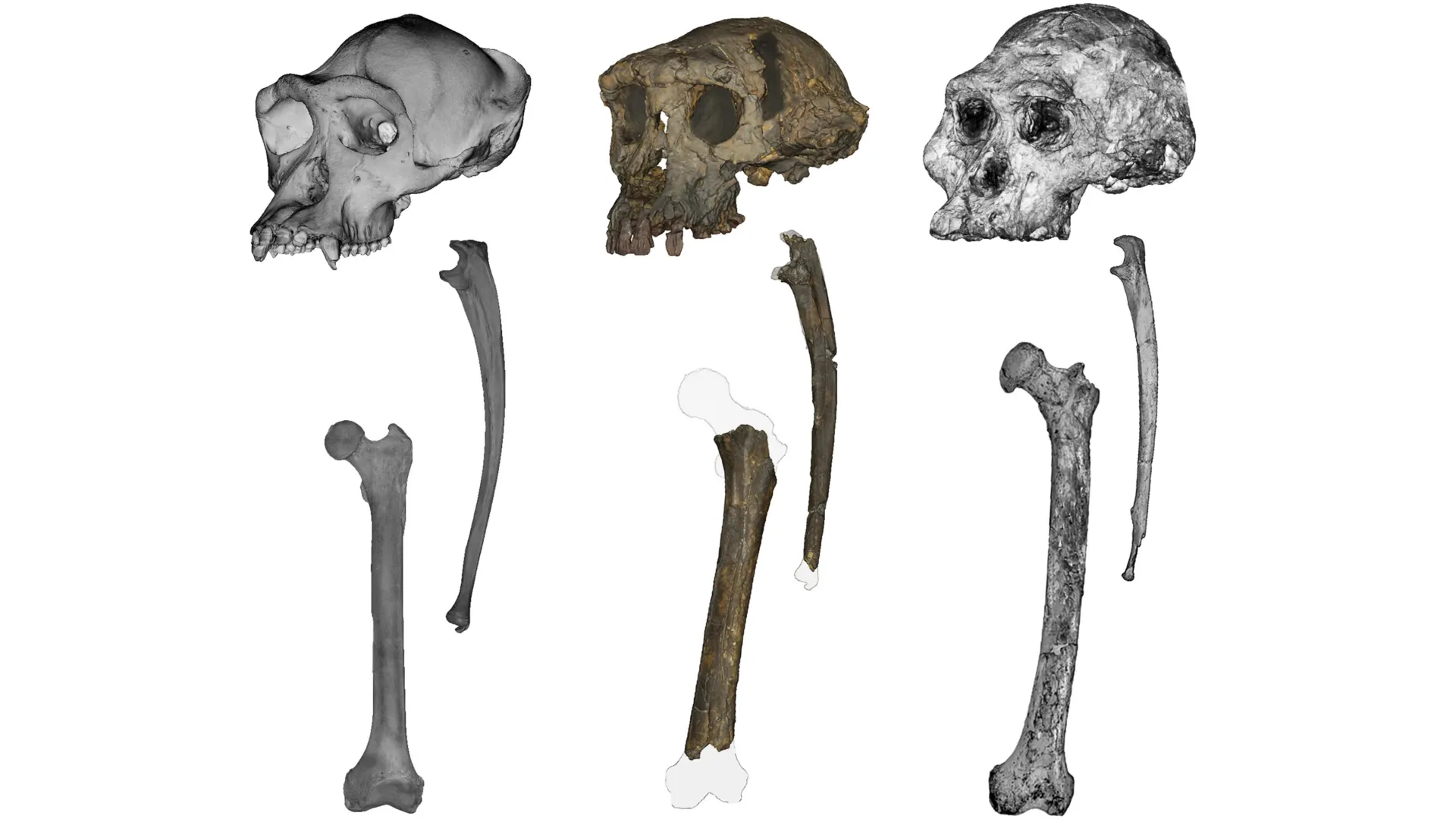
For decades, researchers have argued over whether a fossil that is about seven million years old could walk on two legs. If true, that ability would make it the earliest known human ancestor. A new study by anthropologists now presents strong evidence that Sahelanthropus tchadensis, a species first identified in the early 2000s, was capable of upright walking. The key lies in a skeletal feature previously seen only in bipedal members of the human lineage.
Bone Evidence Linked to Upright Walking
Using advanced 3D imaging along with other analytical techniques, the research team identified a femoral tubercle in Sahelanthropus. This small but important structure serves as the attachment point for the iliofemoral ligament, the strongest ligament in the human body and a critical component for standing and walking upright. Along with this discovery, the analysis confirmed several other anatomical traits associated with bipedal movement.
"Sahelanthropus tchadensis was essentially a bipedal ape that possessed a chimpanzee-sized brain and likely spent a significant portion of its time in trees, foraging and seeking safety," says Scott Williams, an associate professor in New York University's Department of Anthropology and the study's lead author. "Despite its superficial appearance, Sahelanthropus was adapted to using bipedal posture and movement on the ground."
The findings were produced by a collaborative team that included scientists from the University of Washington, Chaffey College, and the University of Chicago. The study was published in the journal Science Advances.
From Skull to Skeleton: Why the Debate Continued
Sahelanthropus was first uncovered in the Djurab desert of Chad by paleontologists from the University of Poitiers in the early 2000s. Early research focused largely on the fossil's skull, which provided limited insight into how the species moved. About twenty years later, scientists reported analyses of additional bones from the same discovery, including forearm bones known as ulnae and a thigh bone called the femur. Those later studies sparked renewed debate about whether the species truly walked upright, leaving open a central question: Is Sahelanthropus a hominin (a human ancestor)?
Comparing Ancient Bones With Modern and Fossil Species
In the Science Advances study, researchers reexamined the ulnae and femur using two main approaches. First, they compared multiple traits in these bones with those of both living species and fossil specimens. Second, they applied 3D geometric morphometrics, a widely used method that allows scientists to analyze bone shape in fine detail and pinpoint meaningful differences. One of the fossil species included in the comparison was Australopithecus, an early human ancestor made famous by the discovery of the "Lucy" skeleton in the early 1970s and dated to roughly four to two million years ago.
Three Key Signs of Bipedalism
The detailed analysis identified three distinct features in Sahelanthropus that support upright walking:
- A femoral tubercle that anchors the iliofemoral ligament connecting the pelvis and femur, a feature so far observed only in hominins
- A natural rotational twist in the femur, known as femoral antetorsion, that falls within the hominin range and helps orient the legs forward for efficient walking
- Evidence from 3D modeling of gluteal, or butt, muscles similar to those of early hominins, which stabilize the hips and assist with standing, walking, and running
The last two characteristics, femoral antetorsion and the gluteal complex, had been suggested by earlier research, and the new study confirmed their presence.
Limb Proportions Offer Additional Clues
The researchers also found that Sahelanthropus had a relatively long femur compared to its ulna, which adds further support for bipedal behavior. Apes typically have long arms and short legs, while hominins show the opposite pattern. Although Sahelanthropus had shorter legs than modern humans, its limb proportions differed from those of apes and more closely resembled Australopithecus. This intermediate pattern suggests another evolutionary step toward upright walking.
"Our analysis of these fossils offers direct evident that Sahelanthropus tchadensis could walk on two legs, demonstrating that bipedalism evolved early in our lineage and from an ancestor that looked most similar to today's chimpanzees and bonobos," Williams concludes.
Study Authors and Funding
In addition to Williams, the study's authors include Xue Wang and Jordan Guerra, both doctoral students at NYU; Isabella Araiza, an NYU graduate student at the time of the research and now a doctoral candidate at the University of Washington; Marc Meyer, an anthropology professor at Chaffey College; and Jeffery Spear, an NYU graduate student during the study who is now a researcher at the University of Chicago.
The research was funded by the National Science Foundation (BCS-2041700).
Story Source:
Materials provided by New York University. Note: Content may be edited for style and length.
Journal Reference:
- Scott A. Williams, Xue Wang, Isabella Araiza, Jordan S. Guerra, Marc R. Meyer, Jeffrey K. Spear. Earliest evidence of hominin bipedalism in Sahelanthropus tchadensis. Science Advances, 2026; 12 (1) DOI: 10.1126/sciadv.adv0130
Cite This Page: