
This strange form of water may power giant planets’ magnetic fields
Water pushed to planetary extremes turns into an exotic, electricity-conducting solid — and it’s far stranger than scientists ever imagined.
- Date:
- January 13, 2026
- Source:
- University of Rostock
- Summary:
- At extreme pressures and temperatures, water becomes superionic — a solid that behaves partly like a liquid and conducts electricity. This unusual form is believed to shape the magnetic fields of Uranus and Neptune and may be the most common type of water in the solar system. New high-precision experiments show its atomic structure is far messier than expected, combining multiple crystal patterns instead of one clean arrangement. The finding reshapes models of icy planets both near and far.
- Share:
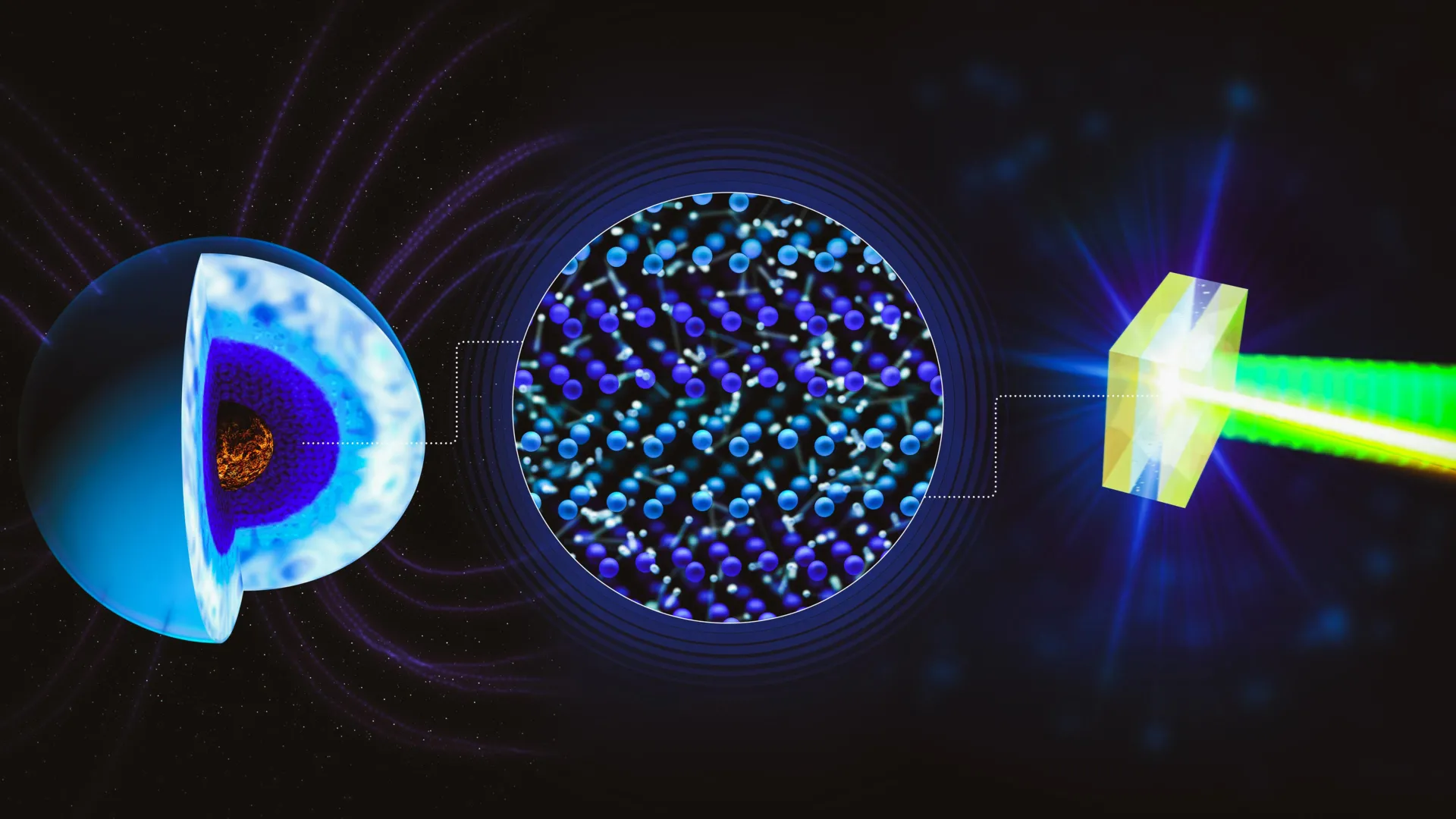
When water is exposed to temperatures of several thousand degrees Celsius and pressures reaching millions of atmospheres, it undergoes a dramatic transformation. Under these extreme conditions, water enters a rare state known as superionic water.* In this form, the oxygen atoms lock into a rigid solid framework, while hydrogen ions move freely through the structure, creating behavior unlike that of ordinary ice or liquid water.
This unusual phase of water conducts electricity exceptionally well, making it a strong candidate for explaining the strange magnetic fields observed around ice giant planets. Uranus and Neptune are believed to contain vast quantities of water deep within their interiors, meaning superionic water could be the dominant form of water across much of the solar system.
Longstanding Mystery of Superionic Water's Structure
Scientists have managed to create superionic water in laboratory experiments before, but its internal structure remained poorly understood. Earlier research proposed that the oxygen atoms might arrange themselves into one of two simple cubic patterns. These included a body-centered cubic arrangement, where an extra atom sits in the middle of the cube, or a face-centered cubic arrangement, where atoms occupy the centers of each face.
The new study reveals that reality is far more complicated. Instead of forming a single orderly pattern, the oxygen atoms assemble into a mixed structure that combines face-centered cubic regions with hexagonal close-packed layers. In the hexagonal regions, atoms stack tightly in repeating hexagonal patterns. When these regions merge with cubic sections, the result is widespread structural disorder. Rather than a clean, repeating lattice, the atoms form a hybrid and irregular sequence that can only be detected using extremely precise measurement techniques made possible by advanced X-ray lasers.
Recreating Planetary Extremes in the Lab
To uncover these details, researchers carried out two separate experiments. One was performed at the Matter in Extreme Conditions (MEC) instrument at LCLS in the US, and the other took place at the HED-HIBEF instrument at European XFEL. These powerful facilities allowed scientists to squeeze water to pressures exceeding 1.5 million atmospheres and heat it to several thousand degrees Celsius, all while capturing snapshots of its atomic structure within trillionths of a second.
The findings align closely with the most advanced computer simulations and show that superionic water can adopt multiple structural forms, much like ordinary ice, which is known to exist in many different crystal phases depending on temperature and pressure. The work reinforces the idea that water -- despite its apparent simplicity -- continues to reveal unexpected and remarkable behaviors under extreme conditions. These results also help refine models of the internal structure and long-term evolution of ice giant planets, which are thought to be common throughout the universe.
*Superionic water is an unusual state of water that forms under extremely high pressures and temperatures, far beyond those found on Earth's surface. In this phase, water behaves as a solid, but the hydrogen ions can move freely through a rigid lattice of oxygen atoms. This unique combination gives superionic water the ability to conduct electricity. Scientists believe it exists deep inside large planets, where such extreme conditions naturally occur.
The research was supported through a joint initiative between the German Research Foundation (DFG) and the French research funding agency ANR. More than 60 scientists from Europe and the US contributed to the experiments and analysis.
Story Source:
Materials provided by University of Rostock. Note: Content may be edited for style and length.
Journal Reference:
- L. Andriambariarijaona, M. G. Stevenson, M. Bethkenhagen, L. Lecherbourg, F. Lefèvre, T. Vinci, K. Appel, C. Baehtz, A. Benuzzi-Mounaix, A. Bergermann, D. Bespalov, E. Brambrink, T. E. Cowan, E. Cunningham, A. Descamps, S. Di Dio Cafiso, G. Dyer, L. B. Fletcher, M. French, M. Frost, E. Galtier, A. E. Gleason, S. H. Glenzer, G. D. Glenn, Y. Guarnelli, N. J. Hartley, Z. He, M.-L. Herbert, J.-A. Hernandez, B. Heuser, H. Höppner, O. S. Humphries, R. Husband, D. Khaghani, Z. Konôpková, J. Kuhlke, A. Laso Garcia, H. J. Lee, B. Lindqvist, J. Lütgert, W. Lynn, M. Masruri, P. May, E. E. McBride, B. Nagler, M. Nakatsutsumi, J.-P. Naedler, B. K. Ofori-Okai, S. Pandolfi, A. Pelka, T. R. Preston, C. Qu, L. Randolph, D. Ranjan, R. Redmer, J. Rips, C. Schoenwaelder, S. Schumacher, A. K. Schuster, J.-P. Schwinkendorf, C. Strohm, M. Tang, T. Toncian, K. Voigt, J. Vorberger, U. Zastrau, D. Kraus, A. Ravasio. Observation of a mixed close-packed structure in superionic water. Nature Communications, 2025; 17 (1) DOI: 10.1038/s41467-025-67063-2
Cite This Page: