
Low-Earth orbit is just 2.8 days from disaster
- Date:
- January 28, 2026
- Source:
- Universe Today
- Summary:
- Low-Earth orbit is more crowded—and fragile—than it looks. Satellites constantly weave past each other, burning fuel and making dozens of evasive maneuvers every year just to stay safe. A major solar storm could disable navigation and communications, turning that careful dance into chaos. According to new calculations, it may take just days—not decades—for a catastrophic chain reaction to begin, potentially choking off humanity’s access to space for generations.
- Share:
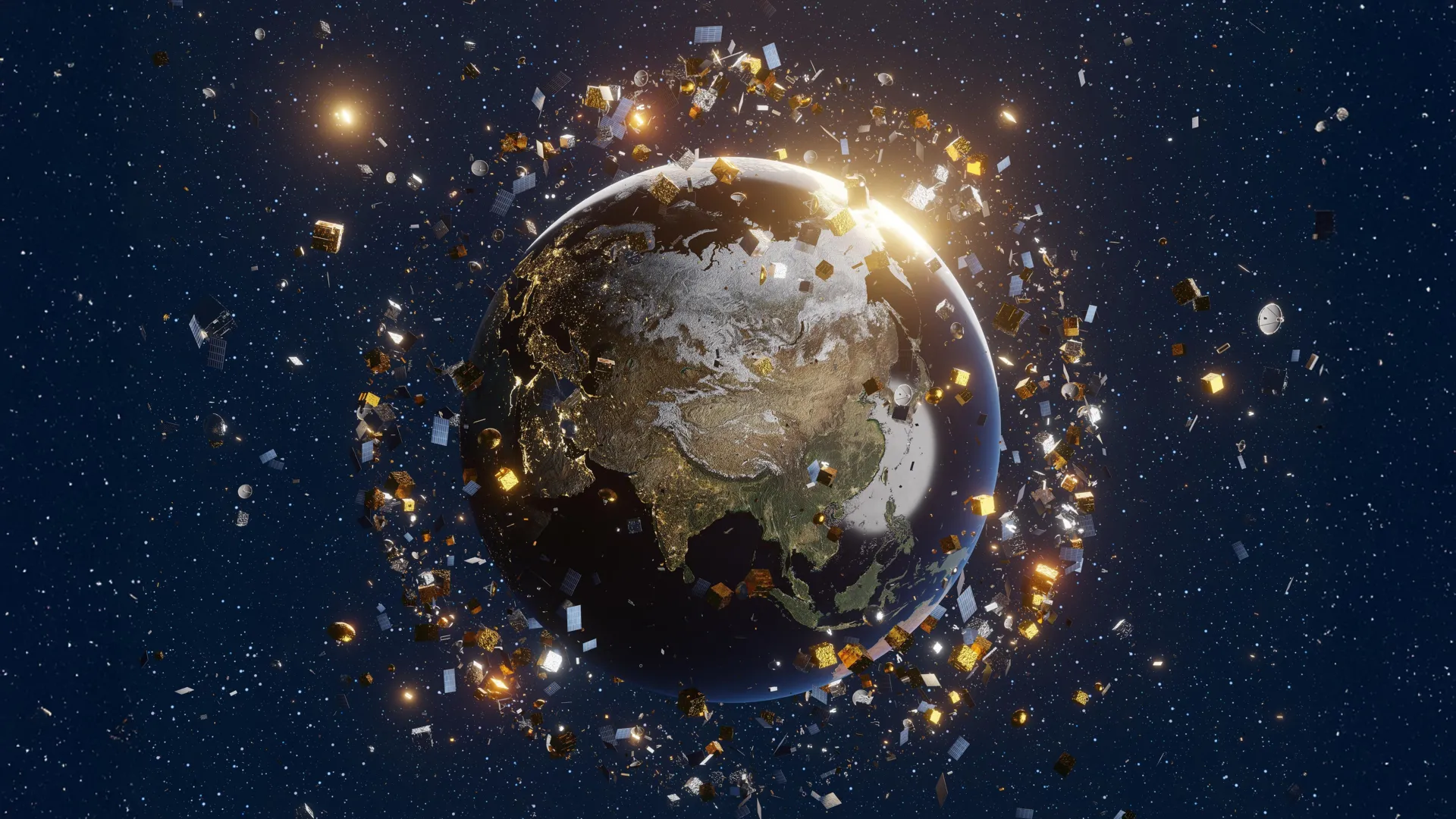
The phrase "House of Cards" is often linked today with a popular Netflix political series, but its original meaning describes something far more literal: a structure that can collapse easily. That idea is exactly how Sarah Thiele, formerly a PhD student at the University of British Columbia and now a researcher at Princeton, and her colleagues characterize today's massive satellite networks. In a new paper available as a pre print on arXiv, they argue that modern satellite mega constellations rest on an unstable foundation.
Their reasoning is backed by striking numbers. Across all Low Earth Orbit mega constellations, satellites pass dangerously close to one another with surprising frequency. A "close approach," defined as two satellites coming within less than 1km of each other, happens about once every 22 seconds. Within the Starlink network alone, this occurs roughly every 11 minutes. To avoid collisions, each Starlink satellite must carry out an average of 41 course corrections every year.
When Rare Events Become Serious Risks
At first glance, this constant maneuvering might sound like proof that the system is working as intended. Engineers, however, know that failures often come from unusual situations rather than everyday operations. These rare scenarios, often called "edge cases," can expose weaknesses that routine conditions never reveal. According to the study, solar storms are one such scenario that poses a serious threat to satellite mega constellations.
Solar storms typically disrupt satellites in two main ways.
How Solar Storms Disrupt Satellites
The first effect is atmospheric heating. When a solar storm hits Earth, it causes the upper atmosphere to expand and thicken, increasing drag on satellites. This added resistance forces satellites to burn more fuel just to stay in orbit and raises uncertainty about their precise positions. As a result, satellites must perform additional avoidance maneuvers to prevent collisions. During the "Gannon Storm" of May 2024 (which, unfortunately, appears not to be named after the Zelda villain), more than half of all satellites in LEO were forced to expend fuel on these adjustments.
The second effect can be even more damaging. Solar storms can interfere with or disable satellite navigation and communication systems altogether. When that happens, satellites may be unable to respond to threats in their path. Combined with higher atmospheric drag and increased uncertainty, this loss of control could quickly lead to a serious accident.
Measuring the Speed of Disaster
The most widely known outcome of widespread satellite collisions is Kessler syndrome. In this scenario, debris from collisions accumulates around Earth, making it nearly impossible to launch spacecraft without them being destroyed. While Kessler syndrome unfolds over decades, the researchers wanted to show how quickly a crisis could begin. To do this, they introduced a new measurement called the Collision Realization and Significant Harm (CRASH) Clock.
Using this metric, the authors calculated that as of June 2025, a complete loss of command over satellite avoidance maneuvers would result in a catastrophic collision in about 2.8 days. In contrast, similar conditions in 2018, before the rise of mega constellations, would have allowed roughly 121 days before such a collision occurred. The risk becomes even more alarming over shorter periods. Losing control for just 24 hours carries a 30% chance of a major collision that could kick off the long chain reaction leading to Kessler syndrome.
Little Warning and Few Options
One of the most troubling aspects of solar storms is how little notice they provide. In many cases, warnings come only a day or two in advance. Even with that notice, there are limited actions operators can take beyond trying to protect vulnerable systems. Solar storms create a rapidly changing atmospheric environment that requires constant, real time monitoring and control. If that real time control is lost, the paper suggests there may be only a few days to restore it before the entire system collapses.
This concern is not hypothetical. The 2024 Gannon Storm was the strongest solar storm in decades, but it was not the most powerful on record. That distinction belongs to the Carrington Event of 1859. If a storm of similar strength occurred today, it could disrupt satellite control for far longer than three days. A single event like this, which has already happened once in recorded history, could severely damage global satellite infrastructure and confine humanity to Earth for the foreseeable future.
Weighing the Risks of a Connected Sky
Few readers would welcome a future cut off from space. While satellite mega constellations offer enormous technological benefits, they also introduce serious long term risks. A realistic understanding of those dangers is essential. When the potential outcome includes losing access to space for generations due to one extreme solar storm, informed decision making becomes critical. This research provides a clearer picture of what is at stake and why the risks can no longer be ignored.
Story Source:
Materials provided by Universe Today. Original written by Andy Tomaswick. Note: Content may be edited for style and length.
Journal Reference:
- Sarah Thiele, Skye R. Heiland, Aaron C. Boley, Samantha M. Lawler. An Orbital House of Cards: Frequent Megaconstellation Close Conjunctions. arXiv, 10 Dec 2025 DOI: 10.48550/arXiv.2512.09643
Cite This Page: