
Weak magnetism causes big changes in a strange state of matter
Physicists have shown that even faint magnetic fields can dramatically change the behavior of dusty plasmas.
- Date:
- January 31, 2026
- Source:
- Auburn University Department of Physics
- Summary:
- A strange, glowing form of matter called dusty plasma turns out to be incredibly sensitive to magnetic fields. Researchers found that even weak fields can change how tiny particles grow, simply by nudging electrons into new motions. In lab experiments, this caused nanoparticles to form faster and remain smaller. The discovery could influence everything from nanotechnology design to our understanding of space plasmas.
- Share:
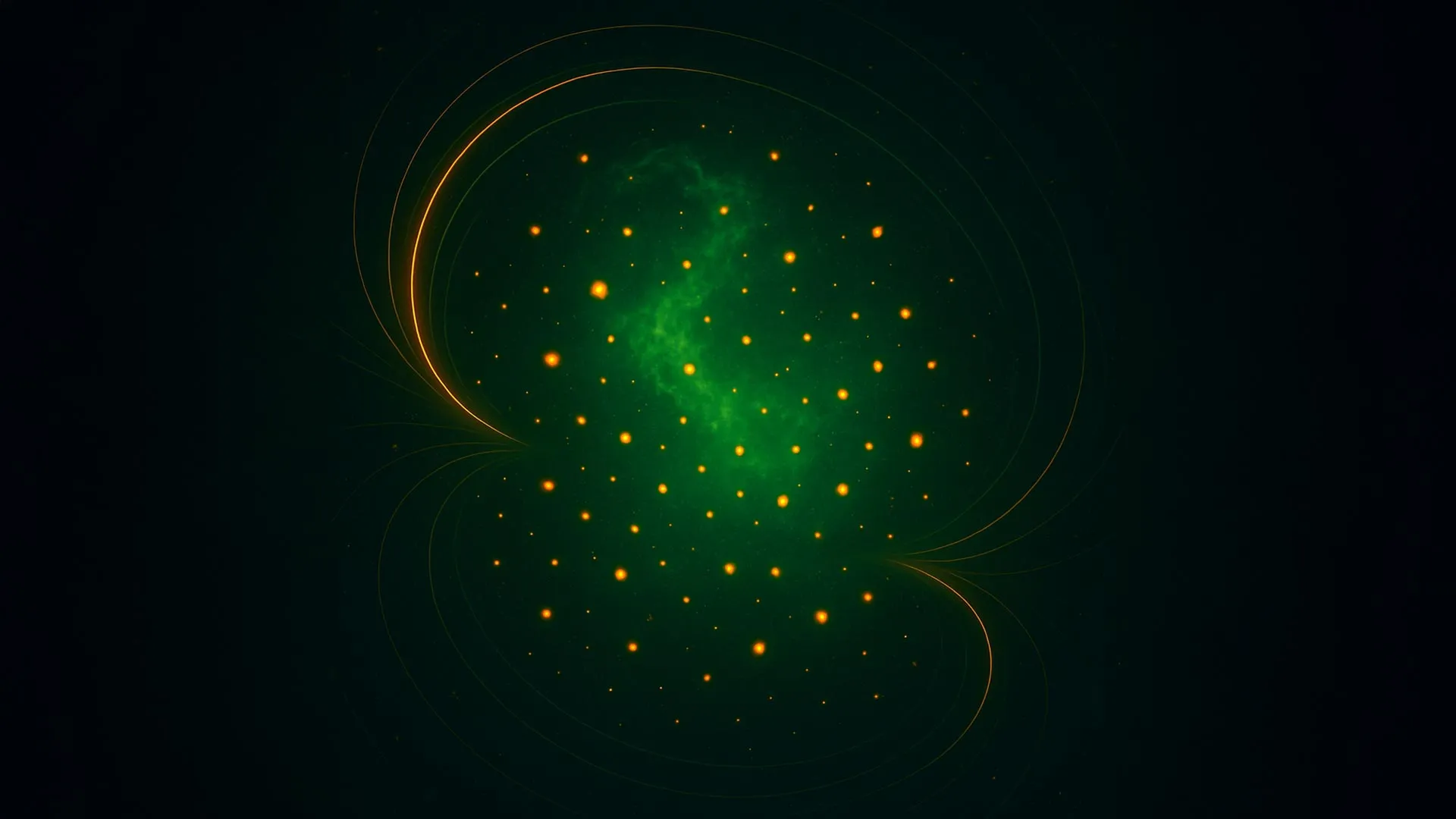
Picture a glowing cloud that looks like a neon sign, but instead of water droplets it holds vast numbers of microscopic dust particles suspended in space. This unusual mixture is known as dusty plasma, a rare state of matter that exists both in outer space and inside laboratory experiments.
In a new study published in Physical Review E, physicists at Auburn University found that even very weak magnetic fields can significantly change how dusty plasmas behave. The team discovered that magnetism can either slow down or speed up the growth of nanoparticles floating within the plasma. When a magnetic field causes electrons to move in spiral paths, the entire plasma shifts in response, altering how particles gain electrical charge and increase in size.
"Dusty plasmas are like tiny particles in a vacuum box," said Bhavesh Ramkorun, lead author of the study. "We found that by introducing magnetic fields, we could make these particles grow faster or slower, and the dust particles ended up with very different sizes and lifetimes."
Watching Nanoparticles Form
To explore this effect, the researchers created carbon nanoparticles by igniting a mixture of argon and acetylene gas. Under normal conditions, the particles formed steadily for about two minutes before drifting out of the plasma. When magnetic fields were applied, that growth period became much shorter, sometimes lasting less than a minute, and the resulting particles remained smaller.
Why Electrons Matter So Much
"It's remarkable how sensitive the system is," explained Saikat Thakur, a co-author of the study. "Electrons are the lightest players in the plasma, but when they become magnetized, they dictate the rules. That simple change can completely alter how nanomaterials form."
From the Lab to the Cosmos
The findings may help scientists develop new plasma-based methods for producing nanoparticles with specific properties for use in electronics, surface coatings, and quantum technologies. Beyond practical applications, the research also sheds light on natural plasmas found throughout space, including planetary rings and the Sun's atmosphere, where dust and magnetic fields constantly interact.
"Plasma makes up most of the visible universe, and dust is everywhere," Ramkorun added. "By studying how the smallest forces shape these systems, we're uncovering patterns that connect the lab to the cosmos."
Story Source:
Materials provided by Auburn University Department of Physics. Note: Content may be edited for style and length.
Journal Reference:
- Bhavesh Ramkorun, Saikat C. Thakur, Ryan B. Comes, Edward Thomas. Electron magnetization effects on carbonaceous dusty nanoparticles grown in Ar−C2H2 capacitively coupled nonthermal plasma. Physical Review E, 2025; 112 (4) DOI: 10.1103/3d3h-rkmb
Cite This Page: