
This ultra-thin surface controls light in two completely different ways
A new ultra-thin optical design lets light of different spins do entirely different jobs—cleanly, precisely, and across a rainbow of colors.
- Date:
- February 5, 2026
- Source:
- Chinese Society for Optical Engineering
- Summary:
- A new metasurface design lets light of different spins bend, focus, and behave independently—while staying sharp across many colors. The trick combines two geometric phase effects so each spin channel can be tuned without interfering with the other. Researchers demonstrated stable beam steering and dual-focus lenses over wide frequency ranges. The approach could scale from microwaves all the way to visible light.
- Share:
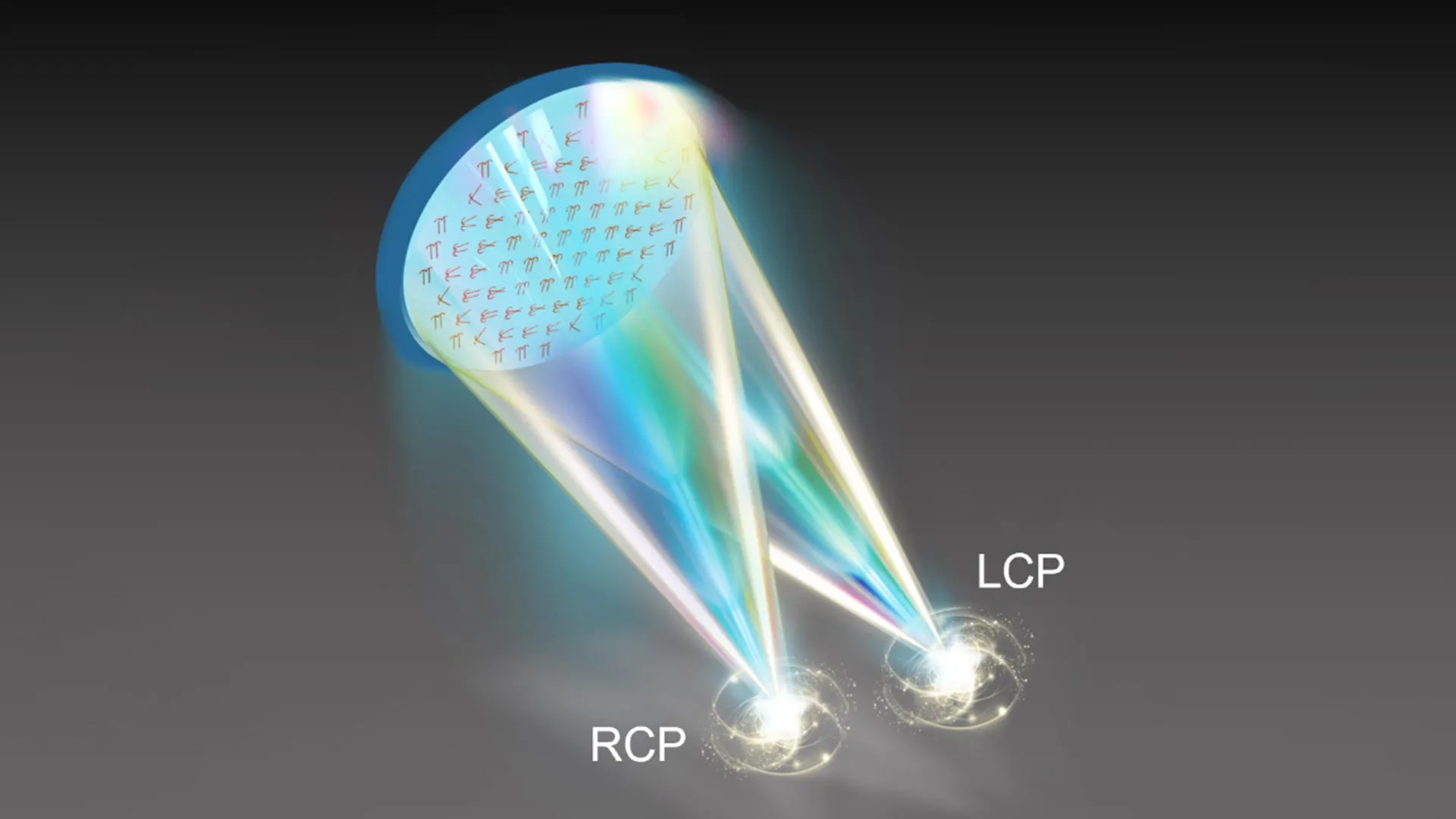
Broadband achromatic wavefront control is a key requirement for next-generation optical technologies, including full-color imaging and multi-spectral sensing. Researchers led by Professor Yijun Feng and Professor Ke Chen at Nanjing University have now reported a major advance in this area in PhotoniX. Their work introduces a hybrid-phase cooperative dispersion-engineering approach that brings together Aharonov-Anandan (AA) and Pancharatnam-Berry (PB) geometric phases within a single-layer metasurface. This combination makes it possible to achieve independent achromatic control of light with two different spin states.
Dispersion is a fundamental property of electromagnetic waves. While it enables useful wavelength-dependent effects, it also causes chromatic aberrations that become more severe as bandwidth increases. These effects can shift steering angles, move focal points, and reduce spatial accuracy. Metasurfaces, which are flat structures made from carefully designed arrays of subwavelength meta-atoms, offer a powerful way to shape light. However, most existing achromatic metasurface designs are limited in practice to a single spin channel. In other cases, both spin channels are addressed but forced to share the same dispersion behavior. As a result, fully independent control of phase and group delay for both spins within a compact device has remained difficult, even though it is essential for multi-channel and multiplexed optical systems.
Combining Geometric Phases to Unlock Dual-Spin Control
To overcome this challenge at the level of individual meta-atoms, the researchers developed a hybrid-phase framework in which each geometric phase plays a distinct role. In this design, the AA phase enables what the team calls "spin unlocking," while the PB phase provides "phase extension." Asymmetric current distributions inside each meta-atom cause right- and left-handed circularly polarized (RCP and LCP) waves to reflect along different paths. This separation allows their phase and dispersion properties to be controlled independently.
The team then fine-tuned the resonant strength of the meta-atoms to independently adjust the group delay for each spin. At the same time, frequency tuning and local structural rotation were used to set the phase while keeping unwanted crosstalk low. The PB phase, added through global rotation, extends the available phase range toward a full 2π without significantly altering the group delay design. Together, these elements create a practical single-layer design strategy for dual-spin achromatic control.
Experimental Proof Across Multiple Frequency Bands
The researchers demonstrated their approach experimentally using two types of devices operating in the 8-12 GHz range. One class consisted of spin-unlocked achromatic beam deflectors that maintained stable, spin-dependent steering across the band. The other involved achromatic metalenses that assigned different focusing functions to RCP and LCP light while preserving strong performance over a broad frequency range.
In addition, the team presented designs that apply the same principles in the 0.8-1.2 THz terahertz range. This shows that the method is not restricted to a single part of the electromagnetic spectrum, but instead represents a broadly applicable dispersion-engineering framework.
Toward More Versatile Meta-Optical Systems
This work moves achromatic metasurfaces beyond single-channel correction and into the realm of fully independent dual-spin meta-optics. By treating the two spin states as genuinely separate degrees of freedom, the approach enables compact optical systems with multiple functions built into a single device. Looking ahead, the hybrid-phase design strategy could be extended into the visible range for polarization-multiplexed imaging and broadband integrated optics. The researchers also note that inverse-design methods, including genetic algorithms and deep learning, could help speed up device optimization and support real-world system deployment.
Story Source:
Materials provided by Chinese Society for Optical Engineering. Note: Content may be edited for style and length.
Journal Reference:
- Jiahao Wang, Kai Qu, Junzhe Ni, Weixu Yang, Kui Tang, Shufang Dong, Shaojie Wang, Junming Zhao, Tian Jiang, Ke Chen, Yijun Feng. Broadband spin-unlocked achromatic meta-devices empowered by hybrid-phase cooperative dispersion engineering. PhotoniX, 2025; 6 (1) DOI: 10.1186/s43074-025-00217-z
Cite This Page: